

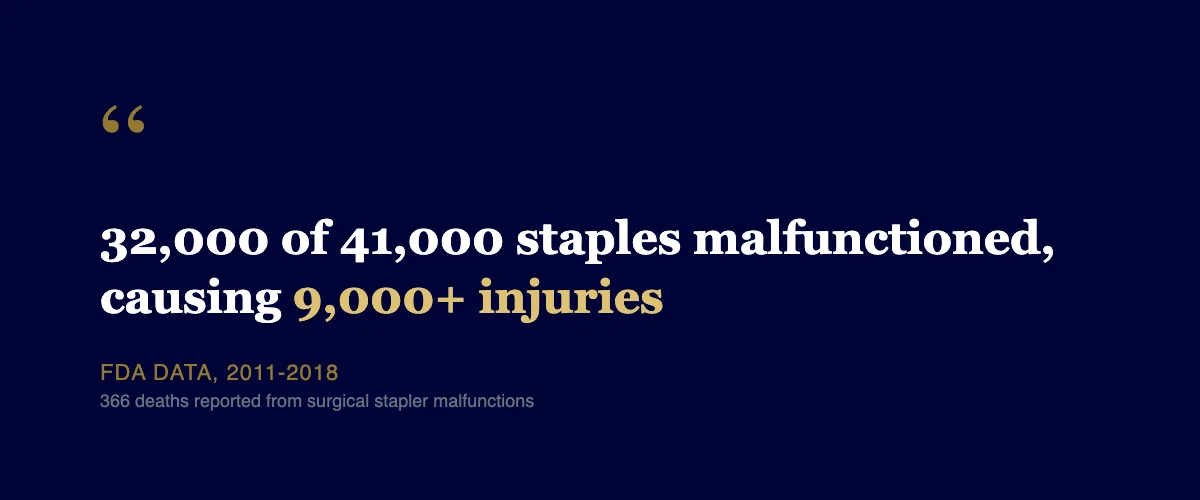
Surgical staplers, used to close incisions and internal tissue during surgery, have a documented history of malfunction: FDA data from 2011 to 2018 found roughly 32,000 malfunctions out of 41,000 reported events, resulting in more than 9,000 reported injuries and 366 deaths nationwide. A 2026 Class I recall on a widely used robotic-surgery stapler reload shows the problem hasn’t gone away.
What Goes Wrong With Surgical Staplers
Surgical staplers are designed to close tissue quickly and consistently during procedures ranging from routine gallbladder removal to major bowel resections and bariatric surgery, replacing or supplementing hand-sewn sutures. When they work correctly, they’re a significant improvement in surgical efficiency and consistency compared to manual suturing. When they fail, the consequences can be severe: an incomplete or malformed staple line can leave a leak at a surgical site, internal bleeding, or a failure to properly seal tissue that was supposed to be joined together permanently. These failures often aren’t discovered during the original surgery, surfacing instead as post-operative complications, infection, sepsis, or the need for emergency follow-up surgery, sometimes days after the patient has gone home believing the procedure went smoothly and the stapled tissue had properly sealed.
The Scale of the Problem, by the Numbers
According to FDA adverse event data covering 2011 through 2018, roughly 41,000 staple-related device problems were reported, and about 32,000 of those involved an actual malfunction of the device itself. That volume of malfunctions was linked to more than 9,000 injuries and 366 deaths over that same roughly seven-year period alone. These aren’t outlier numbers from a single bad batch, they reflect a recurring pattern across different manufacturers and stapler models used across hospitals nationwide over nearly a decade of reporting.
The 2026 Recall
In early 2026, Intuitive Surgical, maker of the da Vinci robotic surgical system, notified customers about incomplete staple lines in its 8mm SureForm 30 gray stapler reloads. By the time the FDA classified it as a Class I recall on May 5, 2026, its most serious category reserved for situations where continued use could cause serious injury or death, the company had already reported four serious injuries and one death associated with the defect. This recall is a reminder that stapler malfunctions aren’t a solved, historical problem, they continue to surface in current-generation surgical technology, including robotically assisted procedures marketed to patients and surgeons alike as more precise and safer than traditional, manually performed surgery.
This Is a Product Liability Claim, Not a Malpractice Claim
It’s important to understand which kind of case a stapler malfunction actually is. If your surgeon used the device correctly and it still failed because of a manufacturing or design defect, your claim is against the device manufacturer under product liability law, not a medical malpractice claim against your surgeon. Illinois applies strict liability to defective products, meaning you generally don’t have to prove the manufacturer was negligent in how it designed or built the device, only that the product was unreasonably dangerous or defective when it left the manufacturer’s control, and that the defect caused your injury. This is a meaningfully different, and often more favorable, legal standard than the negligence-based proof required in a malpractice case.
Types of Defects in a Stapler Case
A stapler product liability claim can rest on one of three recognized defect theories. A manufacturing defect means a specific unit was flawed during production, even though the overall design itself was sound, essentially a bad unit produced within an otherwise reliable batch. A design defect means the stapler’s design itself is unreasonably dangerous, a flaw present in every single unit of that particular model, regardless of manufacturing quality. A failure to warn means the manufacturer knew, or should have known, about malfunction risks and didn’t adequately warn surgeons, hospitals, or patients. The 2026 SureForm recall, tied to a specific reload defect the manufacturer itself identified and disclosed, is the kind of fact pattern that can support either a manufacturing or design defect claim, depending on how widespread the underlying flaw turns out to be.
Is There a Class Action or MDL?
As of this writing, there’s no consolidated multi-district litigation or formal class action specific to surgical staplers, even though the volume of malfunction reports and the breadth of manufacturers and models involved have led some to describe stapler litigation as one of the larger emerging areas of medical device law. The absence of an MDL doesn’t prevent you from filing an individual claim, and settlements and verdicts in stapler cases that have gone forward individually have ranged widely, from roughly $5 million to $80 million, reflecting how severe these injuries can be when a stapler fails during a major procedure.
Statute of Limitations and Repose
Illinois gives you generally two years from the date of injury to file a product liability claim, under 735 ILCS 5/13-202. Separately, Illinois imposes a statute of repose under 735 ILCS 5/13-213: no product liability action can be filed more than 12 years after the product was first sold, or more than 10 years after it was first delivered to its initial end user, whichever comes first. In practice, this means both deadlines have to be satisfied, the two-year clock from your injury, and the outer limit tied to when the device itself was first manufactured and put into use, which matters more for older devices than recently introduced ones.
What Evidence Matters in a Stapler Case
Your complete surgical and hospital records, including the operative report identifying the specific device, model, and lot number used, are the starting point, that information is often what connects your case to a known recall or defect pattern that otherwise might go unnoticed. Request this documentation as early as possible; device identification details aren’t always included in standard discharge paperwork and sometimes require a specific records request to the hospital’s surgical department or its biomedical/sterile-processing records. Post-operative records documenting the complications, infection, bleeding, a return to surgery, and when they appeared relative to the original procedure, help establish the timeline connecting the device failure to your injury, which is often the single most contested issue in these cases, since manufacturers routinely argue a complication was simply a known surgical risk, unrelated to any device defect at all.
Who Can Be Held Liable
The device manufacturer is the primary defendant in most stapler cases, but liability can extend further. A distributor or supplier that sold a known-defective device can potentially share liability under Illinois’ strict liability framework, which generally applies to every party in the chain of distribution, not just the original manufacturer. The hospital itself is typically not liable for the device defect under a product liability theory, since it didn’t design or manufacture the stapler, but a hospital that continued using a device after receiving a recall notice, or failed to properly maintain reusable stapler components, can face a separate negligence claim distinct from the product liability claim against the manufacturer.
A Worked Example
Suppose a patient undergoes a routine bowel resection using a stapler later found to be part of an affected recall lot. The procedure appears to go well, but three days later the patient is readmitted with severe abdominal pain and is found to have an anastomotic leak, a failure at the site where the stapled tissue was supposed to have sealed. A second emergency surgery is then required to repair the leak and address the resulting infection. Here, the operative report identifying the specific stapler model and lot number becomes central: if that lot matches a known recall or malfunction pattern, it directly supports a product liability claim against the manufacturer, entirely separate from any question about whether the surgeon’s own technique during the procedure was appropriate.
Damages Available in a Stapler Case
Damages in a successful stapler claim typically include the cost of additional surgery and extended hospitalization made necessary by the device failure, lost income during an extended and entirely unplanned recovery, and pain and suffering for the complication itself, infection, additional scarring, and the psychological toll of an unexpected return to surgery that the patient reasonably believed was behind them. In cases involving death, a wrongful death claim can pursue damages for the family’s financial and personal losses, including loss of the decedent’s income, companionship, and household contributions. Given the historical settlement and verdict range of $5 million to $80 million in individual stapler cases, the severity of harm a failed stapler can cause, from a minor additional procedure to a life-altering complication, is reflected directly in how widely these cases have resolved.
Why Medical Device Litigation Often Takes Longer
Device defect cases tend to move more slowly than a typical car accident claim, in part because proving the defect usually requires expert testimony from biomedical engineers who can analyze the specific device, and sometimes requires obtaining and testing the actual unit involved, when it’s been preserved, or comparable units from the same manufacturing lot. Manufacturers also tend to litigate these cases aggressively given the exposure a finding of defect can create across many thousands of similar devices already in use in hospitals nationwide. None of this makes an individual claim not worth pursuing, it just means these cases are typically a longer and more document-intensive process than more straightforward personal injury claims.
Frequently Asked Questions
What is wrong with surgical staplers?
Surgical staplers can malfunction by failing to properly close staple lines, misfiring, or applying staples unevenly, which can cause internal bleeding, leaks at surgical sites, infection, and additional surgeries. FDA data covering 2011 to 2018 found that of 41,000 reported staple-related events, roughly 32,000 involved malfunctions, resulting in over 9,000 injuries and 366 deaths.
Is there a current surgical stapler recall?
Yes. In 2026, the FDA classified a Class I recall, its most serious category, for certain Intuitive Surgical SureForm stapler reloads used with the da Vinci Surgical System, after the manufacturer reported incomplete staple lines linked to serious injuries and a death. Other stapler models and manufacturers have been subject to separate recalls over the years.
Is there a class action or MDL for surgical stapler lawsuits?
As of this writing, there is no consolidated multi-district litigation or class action specifically for surgical staplers, though it’s described as one of the larger emerging areas of medical device litigation. Individual claims can still be filed against the device manufacturer regardless of whether a formal MDL exists.
How is a surgical stapler lawsuit different from a medical malpractice claim?
A surgical stapler lawsuit is a product liability claim against the device manufacturer, not a malpractice claim against your surgeon. Illinois applies strict liability to defective products, meaning you generally don’t have to prove the manufacturer was negligent, only that the device was unreasonably dangerous or defective when it left the manufacturer’s control and that the defect caused your injury.
How long do I have to file a surgical stapler claim in Illinois?
Generally two years from the date of injury under Illinois’ personal injury statute of limitations, 735 ILCS 5/13-202. Illinois also imposes a statute of repose under 735 ILCS 5/13-213, barring product liability claims more than 12 years after the product was first sold or 10 years after it was first delivered to its initial user, whichever comes first.
If You Weren’t Told About a Recall
A common and important fact pattern in these cases: patients are sometimes never notified that the device used in their surgery was later recalled, because recall notices typically go to hospitals and purchasing departments, not directly to individual patients who received the device years, or even just months, earlier. If you had surgery involving a stapler and later developed an unexplained complication, it’s worth specifically asking your surgical team or hospital records department whether the device used has ever been subject to an FDA recall or safety communication, rather than assuming the manufacturer, hospital, or surgeon would have automatically notified you of a relevant safety concern.
Strict Liability in Illinois Product Cases: What You Must Prove