
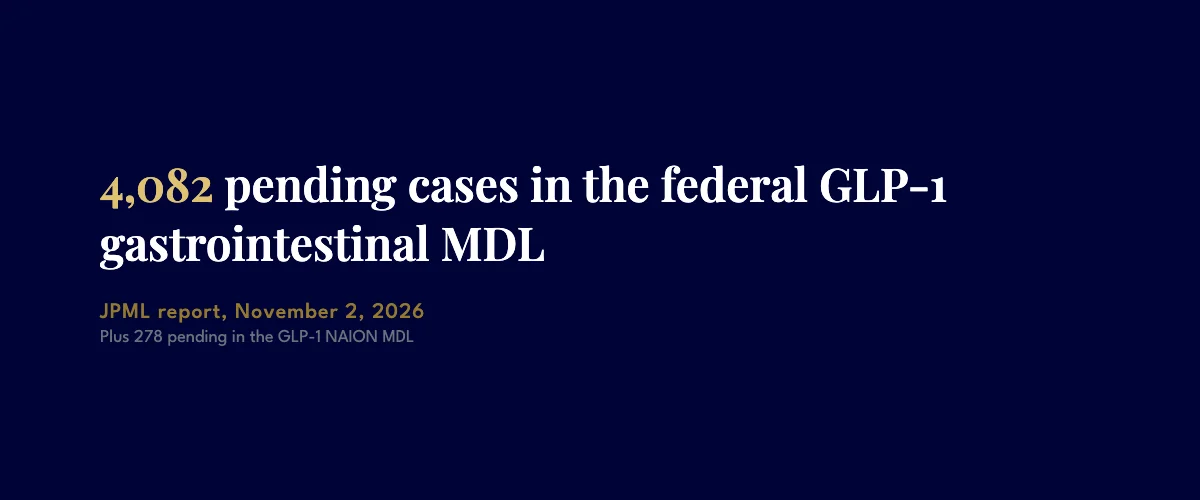
Mounjaro and Zepbound lawsuits claim that Eli Lilly failed to adequately warn patients and doctors that tirzepatide, the active ingredient in both drugs, can cause serious digestive injuries such as gastroparesis (stomach paralysis), ileus and bowel obstruction. Newer cases also claim vision loss from NAION, an eye condition the FDA now requires GLP-1 drug labels to warn about. These are individual lawsuits, not a class action. Most federal cases are grouped in two multidistrict litigations (MDLs) in the Eastern District of Pennsylvania. As of the federal judicial panel’s November 2, 2026 report, the gastrointestinal MDL had 4,082 pending cases and the NAION MDL had 278.
If you took Mounjaro or Zepbound and were hospitalized for severe stomach or bowel problems, or lost vision, Illinois law may give you a product liability claim. Do not stop or change any prescribed medication without talking to your doctor.
What Mounjaro and Zepbound are
Both drugs are weekly injections made by Eli Lilly and Company, and both contain tirzepatide. Mounjaro is approved for type 2 diabetes. Zepbound is approved for chronic weight management and for obstructive sleep apnea in adults with obesity. They work in part by slowing how fast food leaves the stomach, which is also why digestive side effects are at the center of the litigation.
The drugs are commercially important. In its annual report for 2025, Lilly said Mounjaro and Zepbound made up 56% of its total revenue that year.
Injuries claimed in the lawsuits
- Gastroparesis: the stomach empties too slowly, causing severe nausea, vomiting, bloating and pain that can last after the drug is stopped.
- Ileus and intestinal obstruction: the bowel stops moving food or becomes blocked, sometimes requiring hospitalization or surgery.
- Other gastrointestinal injuries: some cases claim related complications from severe vomiting and dehydration.
- NAION (non-arteritic anterior ischemic optic neuropathy): a sudden loss of blood flow to the optic nerve that can cause permanent vision loss, usually in one eye. Our post on GLP-1 drugs and NAION vision loss explains the FDA warning.
Where the litigation stands
Lawsuits since 2023. According to Lilly’s 2025 annual report, plaintiffs have been filing suits since August 2023 claiming injuries from its incretin medicines, including Mounjaro, Trulicity and Zepbound. Novo Nordisk, the maker of Ozempic and Wegovy, is also a defendant in many cases.
Two federal MDLs. Lilly reports that most cases have been consolidated for pretrial proceedings in two federal MDLs in the Eastern District of Pennsylvania, one for gastrointestinal injuries and one for NAION, both before U.S. District Judge Karen S. Marston. The November 2, 2026 report from the Judicial Panel on Multidistrict Litigation lists:
- MDL 3094 (GLP-1 RAs Products Liability Litigation, gastrointestinal injuries): 4,082 pending cases, 4,196 filed in total
- MDL 3163 (GLP-1 RAs NAION Products Liability Litigation): 278 pending cases
Proof of diagnosis matters. Reports on the MDL say that in August 2025 the court required plaintiffs claiming drug-caused gastroparesis to support the diagnosis with an objective test, generally a gastric emptying study. Anyone considering a claim should ask whether that testing was done.
An MDL is not a class action. Each person keeps an individual case, and any settlement or verdict depends on that person’s injuries and evidence. Some cases are also pending in state courts.
How Illinois product liability law applies
Illinois residents can bring claims for injuries from a prescription drug under strict product liability and negligence theories. Drug cases usually focus on failure to warn: whether the label told doctors enough about the risk for them to make an informed choice. Under the learned intermediary doctrine, a drug company’s duty to warn generally runs to the prescribing doctor rather than directly to the patient.
Federal preemption is a common defense in drug cases. The defense argues that federal labeling rules prevented the company from adding a warning. The strength of that defense depends on what the company knew and when, and on whether it could have strengthened the label on its own.
Deadlines. Illinois generally allows two years to file a personal injury claim under 735 ILCS 5/13-202. In drug cases, the clock can start when you knew or reasonably should have known that your injury may have been caused by the drug. Illinois also has a product liability statute of repose under 13-213. Because Mounjaro was first approved in 2022, repose is rarely an issue yet, but the two-year deadline can pass quickly.
Compounded tirzepatide. Many people took compounded or online versions of tirzepatide during the drug shortage. Claims involving compounded products are different, because Lilly did not make them. The pharmacy or seller may be the responsible party, and records of exactly what you took become very important.
What to keep if you are considering a claim
- Pharmacy records showing the brand, dose and dates you used Mounjaro or Zepbound
- Emergency room and hospital records, including any gastric emptying study, imaging or surgery reports
- Eye exam records and diagnosis of NAION from an ophthalmologist
- Records of lost work and out-of-pocket costs
Our earlier post on weight loss drugs linked to stomach paralysis covers the medical background, and who helps with dangerous drug injury lawsuits explains how these cases are handled.
Talk to a Chicago defective drug lawyer
Phillips Law Offices handles defective drug and product liability cases for people across Illinois. We can review your records, tell you whether your injury fits the claims being made in the GLP-1 litigation, and explain the deadline that applies to you. The consultation is free, and you pay no fee unless we recover compensation for you.
Call (312) 346-4262 or book a free consultation online.
Frequently asked questions
Is there a class action lawsuit for Mounjaro or Zepbound?
No. Most federal cases are individual lawsuits grouped in multidistrict litigation in the Eastern District of Pennsylvania. Each plaintiff keeps their own case.
What injuries are Mounjaro and Zepbound lawsuits about?
Mainly gastroparesis, ileus and bowel obstruction, plus vision loss from NAION. The lawsuits claim Eli Lilly did not adequately warn about these risks.
How many GLP-1 lawsuits are pending?
The federal judicial panel’s November 2, 2026 report listed 4,082 pending cases in the gastrointestinal MDL 3094 and 278 in the NAION MDL 3163. These include cases against makers of several GLP-1 drugs, not only Mounjaro and Zepbound.
How long do I have to file a Mounjaro lawsuit in Illinois?
Generally two years from when you knew or reasonably should have known that your injury may have been caused by the drug. A lawyer can review when your deadline started.