

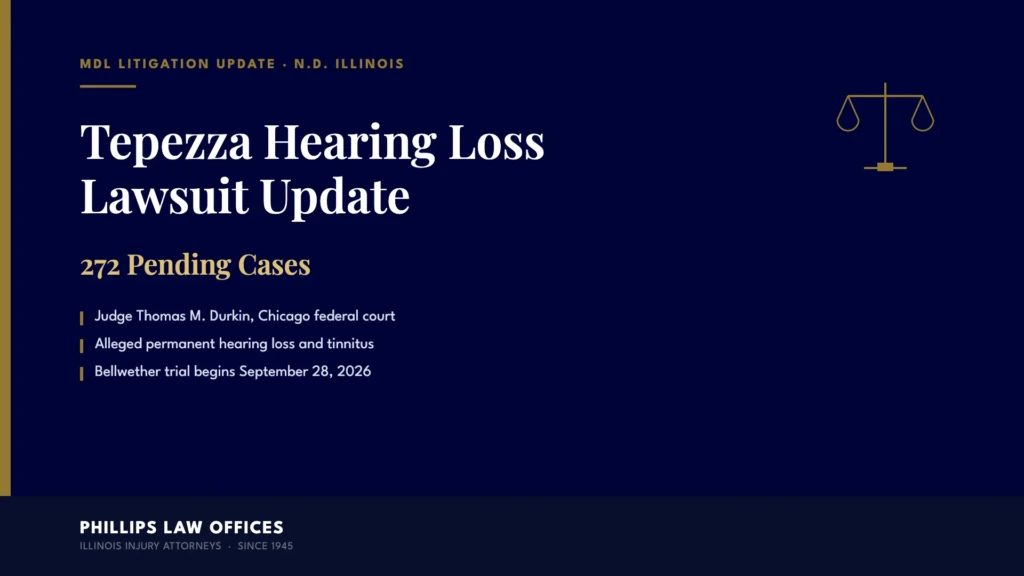
A bellwether trial is scheduled to begin September 28, 2026, in Chicago’s federal courthouse, one of the first real tests of how a jury will view the growing body of lawsuits alleging that the thyroid eye disease drug Tepezza caused permanent hearing loss and tinnitus in patients who took it. As of this month, 272 lawsuits are pending before U.S. District Judge Thomas M. Durkin in the Northern District of Illinois as part of In re: Tepezza Marketing, Sales Practices, and Products Liability Litigation (MDL No. 3079).
What Is Tepezza, and What Are Patients Alleging?
Tepezza (teprotumumab) is an infusion drug approved to treat thyroid eye disease, a condition often associated with Graves’ disease that causes the eyes to bulge and can affect vision. It was developed by Horizon Therapeutics, which is now part of Amgen following a 2023 acquisition.
Patients who received Tepezza allege the drug’s manufacturer knew, or should have known, that it carried a meaningful risk of permanent hearing loss and tinnitus (persistent ringing in the ears), but downplayed how common and how serious those side effects could be. Specific allegations in the litigation include that the manufacturer:
- Failed to adequately warn patients and physicians that hearing damage from the drug could be permanent, not temporary
- Understated how frequently hearing complications occurred in clinical trials
- Did not recommend hearing tests before, during, or after treatment, which could have caught problems earlier
Why This Litigation Is Centered in Chicago
In June 2023, the Judicial Panel on Multidistrict Litigation transferred Tepezza hearing loss lawsuits filed around the country into a single coordinated proceeding in the Northern District of Illinois, before Judge Durkin. As of the panel’s most recent official case count, 277 actions remain pending. As with other consolidated mass tort litigation, this allows the court to manage shared discovery, expert testimony, and pretrial motions efficiently, rather than duplicating that work in dozens of separate courts.
Current Status: Possible Settlement Talks, Real Trial Dates
In late 2025, Judge Durkin’s court vacated a set of previously scheduled bellwether trial deadlines following closed-door discussions between the parties, a development that led many attorneys following the case to believe settlement negotiations were underway. As of September 2026, no global settlement has been publicly announced. At the same time, the court has scheduled a series of bellwether trials to proceed: the first beginning September 28, 2026, followed by additional trials on November 30, 2026, and February 1, 2027, each expected to last three to four weeks.
For patients considering a claim, this combination, active settlement discussions alongside real, scheduled trial dates, typically signals a litigation that is maturing, not one that has stalled or lost momentum.
Who May Have a Claim
Patients who received Tepezza infusions for thyroid eye disease and later experienced hearing loss, tinnitus, or other auditory problems that did not resolve after treatment ended may have a claim. It generally does not matter whether your hearing loss was diagnosed as mild or severe, since damages in these cases account for the full scope of the impact on your daily life, not just a medical label.
Frequently Asked Questions
Has anyone been paid a settlement yet in the Tepezza litigation?
Not as of September 2026. No global settlement has been publicly confirmed, though case developments suggest negotiations may be ongoing. Individual bellwether trials are proceeding on schedule.
My hearing loss happened months after I stopped taking Tepezza. Does that rule me out?
Not necessarily. Because the allegations involve permanent, not temporary, hearing damage, a claim can still be viable even if symptoms became apparent or worsened after your infusions ended. A medical and legal review of your specific timeline is the best way to know for sure.
Why are there so many fewer Tepezza cases than some other mass torts?
Tepezza is a specialized drug used to treat a relatively uncommon condition, so the total patient population is much smaller than for a mass-market product. A smaller case count does not mean a weaker case, it reflects the size of the group of people who took the drug in the first place.
Talk to an Illinois Dangerous Drug Attorney
If you took Tepezza for thyroid eye disease and later experienced permanent hearing loss or tinnitus, the defective drug attorneys at Phillips Law Offices can review your medical history and explain your options at no cost, including how the upcoming Chicago bellwether trials may affect the timeline for your own case. Call (312) 346-4262 or contact us online for a free consultation.