
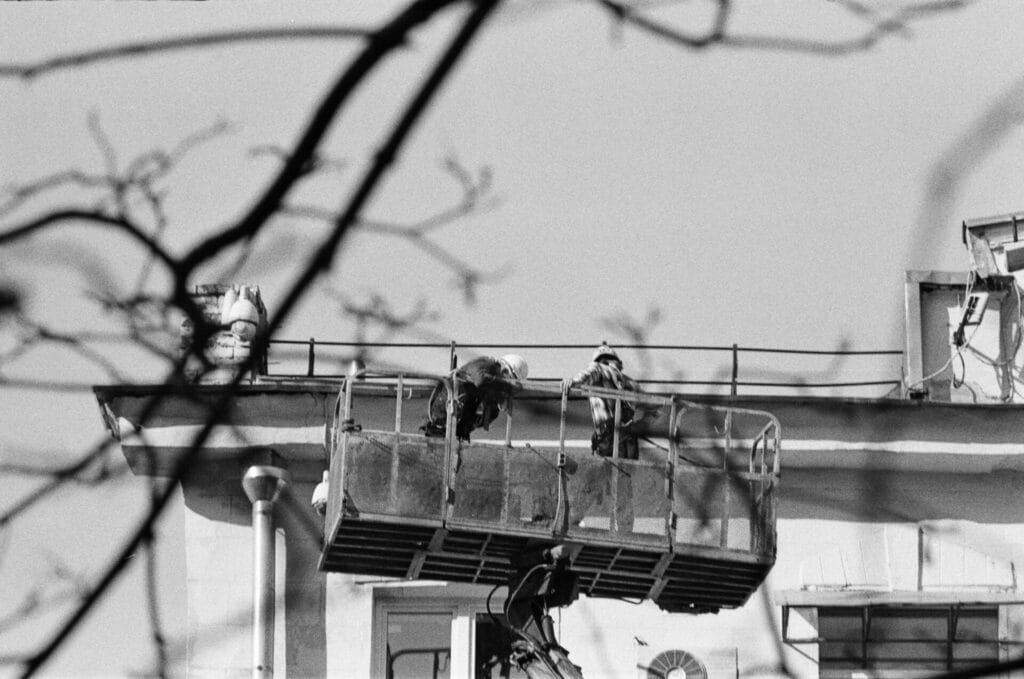
A worker in Wilmington, Illinois became trapped more than 130 feet in the air for roughly six hours on July 21, 2026, after the aerial lift he was using malfunctioned and could not be brought back down to retrieve him. His account only became public in news reports in late August 2026. He was eventually rescued safely by a technical rescue team using a replacement lift escorted in by state police, but the incident is a stark reminder that equipment failure on a job site can create serious legal exposure, even when the worker survives without physical injury.
If you or a loved one has been trapped, injured, or traumatized by malfunctioning equipment at work, call Phillips Law Offices at (312) 346-4262 for a free consultation. We’ve represented injured workers and their families across Illinois since 1945.
What Happened
According to news reports, the worker, an electrician performing routine maintenance on a commercial sign, rode an aerial lift up to the top of a roughly 130-foot structure. When a coworker attempted to bring the lift back down to retrieve him, it developed a mechanical failure and could not return to his height. Because the sign had no internal ladder or stairs, and standard municipal fire department ladder trucks typically extend only to about 100 feet, first responders could not reach him directly.
Fire officials used a drone to keep visual contact with the worker while Illinois State Police provided a highway escort to bring in a replacement boom lift from a nearby city. A technical rescue team eventually transferred him to the working lift and brought him down safely after approximately six hours. During the ordeal, he reportedly recorded video messages to his family, believing he might not survive.
Do You Need a Physical Injury to Have a Legal Claim?
Not necessarily. Incidents like this raise legal questions on more than one front, even when the worker walks away without a broken bone or burn:
Psychological and Emotional Trauma
Illinois workers’ compensation law recognizes claims for psychological injury when it is tied to a sudden, severe workplace event, sometimes called a “traumatic mental injury” or “mental-mental” claim. Believing you may die on the job, especially for six hours with no clear way down, can cause lasting anxiety, PTSD symptoms, or an inability to return to similar work. These effects are real, documentable injuries even without a physical wound.
Equipment Failure and Product Liability
If an aerial lift, boom lift, or similar equipment fails due to a manufacturing defect, poor maintenance, or a design flaw, the equipment manufacturer, rental company, or maintenance provider can potentially be held liable under Illinois product liability law, separate from any workers’ compensation claim against the employer.
Third-Party and General Contractor Liability
On multi-contractor job sites, general contractors have a legal duty to maintain reasonably safe conditions and properly maintained equipment for every worker on site, not just their direct employees. If a general contractor or property owner knew equipment was poorly maintained or failed to inspect it, a third-party negligence claim may be available in addition to workers’ compensation.
Workers’ Compensation vs. Third-Party Claims
| Claim Type | Who You Can Pursue It Against | What It Covers |
|---|---|---|
| Workers’ compensation | Your employer, regardless of fault | Medical bills, a portion of lost wages, permanent disability |
| Third-party negligence | General contractor, property owner, or other non-employer party | Full medical bills, full lost wages, pain and suffering |
| Product liability | Equipment manufacturer, distributor, or maintenance company | Full medical bills, full lost wages, pain and suffering |
Workers’ compensation does not include pain and suffering damages, which is why a third-party or product liability claim, when available, often results in significantly higher total compensation. In many cases, an injured worker can pursue workers’ compensation from their employer while simultaneously filing a third-party claim against the equipment manufacturer or another responsible party.
What to Do If You’re Trapped, Injured, or Traumatized by Equipment Failure at Work
- Get medical and psychological evaluation. Even if you have no visible injury, see a doctor and be honest about any anxiety, sleep problems, or distress following the incident.
- Report the incident in writing to your employer and request a copy of the incident report.
- Preserve the equipment. Do not let the malfunctioning lift or equipment be repaired, discarded, or returned to a rental company before it can be inspected. Equipment condition is often the central piece of evidence in these cases.
- Identify everyone involved, including the equipment owner, rental or maintenance company, and general contractor, not just your direct employer.
- Talk to an attorney before accepting a workers’ compensation settlement that may not account for a separate third-party or product liability claim.
Illinois Deadlines to File a Claim
| Claim Type | Time Limit | Illinois Statute |
|---|---|---|
| Workers’ compensation | 3 years from injury, or 2 years from last payment | 820 ILCS 305/6(d) |
| Third-party negligence / personal injury | 2 years from the date of the incident | 735 ILCS 5/13-202 |
| Product liability | 2 years from discovery of the injury | 735 ILCS 5/13-213 |
Frequently Asked Questions
Can I file a claim if I wasn’t physically hurt, just trapped and scared?
Potentially, yes. Illinois recognizes psychological injury claims tied to a sudden traumatic workplace event. Documentation from a doctor or mental health provider connecting your symptoms to the incident is important to support this type of claim.
Who is responsible if a lift or piece of equipment malfunctions?
It depends on the cause. A manufacturing defect points to the equipment maker, poor maintenance points to whoever was responsible for servicing it, and inadequate inspection or oversight can point to the general contractor or site owner. An attorney can help identify every responsible party.
Can I get workers’ compensation and also sue someone else for the same incident?
Yes, in many cases. Workers’ compensation applies to your employer regardless of fault, while a separate third-party claim can be pursued against parties other than your employer, such as an equipment manufacturer or general contractor, for the same incident.
Talk to an Illinois Workplace Injury Lawyer
Phillips Law Offices has represented injured workers and their families across Illinois since 1945, recovering over $500 million in verdicts and settlements. If you or a loved one was trapped, injured, or traumatized by equipment failure at work, call (312) 346-4262 for a free consultation. We work on contingency, you pay nothing unless we win your case.
Related Resources: