

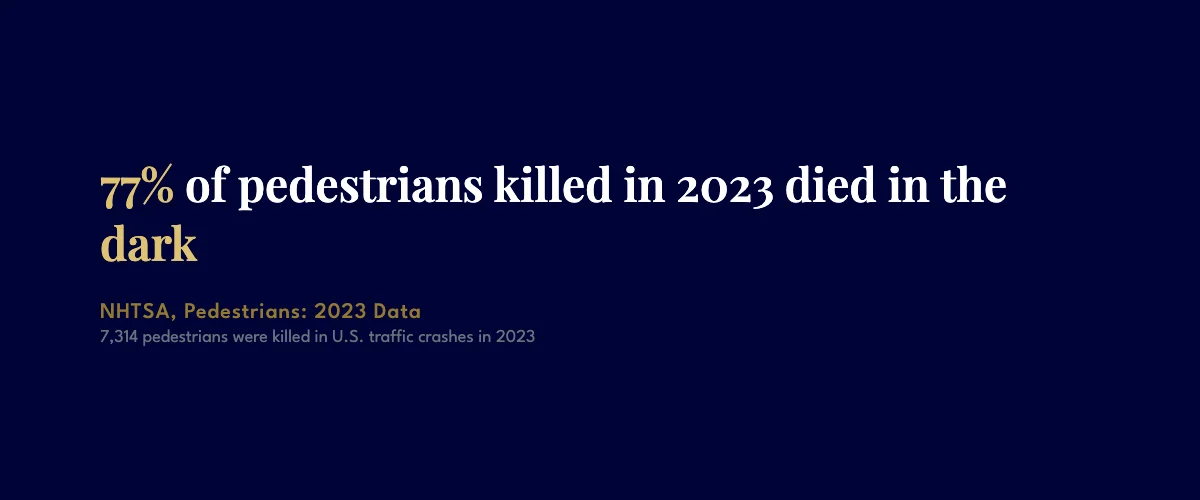
When clocks fall back in November, Chicago loses an hour of evening daylight overnight. The evening rush hour, when the most people are walking to trains, buses and parked cars, suddenly happens in the dark. National data shows why that matters: according to NHTSA, 77% of the 7,314 pedestrians killed in U.S. traffic crashes in 2023 died in the dark. Research from the Insurance Institute for Highway Safety (IIHS) found that fatal crashes involving pedestrians and bicyclists rise after the fall time change, while fatal crashes for people inside vehicles fall.
Darkness does not change the law. Illinois drivers still have to yield to pedestrians in crosswalks, keep their headlights on and watch for people on foot. If a driver hits you while you are walking after dark, you may have a claim even if you were wearing dark clothing.
Why the time change makes walking more dangerous
The IIHS studied fatal crashes in the five weeks before and after each time change from 2010 to 2019. The swings in pedestrian deaths followed the amount of daylight. When an evening hour went dark in the fall, pedestrian and bicyclist deaths in that hour went up. The IIHS president has summed up the finding plainly: pedestrians and bicyclists are at greater risk in low light.
The problem in Chicago is timing. After the November change, the sun sets before 4:30 p.m. for much of December. That puts the darkest part of the day right on top of the evening commute, school pickups and holiday shopping trips. Drivers are tired, roads are busy, and many are still adjusting to seeing less.
Several things make a person on foot harder to see at night:
- Headlights only light the road ahead for a limited distance, and a driver going too fast can outrun them.
- Glare from oncoming traffic, wet pavement and storefront lighting hides people standing at the curb.
- Large SUVs and pickups have tall front ends and wide pillars that block the view of a person crossing.
- Turning drivers are looking for a gap in traffic, not for someone stepping into the crosswalk.
What Illinois law requires of drivers after dark
Headlights. Under 625 ILCS 5/12-201(b), drivers must use their headlights from sunset to sunrise, any time weather requires windshield wipers, and any time people and vehicles cannot be clearly seen at 1,000 feet. A driver who hits a pedestrian at dusk without headlights on has broken a basic safety law.
Yielding at crosswalks. Under 625 ILCS 5/11-1002, a driver must stop and yield to a pedestrian crossing within a crosswalk where there is no traffic signal. At signals, pedestrians with a walk signal have the right of way, and turning drivers must yield to them.
Due care, everywhere. Section 11-1003.1 requires every driver to exercise due care to avoid hitting any pedestrian, to sound the horn when needed, and to take extra precautions around children and people who seem confused or impaired. This duty applies even when the pedestrian is not in a crosswalk.
Pedestrians have duties too. A person crossing outside a crosswalk generally has to yield to vehicles under Section 11-1003, and no one may suddenly step off the curb into the path of a car that is too close to stop. Those rules can affect fault, but they do not give drivers permission to stop paying attention.
Who is at fault when a pedestrian is hit at night?
Insurers often argue that a pedestrian was “impossible to see.” That argument depends on the facts. Investigators and lawyers look at:
- The driver’s speed, and whether the driver could have stopped within the distance their headlights covered
- Whether the headlights were on and working
- Phone use and other distraction in the seconds before the crash
- The street lighting at the location, and whether lights were out
- Video from traffic cameras, businesses, buses and doorbells
- Vehicle data from the car’s event data recorder
Illinois uses modified comparative fault under 735 ILCS 5/2-1116. If a jury finds a pedestrian partly at fault, for example 20% for crossing mid-block, the pedestrian’s damages are reduced by that percentage. A pedestrian found more than 50% at fault cannot recover. Wearing dark clothing is not, by itself, a reason to bar a claim. Our post on what happens if a pedestrian caused an accident explains how shared fault works.
Poor lighting can also point to another responsible party. If a street light had been out for a long time and the city or another public body knew about it, a claim against that public entity may be possible. Those claims fall under the Local Governmental and Governmental Employees Tort Immunity Act, which has a one-year filing deadline and several immunities, so they need to be looked at quickly.
If the driver was uninsured or drove away
Many nighttime pedestrian crashes are hit-and-runs. If the driver is never found or has no insurance, your own auto policy’s uninsured motorist coverage may pay for your injuries, even though you were walking and not driving. Illinois requires uninsured motorist coverage on auto policies, and it often covers household members too. Report the crash to police right away, because a prompt police report is usually required for these claims.
Staying safer while walking in the dark
- Wear something light or reflective, or carry a small light, especially in December and January.
- Cross at signals and marked crosswalks when you can, and make eye contact with drivers before stepping out.
- Watch for turning cars at intersections, even when you have the walk signal.
- Keep your phone in your pocket while crossing, and take headphones off at busy corners.
- Be extra careful in the first few weeks after the time change, when drivers are still adjusting.
None of these steps shift legal responsibility onto the person walking. They simply lower the risk.
What to do after a pedestrian accident in Chicago
- Call 911 and get medical care, even if you feel able to walk away. Head and internal injuries are common in pedestrian crashes and can show up later.
- Get the driver’s name, insurance and plate number, and the names of any witnesses.
- Photograph the scene, including the lighting, the crosswalk and any damage to the car.
- Write down nearby businesses and buses that may have cameras. Many systems record over footage within days.
- Do not give a recorded statement to the driver’s insurer before talking to a lawyer.
Most pedestrian injury claims in Illinois must be filed within two years under 735 ILCS 5/13-202. Claims involving a public entity can have a one-year deadline. For more on what these cases can be worth, see the average payout for a pedestrian hit by a car and how much to expect from a pedestrian accident claim.
Talk to a Chicago pedestrian accident lawyer
Phillips Law Offices represents people hit by cars while walking in Chicago and across Illinois. Our pedestrian accident guide covers your rights in more detail. If you were injured after dark, we can move quickly to preserve video and lighting evidence before it disappears. The consultation is free, and you pay no fee unless we recover compensation for you.
Call (312) 346-4262 or book a free consultation online.
Frequently asked questions
Do pedestrian accidents increase after daylight saving time ends?
Yes. IIHS research on fatal crashes from 2010 to 2019 found that pedestrian and bicyclist deaths rise in the evening hour that becomes dark after the fall time change. NHTSA data shows 77% of pedestrian deaths in 2023 happened in the dark.
Is a pedestrian at fault for wearing dark clothes at night?
Not automatically. Illinois drivers must use headlights, drive at a speed that lets them stop for what they can see, and exercise due care for pedestrians. Clothing may be raised as an argument, but fault depends on all the facts.
Do drivers have to stop for pedestrians in a crosswalk in Illinois?
Yes. Under 625 ILCS 5/11-1002, drivers must stop and yield to pedestrians crossing within a crosswalk where there is no traffic signal, and turning drivers must yield to pedestrians with a walk signal.
How long do I have to file a pedestrian accident claim in Illinois?
Generally two years from the date of the crash. Claims against a city or other public entity usually must be filed within one year.