

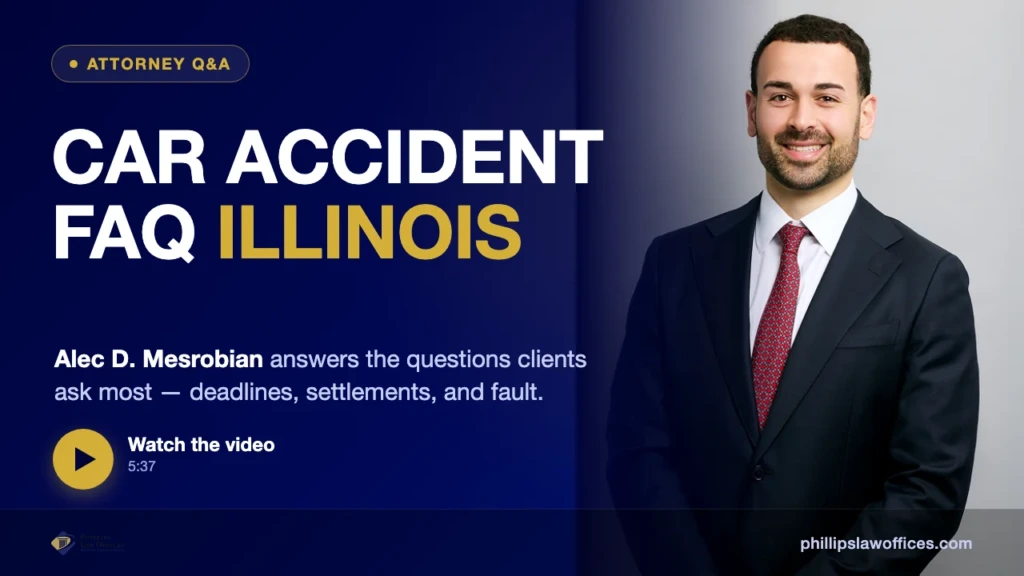
Car accident clients tend to ask the same handful of questions in the first conversation with a lawyer: how long they have to file, whether to sign what the insurance company sends over, and whether hiring an attorney is going to cost money they don’t have. This car accident FAQ walks through those questions in Illinois-specific terms, straight from Phillips Law Offices attorney Alec D. Mesrobian, plus a few that only come up once a claim is already moving: shared fault, waivers, and what happens when the other driver has little or no insurance.
The video runs about five and a half minutes. In it, Alec covers:
- The Illinois filing deadline for a car accident lawsuit
- Whether to accept the insurance company’s first settlement offer
- Shared fault, signed waivers, and uninsured drivers
- Whether you need to go to the ER right away
- Attorney fees and the contingency fee model
- Uninsured and underinsured motorist coverage
How long do you have to sue after a car accident in Illinois?
I was in a car accident. How long do I have to sue?
Generally, two years in Illinois. The deadline varies state to state, but Illinois gives you two years to file. That clock is a big reason to get a lawyer involved early rather than waiting to see how you feel: once it runs out, the claim is usually barred no matter how strong it was.
Should you take the insurance company’s first settlement offer?
The insurance company offered me a settlement. Should I take it?
No. The simple answer is no. Alec has had clients come to him after an insurance company reached out directly and offered them $750 each, on cases that were worth well in excess of that. He ended up recovering close to $120,000 for those clients. A fast, low offer made before you’ve even finished treatment is a sign the insurer is trying to close the file cheap, not a sign of what the case is actually worth.
Does being partly at fault stop you from recovering?
Does it matter if I was partly at fault for the accident?
Sure, it can matter to how a case is valued. But it does not prevent you from recovering in a lawsuit. Being partially responsible is not the same as being locked out of compensation entirely.
Can you sue if you signed a waiver?
Can I sue if I signed a waiver?
It depends on what the waiver actually says. You can still go ahead and sue, but a waiver in the picture makes it a more difficult case. It’s worth having a lawyer read the specific language before assuming it closes the door.
The other driver had no insurance. Can you still recover money?
The other driver wasn’t insured. Can I still recover money?
Yes, you can. Illinois has uninsured motorist (UM) and underinsured motorist (UIM) coverage. If you carry UM or UIM coverage on your own policy, you can collect under that policy even if the at-fault driver has no insurance at all. Alec sees this situation unfortunately often in Illinois.
Do you need to go to the ER if you don’t feel hurt right away?
Do I need to go to the ER if I don’t feel hurt right away?
Even if you don’t feel hurt right away, Alec still recommends seeing your primary care physician. After these accidents, symptoms sometimes don’t become noticeable until a day or two later. It’s always better to be safe than sorry and get checked out, and the sooner you’re evaluated, the sooner you know how soon you should talk to a lawyer too.
Should you talk to the insurance company without a lawyer?
The insurance company is calling me. Should I talk to them without a lawyer?
No. For the same reason as the settlement question above: they’re always going to offer some sort of settlement that is well below the actual value of your case, hoping to resolve it quickly and quietly before you know what it’s worth.
What does it cost to hire a personal injury attorney?
Does it cost anything to hire a personal injury attorney?
No, it doesn’t. Phillips Law Offices is here to answer questions for anyone dealing with car accidents, trucking cases, or medical malpractice cases, at no upfront cost to you.
Is there an hourly fee, and what is a contingency fee?
Is there an hourly fee to hire a personal injury attorney? And what’s a contingency fee basis?
No hourly fee. The firm works on a contingency fee basis, generally a one-third recovery for attorney’s fees. That’s not the hourly-fee or retainer arrangement you might picture from TV or the movies. You don’t pay out of pocket as the case goes; the fee comes out of the recovery at the end.
Should you post on social media about your accident?
Can I post on social media about my accident?
Insurance companies and defense attorneys, whether you know it or not, will scrub your social media and use it against you.
Alec’s advice: the safest move is to stay off social media entirely while a claim is open.
Uninsured and underinsured motorist coverage, explained
What is underinsured and uninsured motorist coverage?
It’s protection, and specifically it’s protection against other drivers who are either uninsured, which is against the law, or underinsured. Illinois requires only a $25,000 minimum policy, and a lot of drivers carry exactly that state minimum and nothing more, see our breakdown of Illinois’ SB 714 auto-insurance reform for how those minimums are changing.
If you’re hit by a driver like that, go to the emergency room, have imaging done, and go through physical therapy, those medical bills add up fast, but you can typically only collect against the amount of the at-fault driver’s policy. If you have UM or UIM coverage through your own insurer, that lets you collect under your own policy to make up the difference. Alec recommends calling your own car insurance provider and asking about uninsured and underinsured motorist coverage. It’s not terribly expensive to get a meaningful policy, and it’s protection he thinks everyone should carry.
The most rewarding part of the work
What is the most rewarding part about being a personal injury attorney?
Helping the clients. You build tremendous relationships with them, because you’re with them for anywhere from two to five years working on a case. In that time you get to know what kind of person they are, often after they’ve called you during one of the darkest, most difficult stretches of their lives. Getting to congratulate a client at the end of a case, once there’s been a recovery, and knowing the two of you have built a relationship that will last, is the most rewarding part of the job.
About Alec D. Mesrobian. Alec is an attorney at Phillips Law Offices in Chicago. He earned his undergraduate degree in Justice & Law from American University, where he was a member of the Dean’s List, and went on to earn his J.D. from the University of Illinois Chicago School of Law. Alec spent six years as a clerk at the firm before his admission to practice, assisting on numerous high-profile cases and working closely with senior attorneys to develop the legal strategies behind successful outcomes. He is known for his attention to detail and strong advocacy skills, and takes a client-centered approach, tailoring his representation to each client’s individual needs. Alec is admitted to practice law in Illinois and is a member of the Illinois Trial Lawyers Association and the Armenian Bar Association. Read his full biography at Alec D. Mesrobian, Phillips Law Offices.
If you or a family member has been hurt in a car accident, Phillips Law Offices offers free consultations. Call (312) 346-4262 or visit the firm’s contact page.
This video has been transcribed and lightly edited for length and clarity. It is provided for general informational purposes and is not legal advice, and it does not create an attorney-client relationship. Insurance minimums, coverage rules, and deadlines can change, and every case is decided on its own facts, so talk to a licensed attorney about your specific situation. Prior results do not guarantee or predict a similar outcome in any future case.