
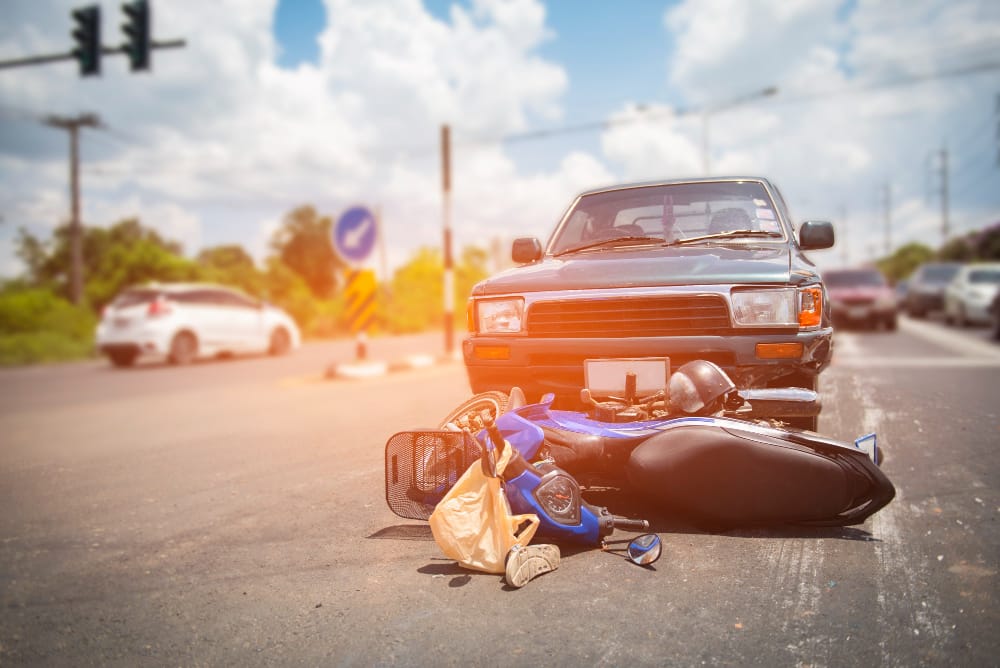
Motorcyclists are nearly 28 times more likely to die in a crash than car occupants, per mile traveled, according to the Insurance Institute for Highway Safety’s 2024 Fatality Facts report, citing 2023 NHTSA data. In 2024, 6,228 motorcyclists died nationwide out of 39,254 total motor vehicle deaths, meaning motorcycles accounted for 16% of traffic deaths despite representing a small fraction of registered vehicles.
If you’ve been injured in a motorcycle or car accident in Chicago, call our experienced motorcycle accident lawyers at Phillips Law Offices: (312) 346-4262 for a free consultation.
Motorcycle vs. Car Accident Statistics
Understanding the stark differences between motorcycle and car accident risks is critical for all Illinois road users:
| Statistic (2024) | Motorcyclists | Passenger Vehicle Occupants |
|---|---|---|
| Total U.S. deaths | 6,228 | 22,713 |
| Share of all traffic deaths | 16% | 58% |
| Single-vehicle crash deaths | 35% | 43% |
| Fatality rate per mile traveled vs. cars (2023) | ~28x higher | baseline |
Source: IIHS Fatality Facts 2024: Motorcycles and ATVs, based on FARS data, posted June 2026.
Why Are Motorcycle Accidents More Deadly Than Car Accidents?
Several factors contribute to the dramatically higher fatality and injury rates for motorcyclists:
1. Lack of Protective Structure
Cars provide multiple layers of protection that motorcycles simply don’t have: an enclosed metal frame, airbags, seatbelts, and crumple zones. Motorcyclists have none of these, which is a large part of why a crash that would leave a car occupant with minor injuries can kill a motorcyclist.
2. Visibility Issues
Motorcycles are significantly harder for other drivers to see. A smaller profile, blind spots, and “inattentional blindness” (drivers not consciously scanning for a shape they don’t expect) all contribute. The most common phrase in motorcycle-car collisions is: “I didn’t see the motorcycle.”
3. Instability
Two wheels instead of four make motorcycles inherently less stable and more vulnerable to road hazards (gravel, potholes, debris), weather, and emergency braking situations.
4. Ejection Risk
Car occupants typically remain inside the vehicle in a crash. Motorcyclists are frequently thrown from the bike, exposing them to impact with the road, other vehicles, or roadside objects.
Illinois Has No Universal Helmet Law, and the Data Shows What That Means
Illinois is one of a small number of states with no helmet requirement for adult riders. IIHS data on fatally injured motorcyclists nationwide shows exactly why that matters: in states with a universal helmet law, 89% of fatally injured motorcyclists were wearing a helmet at the time of the crash. In states with no helmet law at all, that number drops to 40%.
Helmets are about 37% effective at preventing motorcyclist deaths and about 67% effective at preventing brain injury, according to NHTSA research cited by IIHS. Nationally in 2024, 66% of fatally injured motorcycle drivers were wearing a helmet; 31% were not.
The Illinois motorcycle helmet law only requires helmets for riders under 18.
Who Is at Risk: Age, Alcohol, and Crash Type
Per the same 2024 IIHS/FARS data:
- Age: 33% of motorcyclist deaths in 2024 were riders under 30; 31% were 50 or older. The share of older riders killed has grown steadily since the 1990s.
- Alcohol: 26% of fatally injured motorcycle drivers had a blood alcohol concentration at or above the legal limit (0.08%); in single-vehicle crashes, that rises to 39%.
- Crash type: 65% of motorcyclist deaths happened in multi-vehicle crashes, meaning another driver was involved more often than not.
- Timing: 46% of deaths occurred on weekends, and 57% happened May through September.
- Location: 65% of motorcyclist deaths occurred in urban areas, and 56% happened on major roads other than interstates and freeways, ordinary city and suburban streets, not just highways.
Leading Causes of Motorcycle-Car Collisions
1. Left-Turn Accidents
One of the most common patterns in motorcycle-car collisions is a car turning left in front of an oncoming motorcycle. The driver typically fails to see the motorcycle or misjudges its speed and closing distance.
2. Unsafe Lane Changes
Cars changing lanes without checking blind spots strike motorcycles the driver never saw. Note: lane splitting (riding between lanes of stopped or slow traffic) is illegal in Illinois.
3. Speeding
Excessive speed reduces reaction time for both riders and drivers and increases the severity of any resulting crash.
4. Impaired Driving
Alcohol plays a significant role on both sides of motorcycle-involved crashes, as the BAC data above shows.
5. Distracted Driving
A driver looking at a phone is less likely to notice a motorcycle in traffic, especially at an intersection or during a lane change.
6. Road Hazards
Potholes, gravel, oil slicks, railroad tracks, and wet leaves cause minor problems for a car and can be catastrophic for a motorcycle.
Motorcycle Accident Injuries vs. Car Accident Injuries
The types and severity of injuries differ significantly between motorcycle and car accidents. Motorcyclists face a much higher risk of traumatic brain injury, spinal cord injury, road rash, and broken bones, since none of a car’s protective structure is available to absorb the impact.
What to Do After a Motorcycle or Car Accident
Whether you’re in a motorcycle or car accident, take these steps to protect yourself:
- Seek medical attention immediately, even if injuries seem minor
- Call police and get an official accident report
- Document the scene with photos and witness information
- Don’t admit fault or give recorded statements to insurance companies
- Contact an experienced accident attorney before accepting any settlement
Frequently Asked Questions
Are motorcycles or cars safer?
Cars are significantly safer than motorcycles. Per mile traveled, motorcyclists are nearly 28 times more likely to die in a crash than car occupants, according to IIHS analysis of federal data. Cars provide protective enclosures, airbags, seatbelts, and crumple zones that motorcycles lack.
What is the leading cause of motorcycle accidents involving a car?
A car making a left turn in front of an oncoming motorcycle is one of the most frequently cited patterns in motorcycle-car collisions. The driver typically fails to see the motorcycle or misjudges its speed.
Do motorcycles cause more accidents than cars?
No. Cars are involved in far more total crashes because there are vastly more cars on the road. But motorcycle crashes are far more likely to be fatal: motorcyclists made up 16% of all traffic deaths in 2024.
Does Illinois require a helmet?
No. Illinois has no helmet law for adult riders, one of only a handful of states without one. Riders under 18 are required to wear a helmet.
How can I reduce my risk of a motorcycle accident?
Wear a DOT-approved helmet, take a motorcycle safety course, wear high-visibility gear, never ride impaired, maintain your motorcycle properly, and ride defensively, assuming other drivers may not see you.
Contact Our Chicago Motorcycle and Car Accident Lawyers
Whether you’ve been injured in a motorcycle accident or car crash, you deserve experienced legal representation to fight for maximum compensation. At Phillips Law Offices, we’ve helped accident victims across Illinois recover for their injuries.
We handle all types of motor vehicle accidents:
Call (312) 346-4262 today for a free, no-obligation consultation. We work on contingency, you pay nothing unless we win your case.
Related Resources: