
The U.S. Consumer Product Safety Commission has announced a wave of adult portable bed rail recalls in 2026, and one of them — Vive Health’s recall of about 122,000 bed rails — followed two reported entrapment deaths, including a 97-year-old man at an assisted living facility. For Illinois families with a parent in a nursing home, the recall raises a question the CPSC notice does not answer: if a facility was using one of these rails, who is responsible?
If your family member was injured or died in a bed rail entrapment at an Illinois nursing home or assisted living facility, call Phillips Law Offices at (312) 346-4262 for a free, confidential consultation.
What the Vive Health Recall Says
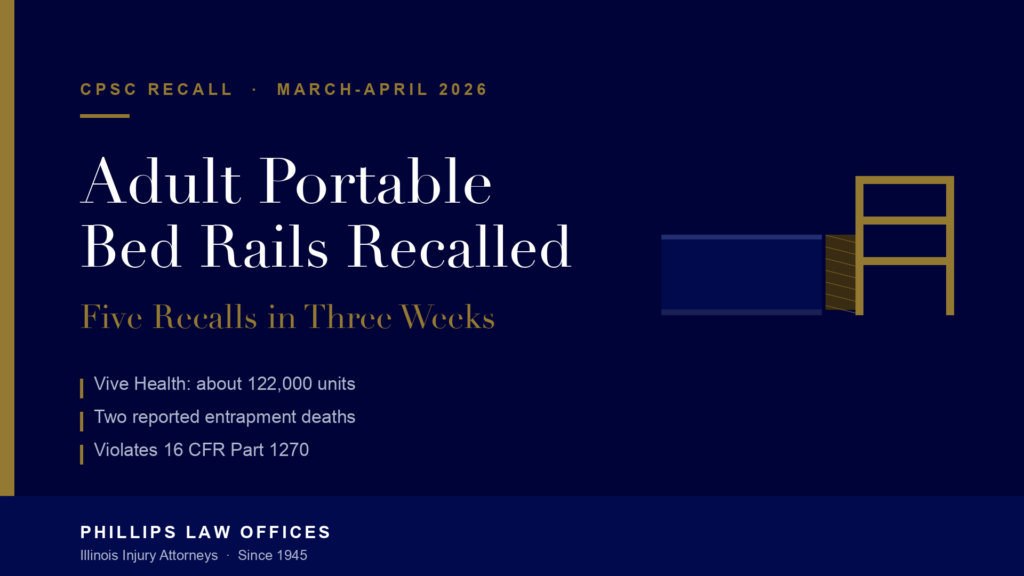
According to CPSC recall 26341, announced March 26, 2026, Vive Health recalled its Compact Bed Rail (model LVA2009SLV), Bed Rail Collection V (model LVA2097SLV), and units of model LVA1024 purchased on or before August 21, 2023. About 122,000 units were sold at medical supply stores nationwide and online through vivehealth.com and Amazon, from September 2019 through December 2025, for between $45 and $90.
The CPSC describes the hazard this way: when the rails are attached to a bed, “users can become entrapped within the bed rail or between the bed rail and the side of the mattress,” posing a serious entrapment hazard and risk of death by asphyxiation.
On the injuries, the notice states that Vive Health received two reports of entrapment deaths associated with one model. Both occurred in September 2024, and involved a 97-year-old man at an assisted living facility in Texas and a 93-year-old man at his home in Florida.
Two details are worth noting. The deaths were reported in September 2024, and the recall was announced in March 2026. And this was not Vive Health’s first action on these rails: the company had already recalled units of model LVA1024 purchased after August 21, 2023, on February 19, 2026, before expanding to earlier units the following month.
This Is a Category-Wide Problem, Not One Brand
Within roughly three weeks, the CPSC announced five separate adult portable bed rail recalls. Most cite the same failure: the product violates the federal Safety Standard for Adult Portable Bed Rails (16 CFR Part 1270), and in several cases the rails also lacked the required hazard warning labels.
| Brand | Recall date | Units | Reported injuries |
|---|---|---|---|
| Vive Health | March 26, 2026 | ~122,000 | Two entrapment deaths |
| MPINOI | March 26, 2026 | ~200 | None reported |
| ELENKER | April 2, 2026 | ~30 | None reported |
| Sangohe (re-announced and expanded) | April 2, 2026 | ~36,500 | None reported |
| Easymake | April 9, 2026 | ~19,000 | None reported |
The Sangohe entry deserves attention: it is a re-announcement and expansion of a recall the company had already issued in January 2026 for about 26,200 rails. A recall that has to be expanded is a recall that did not reach everyone the first time — which means product can remain in use long after the original notice.
Why Bed Rail Entrapment Is So Dangerous
Bed rails are meant to help someone reposition themselves or avoid rolling out of bed. The danger is the gap. A person who is frail, sedated, or living with dementia can slide into the space between the rail and the mattress, or into an opening within the rail itself, and be unable to pull themselves free. Because the chest or neck can be compressed against the frame, entrapment can cause asphyxiation quickly and quietly, often without any sound that would alert staff.
That is exactly why the federal standard exists, and why an undersized or non-compliant gap is treated as a serious defect rather than a minor design issue.
In Illinois, There May Be Two Responsible Parties
A recall notice addresses the manufacturer. An Illinois injury claim can be broader, and this is the part families most often do not realize.
The manufacturer or seller. Illinois recognizes strict product liability for a product sold in a defective and unreasonably dangerous condition. A recall is not itself proof of liability, but a recall notice, a violation of the federal standard, and missing warning labels are all evidence a claim can be built on. Notably, Vive Health LLC is based in Naples, Florida — unlike several of the other recalled brands, whose importers are based overseas, which can make recovery considerably harder in practice.
The nursing home or assisted living facility. Under the Illinois Nursing Home Care Act (210 ILCS 45), a facility owes its residents a duty of care that includes the equipment it puts in a resident’s room. A facility that continued using a recalled bed rail after the recall, that failed to assess whether a resident was at risk of entrapment, or that failed to monitor a resident it knew to be at risk, may face a negligence claim independent of any product defect. The Act also allows recovery of attorney’s fees and costs in a successful action, which matters in cases where the resident’s economic damages are limited.
In practice, these two theories are often pursued together. Our Chicago nursing home abuse lawyers and our product liability lawyers work these cases as one investigation, because the answer to “was the rail defective?” and the answer to “should the facility have removed it?” come from the same records.
What Families Should Do Now
- Do not destroy the rail. The recall notices instruct consumers to cut the straps, mark the rail “RECALLED,” photograph it and dispose of it. That is sound consumer advice — but if someone has already been hurt, the rail is evidence. Photograph it in place first, and speak to a lawyer before following the disposal steps.
- Photograph the setup, not just the product. The gap between the rail and the mattress, the mattress size, and how the rail was attached are all central to an entrapment case.
- Request the records. Ask the facility in writing for the incident report, the resident’s care plan, restraint and side-rail assessments, and nursing notes from the relevant shift.
- Note the model. Several recalled rails carry no model number or brand label at all, so the purchase record or the facility’s equipment log may be the only way to identify it.
- Watch the deadline. Illinois generally allows two years to file a personal injury or wrongful death lawsuit (735 ILCS 5/13-202; 740 ILCS 180/2). Deadlines in cases involving a facility can turn on specific facts, so do not wait to get advice.
Frequently Asked Questions
Does a recall mean the manufacturer is automatically liable?
No. A recall is a corrective action, and in these cases a voluntary one; it is not a court finding that the product injured anyone. What a recall does provide is evidence — the manufacturer’s own description of the hazard, the fact that the product violated a federal safety standard, and in some cases an admission that injuries were reported. A claim still has to prove the defect caused the specific injury.
Can we sue the nursing home as well as the manufacturer?
Often, yes. A product liability claim against the manufacturer and a negligence claim against the facility under the Illinois Nursing Home Care Act are separate theories and can be pursued in the same case. Whether both apply depends on what the facility knew, when it knew it, and what it did about the resident’s risk of entrapment.
My father died in 2024, before the recall was announced. Is it too late?
Not necessarily, but time matters. Illinois generally allows two years for a wrongful death action, and the recall itself does not restart that clock. There are circumstances in which a deadline is calculated differently, including when the cause of an injury was not reasonably discoverable at the time. Have the specific dates reviewed by a lawyer rather than assuming the claim is barred.
The rail has no model number. Can we still identify it?
Frequently yes. The CPSC notes that some recalled rails carry no model number or brand-specific label. Purchase records, the facility’s equipment inventory, delivery records, and photographs of the product’s dimensions and construction can all be used to identify it.
What if the bed rail was bought by our family, not the facility?
That does not automatically end a claim against the facility. A nursing home is generally responsible for assessing whether equipment in a resident’s room is safe for that resident, including equipment a family brought in, and for acting when it is not.
Talk to an Illinois Nursing Home and Product Liability Lawyer
Phillips Law Offices has represented Illinois families in nursing home neglect and defective product cases since 1945, recovering more than $500 million in verdicts and settlements. If a bed rail was involved in a serious injury or death in an Illinois facility or at home, we can review the recall status, the equipment records and the facility’s conduct together.
Call (312) 346-4262 for a free, confidential consultation. There is no fee unless we recover compensation for you, and we advance case costs.
This article is for general information and is not legal advice. It describes recalls announced by the U.S. Consumer Product Safety Commission and does not assert that any product caused a particular injury or that any facility acted improperly. Every case depends on its own facts.