
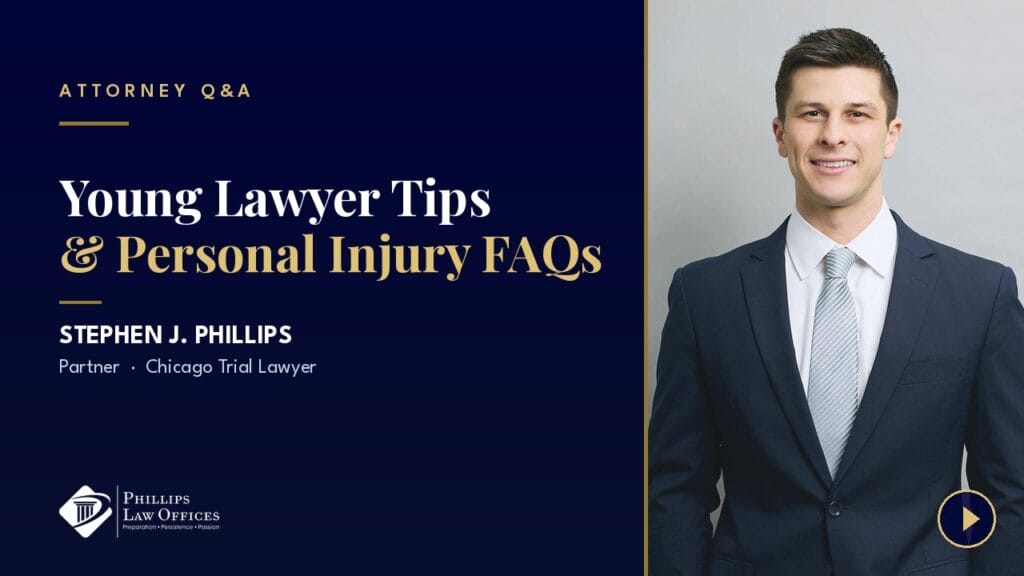
Every summer, Phillips Law Offices takes on a handful of law clerks. On his last day this year, one of them, a rising second-year law student named Grafton, sat down with partner Stephen J. Phillips and asked the questions law students actually want answered. Not the recruiting-brochure questions. The real ones: what young lawyers get wrong in front of a jury, how to handle an opposing counsel with twenty years on you, and whether the work is anything like the billboards suggest.
The full conversation runs about twenty minutes and is worth watching straight through. A lightly edited transcript follows below.
What a small firm can do that a billboard firm cannot
How does Phillips Law Offices separate itself from the bigger firms you see on billboards?
Being nimble is actually a benefit. We handle a low volume of catastrophic injury cases, which means we have a one-on-one relationship with every client. All of our clients have our personal emails and phone numbers. That is something big firms and even medium-sized firms typically do not do.
At a lot of firms, clerks and paralegals work on the vast majority of a case before a lawyer is ever meaningfully involved. We do not operate that way.
The discovery tools that move a case
What is the most useful discovery device you use?
Depositions matter. So do subpoenas to third parties, for the information defendants either cannot produce or will not produce. Requests to admit are important too.
But a simple Illinois Supreme Court Rule 214 production request is a very, very powerful tool. Defendants have an obligation to respond within roughly a month. People underestimate it.
The biggest mistake young lawyers make
In the office or in front of a jury, what do you see go wrong most?
Not knowing the law well enough. A lot of us come out of law school feeling like we can conquer the world, and to a certain extent we can. But there has to be humility in there, and a willingness to learn, and an acceptance that even though you are a hotshot who just graduated, you have a lot to learn. You are at the beginning of your training. School is different from the real world. It just is.
A lot of young lawyers, particularly now with AI, do not know the law well enough. Then they are in the courtroom, the judge asks about a legal principle, and they do not know the answer. That is uncomfortable. Read the rules of civil procedure. Stay current on appellate and Supreme Court decisions. Do that and you are miles ahead of your classmates.
And in front of a jury?
Preparation. When you watch a trial that looks competent, where things move smoothly, that is actually uncommon. Go sit in on trials and you will see a lot of downtime. Lawyers fumbling with exhibits and notes. Unprepared witnesses.
Your trial prep on a big case starts months, certainly weeks, but preferably months, before you walk through the courthouse doors.
If a trial looks good, those lawyers put enormous time into it. I believe you should have your direct examinations and your crosses written out weeks ahead. Do not save it for the night before. You will not have enough time and it will show.
The skill law school does not teach
What were you least prepared for coming out of law school?
Listening to a witness’s answer and being able to think and fence with them on the fly. That is genuinely hard.
As a young lawyer it is far more comfortable to stick to your outline. But you have to learn to actually hear what the witness is saying. What are they giving you? How are they trying to mess with you? And when you get a gem, or an answer you did not expect, you have to follow it rather than retreating to your next written question. I do not think anyone has that ability innately. I did not. I am still working on it. It comes from doing it over and over.
What to study, and where to spend your summers
What class or experience would you recommend to a student interested in personal injury?
Civil procedure, and Illinois civil procedure specifically if your school offers it. When my dad was at Loyola they had an Illinois civil procedure class. They did not when I was there, and I wish they had. A one-semester federal civil procedure course is decent, but it will not give you the granular detail you need practicing here.
For experience: work. Clerk for a plaintiff’s firm. Sit in on depositions, write briefs, talk to potential new clients. There is merit to law journal and moot court and mock trial, but those only take you so far. Seeing how intake works, watching other lawyers try cases at the Daley Center, noting what they do well and what they do badly, that is worth more than another line on a resume.
Good associate versus great associate
Critical thinking, and a willingness to make mistakes without needing constant reassurance that you are doing the right thing.
One thing we say here is: fall forward. It is okay to make mistakes. If you are going to make one, fall forward.
Mentorship is a big part of what we do, and partners are available to guide you. Once or twice, fine. But do not be the person who comes back six, seven, eight times on a single project. Wrestle with it yourself, bring back a genuinely good final product, and let the partner tell you what needs to change.
On AI in the practice
AI is a good supplement, not a replacement. If you are working up a trucking case or a medical negligence case and you already have your three or four theories of negligence from the facts, you can run it and it will mostly give you back what you already thought of. But it might surface one or two facts or theories you had not considered.
That is the value: catching the small thing you missed the first time, and flagging what might be absent. It does not replace knowing the law.
How jury attitudes shifted after COVID
I can speak to what I have seen, what I have researched, and what the older partners in our office describe. The clearest shift is that COVID changed how people think about these cases. Verdicts and settlements are meaningfully higher than they were even ten years ago.
A large part of that, in my view, is that while many of us were locked in our houses and struggling financially, a number of corporations and insurers posted record profits and carried on with bailouts and subsidies. People across the political spectrum came out of that more willing to believe that some corporations put profits and shareholders ahead of the safety of their workers and customers. You can see that reflected in the verdicts.
What the billboards get wrong
What do you wish more law students understood about plaintiff’s work?
That it is a lot of work. Late nights, early mornings, and sitting up thinking about your clients.
Part of the misconception comes from billboard advertising, the “hurt in a wreck, get a check” message. That is not how it works, and I would prefer those firms dropped it. There is no hourly fee in this business and no retainer. We do not get paid until the client gets paid at the end of the case, and we routinely front hundreds of thousands of dollars in expenses on a single case. There is real risk, and the time spent often is not recouped until years down the road.
The McDonald’s coffee case, and the tort reform argument
How do you respond to people who bring up the McDonald’s hot coffee case and see plaintiff’s lawyers as opportunistic?
First, you have to know the actual facts of that case, because it has been badly misrepresented in the media for decades. That woman suffered second and third degree burns to a very private area of her body and required skin grafting. And McDonald’s had hundreds of prior complaints about coffee served near boiling and injuring people.
More generally, young personal injury attorneys are going to hear this from a distant relative at a holiday or from a classmate: that they do not believe in the system, or that there should be caps on damages. The defendants in these cases are usually multibillion-dollar companies or the insurers indemnifying them. Often the answer is simply the facts. Describe a case where a truck driver was watching TV on his phone while driving a 45,000-pound truck through a construction zone and killed a little girl, her mother, and her grandmother. These are public filings. That tends to open eyes.
On caps specifically, his argument is that the data does not support the promise: “States that have enacted tort reform or caps on damages, the insurance premiums that physicians and drivers and trucking companies and contractors in the state end up paying go up at the same rate they do in any other state that has not enacted tort reform.” His view is that capping damages reduces insurer payouts without producing corresponding relief for policyholders.
Handling obstructionist opposing counsel
You will encounter it, though thankfully it is not common. The answer is to use the court.
Especially since COVID, there are defense attorneys from whom you simply will not get anything without a court order. Nothing produced voluntarily, everything a fight. As a young lawyer I did not want to bother the judge. When I filed a motion to compel or asked for something at a case management conference, it felt like an imposition. That was dead wrong. That is why the judge is there. Judges want to move the case toward resolution, and when they see a lawyer being hamstrung by the other side, they will intervene. You just have to ask.
And when opposing counsel has twenty years more experience than you?
They will have more experience. They will know the tricks and which buttons to press. You cannot close that gap quickly, so you close a different one: know the facts of your case and know the law cold. Know what you are entitled to in discovery, what your client may and may not do, what the defense owes you. Have a real command of the rules of civil procedure and the case law.
If you walk into that courtroom and demonstrate to both the defense attorney and the judge that you are young but you know the law and you are prepared, you have leveled the field considerably.
Find a mentor
Incredibly important. Inside your firm if you can, and outside it if you cannot. The Illinois Trial Lawyers Association is a good route, and people on the board are willing to mentor lawyers from outside their own firms.
No matter how smart or prepared you are, you will hit things you have never seen. How do I respond to this nasty email from defense counsel? How do I answer this motion for sanctions against my client? You need someone who can hand you a brief, a template, some case law, and the practical read on how to navigate it. It is very hard as a young lawyer. You will have sleepless nights and anxiety. That is the job. Having someone to talk to through those stretches makes it considerably easier.
The case he is proudest of
A young man, a teenager at the time, had blood and protein in his urine. That is a red flag; children should not have protein in their urine. His mother kept bringing him back to his primary care doctor, and the doctor kept telling him he was fine.
Over roughly two years, his kidneys wasted away. The underlying disease was entirely preventable. Early intervention would have saved his kidneys and he would have lived a normal life. Instead, multiple blood tests were ignored across years, he lost his kidneys, and he went onto dialysis and the transplant list. He has since received a transplant, but he will need another and will end up back on dialysis. It shattered his childhood and his family.
Stephen worked on the case as a clerk during college and law school, handled the Rule 213 disclosures, and took depositions in it after being admitted. His father, Stephen D. Phillips, handled the majority of it. The case settled for $25 million the night before trial.
He is going to be taken care of for the rest of his life. No matter how sick he gets or how well he does, he will have what he needs, the care, the medications, the dialysis. That was a very rewarding feeling. He was a nice kid who did not deserve what happened to him.
The most rewarding part of the work
The clients. Other areas of law are important. Business transactions, real estate, corporate mergers all matter. But this practice means helping a person or a family through one of the worst tragedies they will ever experience. They lost a child, a sibling, a parent. They lost a leg or an arm. They cannot walk. They come to us at one of the lowest points of their lives.
Walking into a courtroom and leveling the playing field against a Fortune 500 company or an insurer with a 50,000-square-foot headquarters is a big deal. And being able to deliver something concrete, the wheelchair van, the accessible home, the medication, the physical therapy, so a client can live as normal a life as possible is genuinely rewarding.
And the hardest part
The ups and downs. There are days when you score points and your team and your witnesses do a great job and you feel like you won the day. Then a witness makes a mistake, or you say something you regret, and it is uncomfortable.
You have to roll with it and trust your preparation. Not too high, not too low. I was definitely too high and too low as a young lawyer and did not regulate myself well. You have to stay even-keeled and understand that just as you score points, the defense is going to score some too. That is the nature of trying cases.
About Stephen J. Phillips. Stephen is a partner at Phillips Law Offices and a third-generation trial lawyer. He earned his B.A. in political science from the University of Michigan and his J.D. from Loyola University Chicago School of Law, and began at the firm as a summer law clerk in 2014. Read his full biography at Stephen J. Phillips, Phillips Law Offices.
If you or a family member has been seriously injured, Phillips Law Offices offers free consultations. Call (312) 346-4262 or visit the firm’s contact page at Contact Phillips Law Offices.
This interview has been edited for length and clarity. It is provided for general informational purposes and is not legal advice, and it does not create an attorney-client relationship. Prior results do not guarantee or predict a similar outcome in any future case; every case is decided on its own facts.