
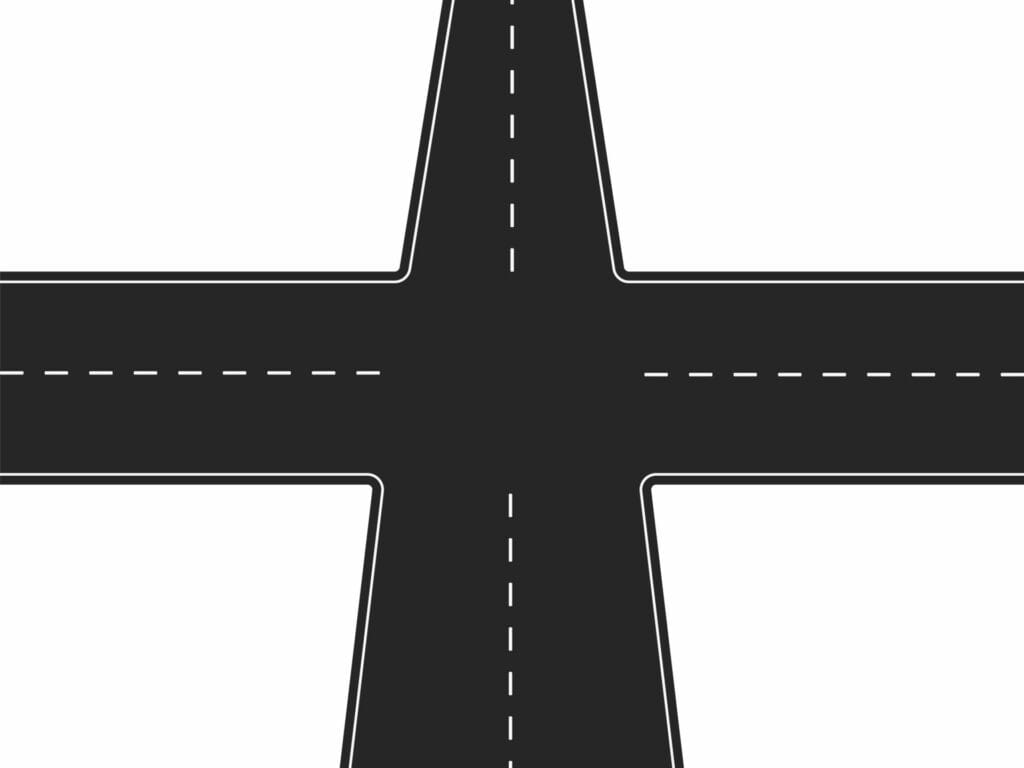
What are the rules of a four-way stop? At a four-way stop in Illinois, (1) every driver must come to a complete stop, (2) the first vehicle to arrive goes first, (3) if two vehicles arrive simultaneously, the vehicle on the right has the right-of-way, and (4) if vehicles arrive at the same time from opposite directions, both may proceed if going straight, but vehicles turning left must yield to oncoming traffic. Under Illinois law (625 ILCS 5/11-904), failure to stop completely or yield right-of-way can result in a $120+ ticket and points on your license.
Four-way stop intersections cause thousands of accidents in Illinois each year. Understanding the rules isn’t just about avoiding tickets—it’s about preventing serious car accidents that can result in injuries and costly legal battles.
Injured at a four-way stop? Contact Phillips Law Offices at (312) 346-4262 for a free consultation with our Chicago car accident attorneys.
Four-Way Stop Rules: Complete Right-of-Way Guide
| Scenario | Who Has Right-of-Way | What You Should Do |
|---|---|---|
| You arrive first | You | Stop completely, then proceed |
| Another vehicle arrived first | The other vehicle | Wait until they clear the intersection |
| Vehicles arrive simultaneously | Vehicle on the right | Yield to the driver on your right |
| Opposite directions, both going straight | Both vehicles | Both may proceed after stopping |
| Opposite directions, one turning left | Vehicle going straight | Left-turning vehicle must yield |
| All four vehicles arrive together | Established through communication | Make eye contact, proceed cautiously |
| Pedestrian in crosswalk | Pedestrian | All vehicles must yield |
Illinois Four-Way Stop Laws (625 ILCS 5/11-904)
Illinois law provides specific requirements for four-way stop intersections:
Complete Stop Required
Under 625 ILCS 5/11-1204, every driver must come to a complete stop at a stop sign. A “rolling stop” or “California stop”—slowing down without stopping completely—is a traffic violation.
What “complete stop” means:
- Wheels must stop moving entirely
- Vehicle must remain stationary momentarily
- Driver must stop at the stop line, crosswalk, or edge of intersection
Right-of-Way Rules
Under 625 ILCS 5/11-901, when two vehicles approach a four-way stop at approximately the same time:
- First to arrive, first to proceed: The vehicle that stops first has the right-of-way
- Right-side priority: If vehicles arrive simultaneously, the vehicle on the right goes first
- Straight traffic priority: Vehicles going straight have priority over turning vehicles when arriving from opposite directions
Pedestrian Right-of-Way
Under 625 ILCS 5/11-1002, pedestrians in a crosswalk always have the right-of-way. All vehicles must yield to pedestrians, regardless of which vehicle arrived first.
Illinois Penalties for Four-Way Stop Violations
| Violation | Illinois Statute | Fine | Points |
|---|---|---|---|
| Running a stop sign | 625 ILCS 5/11-1204 | $120-$250+ | 20 points |
| Failure to yield right-of-way | 625 ILCS 5/11-901 | $120-$250+ | 20 points |
| Rolling stop | 625 ILCS 5/11-1204 | $120-$250+ | 20 points |
| Failure to yield to pedestrian | 625 ILCS 5/11-1002 | $150-$500 | 20 points |
| Stop sign violation causing accident | 625 ILCS 5/11-1204 | $500+ | 50 points |
| Stop sign violation causing injury | 625 ILCS 5/11-1204 | $1,000+ | 50+ points |
Note: Accumulating 3 moving violations within 12 months can result in license suspension for drivers under 21. Adults face suspension at 75 points within 12 months.
Most Common Four-Way Stop Accidents
Intersection accidents, including those at four-way stops, account for approximately 40% of all crashes in the United States. Common accident types include:
T-Bone (Side-Impact) Collisions
The most dangerous four-way stop accidents occur when one vehicle runs the stop sign and strikes another vehicle’s side. These crashes often cause serious injuries because vehicle sides offer less protection than front or rear.
Right-of-Way Confusion Crashes
When multiple vehicles arrive simultaneously and drivers disagree on who should proceed, collisions can occur. These accidents often involve disputed liability.
Rolling Stop Accidents
Drivers who don’t stop completely may misjudge the speed and distance of other vehicles, leading to collisions they could have avoided with a proper stop.
Pedestrian Accidents
Drivers focused on other vehicles may fail to notice pedestrians in crosswalks, particularly in busy urban areas like Chicago.
Common Injuries from Four-Way Stop Accidents
Even at relatively low speeds, four-way stop accidents can cause serious injuries:
- Whiplash and neck injuries: Common in side-impact and rear-end crashes
- Traumatic brain injuries: Head strikes windows or steering wheel
- Spinal cord injuries: T-bone crashes can cause severe back trauma
- Broken bones: Arms, legs, ribs, and pelvis fractures
- Internal injuries: Organ damage from impact forces
- Lacerations: Broken glass and debris cause cuts
Who Is at Fault in a Four-Way Stop Accident?
Determining fault in four-way stop accidents depends on who violated the right-of-way rules:
| Scenario | Likely At-Fault Party | Evidence Needed |
|---|---|---|
| One driver ran the stop sign | Driver who didn’t stop | Witness testimony, traffic cameras |
| Driver proceeded out of turn | Driver who failed to yield | Witness accounts, arrival timing |
| Rolling stop caused accident | Driver who didn’t stop completely | Witness testimony, dashcam footage |
| Both drivers claim to have stopped first | Disputed—requires investigation | Video evidence, accident reconstruction |
| Driver hit pedestrian in crosswalk | Driver | Pedestrian testimony, witnesses |
Illinois Comparative Fault: Under 735 ILCS 5/2-1116, if you’re partially at fault, your compensation is reduced by your percentage of fault. If you’re more than 50% at fault, you cannot recover damages.
Safety Tips for Four-Way Stops
- Always come to a complete stop: Rolling stops are illegal and dangerous
- Count to three: After stopping, pause to assess the intersection
- Make eye contact: Confirm other drivers see you and acknowledge your turn
- Know the rules: First to arrive goes first; yield to the right when simultaneous
- Look for pedestrians: Check crosswalks before proceeding
- Don’t rush: Extra patience prevents accidents
- Use turn signals: Communicate your intentions clearly
- Avoid distractions: Put phones away at intersections
Frequently Asked Questions
Who goes first at a four-way stop if everyone arrives at the same time?
If all four vehicles arrive simultaneously at a four-way stop, there’s no specific rule. Drivers should make eye contact, use hand signals, and proceed cautiously one at a time. Typically, the vehicle on the right proceeds first, followed by the others in a clockwise pattern. When in doubt, yield and let others go—it’s safer than assuming you have the right-of-way.
What is the penalty for running a stop sign in Illinois?
Running a stop sign in Illinois typically results in a $120-$250 fine plus court costs, and 20 points on your driving record. If the violation causes an accident, fines increase to $500+ with additional points. Causing injury can result in $1,000+ fines and potential criminal charges.
Does a rolling stop count as running a stop sign in Illinois?
Yes. Under Illinois law, you must come to a complete stop at a stop sign with your wheels no longer moving. A “rolling stop”—where you slow down but don’t stop completely—is legally the same as running the stop sign and carries the same penalties.
Who has the right-of-way at a four-way stop when turning left?
If two vehicles arrive at a four-way stop from opposite directions at the same time, and one is turning left while the other is going straight, the vehicle going straight has the right-of-way. The left-turning vehicle must yield and wait for the through traffic to pass.
Can I be sued for a four-way stop accident in Illinois?
Yes. If you violated four-way stop rules and caused an accident that injured someone, the injured party can sue you for damages including medical bills, lost wages, pain and suffering, and property damage. Illinois allows two years from the accident date to file a lawsuit.
What should I do after a four-way stop accident?
After a four-way stop accident: (1) Check for injuries and call 911, (2) Move to safety if possible, (3) Exchange information with other drivers, (4) Document the scene with photos, (5) Get witness contact information, (6) Seek medical attention, and (7) Contact a car accident attorney before speaking with insurance companies.
Related Illinois Traffic Resources
- Chicago Car Accident Lawyers – Full legal representation for crash victims
- Truck Accident Claims – Commercial vehicle crashes at intersections
- Motorcycle Accidents – Intersection dangers for riders
- Double Yellow Line Rules – Illinois road marking laws
- Chicago Rush Hour Traffic – When accidents are most common
- Roundabout Accidents – Similar intersection challenges
Injured in a Four-Way Stop Accident? Contact Our Chicago Attorneys
Four-way stop accidents often involve disputed liability and complex right-of-way questions. Insurance companies may try to blame you for the accident or minimize your injuries.
At Phillips Law Offices, our experienced Chicago car accident lawyers investigate intersection accidents thoroughly, gather evidence, and fight for full compensation. We’ve recovered millions for clients injured due to other drivers’ negligence.
Contact us today for a free consultation:
- 📞 Call: (312) 346-4262
- 💬 Free online consultation
No fee unless we win your case.
Four-way stop accidents are a frequent occurrence at Schaumburg’s many residential intersections. If you were injured because another driver failed to yield at a four-way stop in the Schaumburg area, our Schaumburg injury claim attorneys can help establish the other driver’s fault.
Four-way stop violations at Palatine’s residential intersections are a common cause of accidents. Drivers injured by someone who failed to yield in Palatine can contact our car accident attorneys in Palatine for a free case evaluation.