

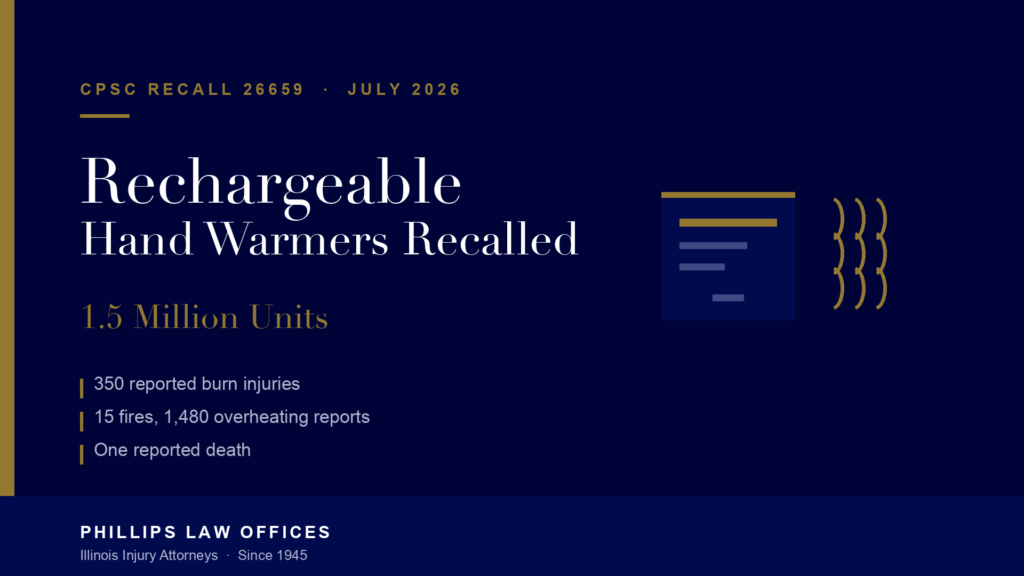
About 1.5 million OCOOPA rechargeable hand warmers were recalled on July 30, 2026 after the company received 1,480 reports of the devices overheating — resulting in 15 fires, 350 burn injuries, and one reported death. With Chicago heading into another winter, these are exactly the devices that go into coat pockets, gloves and work jackets from October onward.
If you or a family member was burned by a hand warmer, power bank or other lithium-ion device, call Phillips Law Offices at (312) 346-4262 for a free, confidential consultation.
What Was Recalled
According to CPSC recall 26659, the recall covers OCOOPA-branded rechargeable lithium-ion hand warmers in models UT3053, UT3056, ZLS-118, ZLS-118S, ZLS-118D, H01 and H01(PD). They were sold in packs of two magnetically joining warmers with a USB-C charging cable, in varying colors and designs, with LED indicator lights on a hard plastic shell and a silicone lanyard.
The CPSC notice states they were sold online at Amazon.com, Ocoopa.com, Ocoopa.net and Walmart.com from September 2018 through May 2026, for between $15 and $60. The model number and a three-digit batch number are printed on the underside of each warmer.
| Detail | Figure |
|---|---|
| Units recalled | About 1,500,000 |
| Overheating reports | 1,480 |
| Fires | 15 |
| Burn injuries | 350 |
| Deaths | One — an 83-year-old consumer in San Diego, February 2026 |
| Sold | September 2018 – May 2026 |
The hazard, in the CPSC’s own words: “The lithium-ion battery in the recalled hand warmers can overheat and ignite, posing a risk of serious injury or death from fire and burn hazards.”
Three figures deserve emphasis. An eight-year sales window means a very large number of these are still in drawers and coat pockets. A death was reported. And 350 burn injuries from a single consumer product is an unusually high number — for context, most consumer product recalls are announced with no reported injuries at all.
Why Lithium-Ion Burns Are Different
A lithium-ion cell that fails can enter thermal runaway: the cell heats, which accelerates the reaction inside it, which produces more heat. Once it starts, it does not stop when you remove the charger, and it can reignite after appearing to go out. That is why the CPSC’s own disposal instructions for this recall are unusually strict.
The notice tells consumers not to put the device in the trash, in curbside recycling, or in the used-battery boxes found at retail and home improvement stores, and to contact a municipal household hazardous waste center first to ask whether it accepts defective lithium-ion batteries. If a government agency is telling you a product is too dangerous for a normal battery recycling bin, that tells you something about the energy involved.
In practice this matters because the device is usually in direct, prolonged contact with skin, or inside a pocket or glove, when it fails. Contact burns in that situation tend to be deep, and often occur on the hands, thighs or abdomen.
This Is Not One Product — It Is a Category
Rechargeable hand warmers sit in the same hazard family as power banks, e-bike and scooter batteries, portable chargers and battery-powered tools, and the CPSC has been recalling these products steadily. In the twelve months to September 2026, the agency announced dozens of lithium-ion recalls, including power banks, magnetic chargers, cordless yard tools, security cameras, and home battery systems.
The agency has also moved from case-by-case recalls toward a rule: in June 2026 the CPSC published a proposed safety standard for lithium-ion batteries in micromobility products. In supporting that proposal, the CPSC pointed to 227 incidents between 2019 and 2023, of which 90 were associated with 39 deaths and 181 injuries.
Illinois Law and a Lithium-Ion Burn Claim
Illinois recognizes strict product liability: a manufacturer or seller can be liable for a product sold in a defective and unreasonably dangerous condition, without the injured person having to prove the company was careless. A claim can be based on a manufacturing defect, a design defect, or a failure to warn.
A recall does not by itself establish liability. What it provides is evidence: the manufacturer’s own description of the hazard, its own count of prior incidents, and the date it learned of them. In a case involving a product with an eight-year sales history and 1,480 reported incidents, when the company knew what it knew is often the central question.
If the burn happened at work — and hand warmers are common on construction sites, loading docks, rail yards and outdoor maintenance crews through a Chicago winter — there may be two claims running in parallel. Illinois workers’ compensation covers medical treatment and part of lost wages regardless of fault, but it does not pay for pain and suffering or full lost earnings. A separate product liability claim against the manufacturer or seller is not barred by the workers’ compensation system, because that company is not your employer. Our Chicago burn injury lawyers handle both tracks together.
One practical caution worth stating plainly. The CPSC lists the importer as Shenzhen Street Cat Technology Co., Ltd., doing business as OCOOPA Direct, of China. Where a product’s importer is based overseas, collecting on a judgment can be considerably harder than it is against a US company, and part of any early case evaluation is identifying every party in the distribution chain — including US retailers and sellers — who may share responsibility under Illinois law.
If You Were Burned: What to Do Now
- Get medical care and keep every record. Burn depth is frequently worse than it first appears, and documentation from the first days is the backbone of any claim.
- Do not send the device back yet. The recall asks consumers to mark the warmer “RECALLED,” photograph it and dispose of it. That is sensible for an uninjured owner — but if someone was hurt, the device is the single most important piece of evidence. Speak to a lawyer before disposing of it.
- Photograph everything before it changes. The device, the model and three-digit batch number on the underside, the charging cable, the clothing or bedding involved, and the burn itself as it heals.
- Keep the purchase record. An Amazon or Walmart order history establishes the model, seller and date of purchase.
- Report the incident to the CPSC at SaferProducts.gov. It helps the agency, and it creates a dated record.
- Note the deadline. Illinois generally allows two years to file a personal injury lawsuit (735 ILCS 5/13-202). Product cases are also subject to a statute of repose, so do not assume you have time.
Frequently Asked Questions
I threw the hand warmer away. Do I still have a case?
Possibly. Losing the product makes a case harder, not automatically impossible. Purchase records, photographs, medical records documenting a contact burn, the fire department or incident report if one exists, and the manufacturer’s own recall admissions can all be used. Have the facts reviewed before assuming the claim is gone.
Does taking the refund give up my right to sue?
A recall refund is normally a consumer remedy for the price of the product, not a settlement of an injury claim. But you should read anything you are asked to sign, and if you were injured, have a lawyer review it before you accept a refund or sign a release.
Can I sue if I was burned before the recall was announced?
Yes, potentially. Liability depends on whether the product was defective when it was sold, not on whether a recall had been announced. The CPSC notice indicates the company received reports over a period of years, and injuries that predate a recall are common in these cases. Illinois deadlines still apply, so timing matters.
What if my child or an elderly parent was burned?
Illinois generally tolls the limitations period for minors until they turn 18, and claims involving older adults may raise additional issues if the person was in a care setting. The reported death in this recall involved an 83-year-old consumer, and reduced skin sensitivity and slower reaction time can make contact burns more severe for older adults.
How do I safely get rid of a recalled hand warmer that was not involved in an injury?
Follow the CPSC instructions: stop using it, contact OCOOPA Direct for a refund, and do not put it in the trash, curbside recycling, or a store battery-collection box. Contact your municipal household hazardous waste collection center first and ask whether it accepts defective lithium-ion batteries.
Talk to an Illinois Burn Injury and Product Liability Lawyer
Phillips Law Offices has represented injured people across Illinois since 1945 and has recovered more than $500 million in verdicts and settlements. If a lithium-ion device caused a burn, a fire or a death, we can review the product, the recall record and every party in the chain that put it in your hands.
Call (312) 346-4262 for a free, confidential consultation. There is no fee unless we recover compensation for you, and we advance case costs. Read more about burn injury claims across Illinois or about defective product claims.
This article is for general information and is not legal advice. It describes a recall announced by the U.S. Consumer Product Safety Commission and does not assert that any product caused a particular injury. Every case depends on its own facts.