
Discovery is the phase of a Chicago personal injury case where both sides formally exchange evidence and take testimony before trial, and it’s often the single longest and most document-heavy part of the entire litigation process. In Illinois, it’s governed by Illinois Supreme Court Rule 201 and includes written interrogatories, document requests, depositions, independent medical examinations, expert witness disclosure, and requests to admit, each with its own specific rule and limits.
Rule 201: The General Discovery Framework
Illinois Supreme Court Rule 201 is the starting point for discovery in every civil case, including car accident claims. It authorizes the tools described below and sets the overall framework for how evidence gets exchanged between the parties. Before either side can ask a judge to compel discovery that the other side is withholding, Rule 201(k) requires the attorneys to personally consult and make a genuine, good-faith attempt to resolve the dispute themselves first.
Written Interrogatories (Rule 213)
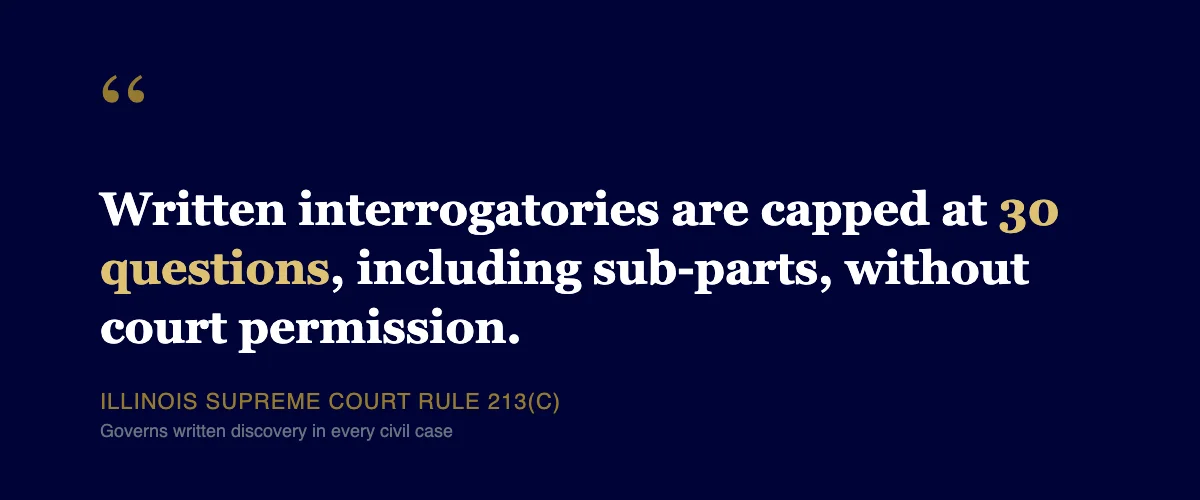
Interrogatories are written questions one side sends the other, which must be answered in writing and under oath. Illinois Supreme Court Rule 213(c) caps the number at 30 questions, including sub-parts, unless the court grants permission for more. Under Rule 213(d), these answers carry real weight, they can be used at trial the same way a deposition transcript can.
Document Production (Rule 214)
Rule 214 covers requests to produce documents and other objects, medical records, repair estimates, insurance correspondence, photos, and more. When documents are produced in response, Illinois Supreme Court Rule 214 requires the producing party to either organize them as they’re normally kept in the ordinary course of business, or label them to match the categories in the request, so the other side isn’t left sorting through a disorganized stack.
Depositions (Rule 206)
A deposition is sworn testimony given outside the courtroom, typically at an attorney’s office with a court reporter present, governed by Illinois Supreme Court Rule 206. Depositions let each side question witnesses, including the other driver, directly and under oath, well before trial. What’s said in a deposition can be used later to support or challenge trial testimony.
Independent Medical Examinations (Rule 215)
If your physical condition is at issue in the case, which it almost always is in a car accident injury claim, Illinois Supreme Court Rule 215 lets the defense request that you undergo an examination by a doctor of their choosing. This is a formal discovery tool, not an informal request: it requires reasonable notice, and the requesting party pays both the examination fee and your reasonable expenses for attending. The examining doctor’s report must be shared with both sides’ attorneys within 21 days of the exam; miss that deadline, and the report and the examiner’s testimony generally can’t be used at trial except at the examined party’s own request. Because this exam is conducted by a doctor the defense selected, not your own treating physician, it’s standard to prepare for it with your attorney beforehand, including understanding what the exam will and won’t cover.
Expert Witness Disclosure (Rule 213(f))
Illinois Supreme Court Rule 213(f) governs when and how expert witnesses have to be disclosed, and it splits experts into three categories with different disclosure requirements:
- Lay or opinion witnesses (213(f)(1)), fact witnesses who may also offer some opinion testimony based on their own perception, with relatively light disclosure requirements.
- Independent expert witnesses (213(f)(2)), typically a treating doctor who wasn’t retained specifically for litigation. Only the subject matter and the general opinions have to be disclosed, not the full basis for them.
- Controlled (retained) expert witnesses (213(f)(3)), an expert specifically hired for the case, such as an accident reconstructionist, an economist calculating lost future earnings, or a life-care planner. This category requires the most disclosure: identity, subject matter, every opinion, the complete basis and reasons for each opinion, and the expert’s qualifications.
Courts take this rule seriously, and an incomplete or late disclosure can result in that expert being barred from testifying at all, which can significantly weaken a party’s ability to prove damages or causation at trial. The purpose, as Illinois courts have described it, is to prevent surprise and discourage tactical gamesmanship between the parties.
Electronic Discovery: Texts, Social Media, and Phone Records
Discovery today regularly extends well beyond paper documents. Text messages, emails, and social media posts can all become discoverable if they’re relevant to the claim, for example, posts or photos that relate to your claimed injuries and limitations, or phone records that could show the other driver was using a device at the time of the crash. Public social media content is fair game regardless of a formal request, since anyone, including an insurance adjuster, can view it directly. Private content is more protected but can still become discoverable through a formal request if it’s reasonably likely to contain relevant evidence, which is one more reason to be cautious about what gets posted after a crash.
Typical Discovery Requests in a Car Accident Case
While every case is different, a few categories of requests show up in nearly every Illinois car accident lawsuit. Plaintiffs are commonly asked to produce: complete medical records and billing from every provider related to the injury, employment and wage records to support a lost-income claim, prior medical records if pre-existing conditions are relevant, and any photos, videos, or social media posts related to the crash or the injury. Defendants are commonly asked to produce: their own account of how the crash happened, any insurance policy information, prior driving record or citation history relevant to the crash, and any internal claim notes or investigation materials, though some of this can be contested as privileged. Interrogatories on both sides typically cover basic facts, who was driving, what the weather and road conditions were, what each party claims caused the crash, and the extent of injuries or damages claimed.
Requests to Admit
Either side can send the other a list of specific facts and ask them to admit or deny each one. This narrows what’s actually disputed going into trial, so both sides, and the court, aren’t spending time on facts nobody actually contests.
Protecting Your Privacy During Discovery
Discovery is broad, but it isn’t unlimited. Requests still have to be relevant to the claims and defenses in the case, and an attorney can object to requests that are overly broad, invasive, or seek information that has nothing to do with the crash or your injuries. If the other side requests something like your complete medical history going back decades, or broad access to your social media accounts, your attorney can push back and, if necessary, ask the court to narrow the request. This is part of why having legal representation during discovery matters, an unrepresented party is far more likely to hand over more than the rules actually require, simply because they don’t know what a proper objection looks like.
What Happens If the Other Side Won’t Cooperate
Discovery doesn’t always go smoothly. If the other side is slow to respond, gives incomplete answers, or withholds documents without a valid objection, Rule 201(k) requires a genuine attempt to resolve it directly first, attorneys talking to each other, not immediately running to the judge. If that fails, the requesting party can file a motion to compel with the court. A judge who grants that motion can order the missing discovery produced on a deadline, and in more serious cases of noncompliance, can impose sanctions, ranging from paying the other side’s costs for bringing the motion to, in extreme cases, barring certain evidence or testimony at trial. This is part of why having an attorney manage the discovery process matters, enforcing these rules effectively often determines how complete the evidentiary record is by the time a case settles or goes to trial.
What If You Realize an Answer Was Wrong or Incomplete?
Discovery responses aren’t locked in stone the moment they’re sent. If you realize after the fact that an interrogatory answer was incomplete, or a new medical issue developed after your initial response, Illinois procedure generally allows supplementing or amending discovery responses as new information becomes available. What matters is doing it promptly and transparently rather than letting an inaccurate or outdated answer sit uncorrected until it’s used against you in a deposition or at trial. Your attorney can advise on the right way to supplement a response if this comes up.
Discovery’s Role in Settlement Negotiations
Discovery isn’t just procedural box-checking before a possible trial, it’s usually what actually drives a case toward settlement. Once both sides have exchanged medical records, taken depositions, and disclosed expert opinions, there’s a much clearer, evidence-based picture of what a case is actually worth and how a jury might view it. This is why serious settlement offers often don’t materialize until discovery is substantially complete; before that point, both sides are negotiating with incomplete information, and neither has much incentive to move off an initial position.
How Long Does Discovery Take?
There’s no single official, fixed timeline for discovery in an Illinois personal injury case, it’s managed case by case based on complexity and the court’s own schedule. The exception is Cook County’s mandatory arbitration track for Law Division cases under $50,000 with no retained expert, where discovery runs on a defined 120-day standard or 60-day expedited schedule. See our guide on what happens after you file a car accident claim in Illinois for how discovery fits into the rest of the case timeline.
Everything exchanged in discovery traces back to what was actually collected after the crash, which is exactly why the earliest evidence-gathering steps matter so much later in the case. Our guide on evidence you need after a car crash covers what to gather before a case ever reaches this stage.
Why Discovery Matters Even If Your Case Never Reaches Trial
Most car accident lawsuits settle before trial, which can make discovery feel like wasted effort if the case never goes in front of a jury. In practice, it’s the opposite: the strength of the discovery record is usually what determines whether a settlement offer is fair. A well-documented case, complete medical records, a strong deposition, clear expert disclosures, gives your attorney real leverage in negotiations, because the insurer can see exactly what a jury would see if the case did go to trial, and a thin or poorly documented discovery record tends to produce a correspondingly thin settlement offer.
Frequently Asked Questions
What is discovery in an Illinois personal injury case?
Discovery is the pre-trial phase where both sides exchange evidence and take testimony under Illinois Supreme Court Rule 201. It includes written interrogatories, requests for documents, depositions, and requests to admit.
How many interrogatories can each side ask in an Illinois case?
Illinois Supreme Court Rule 213(c) caps written interrogatories at 30 questions, including sub-parts, unless the court allows more.
What is a deposition?
A deposition is sworn testimony given outside the courtroom, typically at an attorney’s office with a court reporter present, governed in Illinois by Supreme Court Rule 206. It can be used later at trial.
Do attorneys have to try to resolve discovery disputes before going to a judge?
Yes. Illinois Supreme Court Rule 201(k) requires attorneys to personally consult and make a good-faith attempt to resolve a discovery dispute before filing a motion to compel with the court.
Can the defense make me get a medical exam during discovery?
Yes. Illinois Supreme Court Rule 215 allows the defense to request an independent medical examination by a doctor of their choosing, though the requesting party pays the exam fee and your reasonable compliance expenses.
Will the other side see my social media during discovery?
Potentially, if it’s relevant to your claimed injuries. Public posts are fair game regardless, and even private content can sometimes be requested if it’s likely to contain relevant evidence.
Also Read:
What Happens After You File a Car Accident Claim in Illinois