
Tailgating crashes in Chicago are governed by Illinois’ “following too closely” statute, but that law alone doesn’t automatically decide who’s at fault, which surprises a lot of people who assume the rear driver is always to blame. Illinois doesn’t apply an automatic rear-driver-is-always-at-fault rule, and a following-too-closely citation only counts as evidence of negligence, not proof of it by itself.
The Illinois “Following Too Closely” Law
Illinois law, 625 ILCS 5/11-710, states that “the driver of a motor vehicle shall not follow another vehicle more closely than is reasonable and prudent, having due regard for the speed of such vehicles and the traffic upon and the condition of the highway.” There’s no fixed following distance written into the statute, what counts as “reasonable and prudent” depends on speed, weather, traffic density, and road conditions at the time.
The Physics Behind Following Distance
“Reasonable and prudent” isn’t an arbitrary standard, it reflects basic stopping-distance physics. The faster a vehicle travels, the more distance it needs to come to a complete stop, accounting for both reaction time and braking distance, and that distance increases sharply, not just proportionally, as speed goes up. Wet, icy, or snow-covered roads extend stopping distance further still. A following distance that’s perfectly safe at 25 mph in a parking lot can be dangerously inadequate at 55 mph on an expressway, which is exactly why the statute ties “reasonable” to speed and conditions rather than setting one fixed number of car lengths or seconds. Poor visibility, from heavy rain, fog, or nighttime driving, further reduces a driver’s effective reaction time and is another factor that can be weighed in whether a given following distance was actually reasonable under the circumstances.
A Citation Isn’t Automatic Proof of Fault
A common misconception is that a traffic citation automatically proves negligence in a civil case. Illinois does not apply the doctrine of negligence per se to traffic violations. Instead, a following-too-closely citation is treated as prima facie evidence of negligence, meaning it supports a finding of negligence but can still be explained or rebutted with other evidence. The citation matters, but it isn’t the whole case on its own.
No Automatic Fault for the Rear Driver
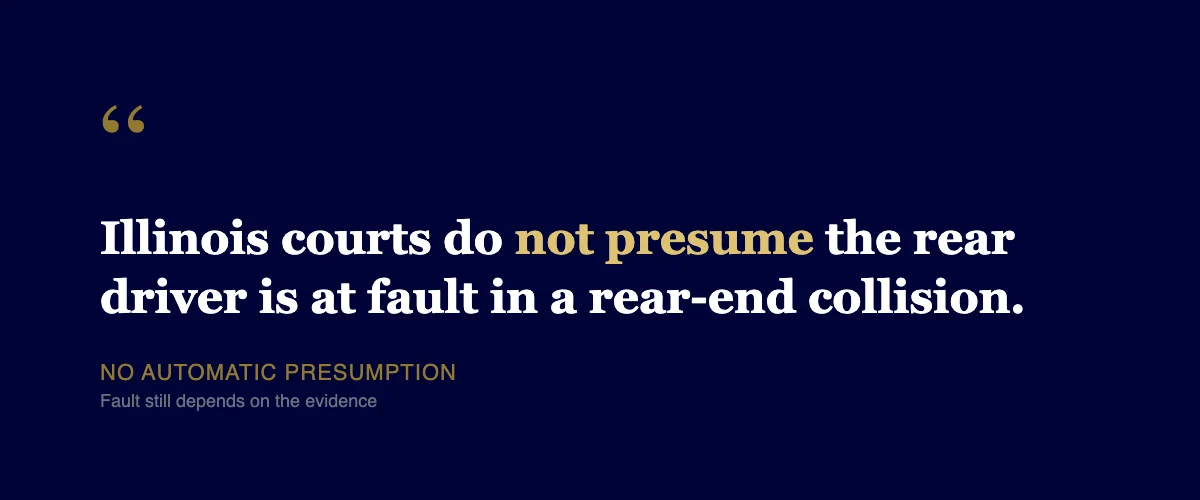
Unlike some states, Illinois courts have not recognized an automatic presumption that the rear driver in a rear-end collision is at fault. Whether either driver acted reasonably is a question of fact, decided based on the specific circumstances of the crash, not a blanket rule applied to every rear-end accident.
When the Lead Driver Shares Fault
Because there’s no automatic presumption, the lead driver’s own conduct can come into play. Sudden unsafe braking without cause, a last-second lane change, driving with non-functioning brake lights, or other actions by the driver in front can all be factored into the fault analysis. Under Illinois’ comparative negligence rule, 735 ILCS 5/2-1116, this directly affects how much either driver can recover: if you’re found 51% or more at fault, you recover nothing, no matter which vehicle was struck.
Tailgating by Commercial Trucks
Tailgating crashes involving commercial trucks raise additional considerations. A fully loaded semi-truck requires dramatically more distance to stop than a passenger vehicle traveling the same speed, which means a following distance that might be adequate for a car can still be dangerously close for a truck. Commercial truck drivers are trained on and generally expected to follow industry safety standards that call for substantially longer following distances than passenger vehicles, on top of Illinois’ general following-too-closely statute that applies to every driver regardless of vehicle type. When a truck rear-ends a passenger vehicle, the size and weight disparity alone often results in much more severe injuries, which is part of why evidence of the truck’s following distance and speed, often available through the truck’s own electronic logging device, becomes especially important. Trucking companies are also generally required to maintain these records for a period of time after an incident, so requesting them promptly through an attorney, before they can be routinely purged, is an important early step in any commercial-vehicle tailgating claim.
Common Tailgating Scenarios on Chicago-Area Roads
Following-too-closely crashes show up in a few recurring patterns around Chicago. Stop-and-go traffic on the Dan Ryan, Kennedy, and Eisenhower expressways creates frequent sudden-braking situations where a tailgating driver has no room to react. Construction zones, common on these same expressways, compress lanes and force abrupt slowdowns. And multi-vehicle pileups, where one rear-end collision triggers a chain reaction, often raise fault questions for several drivers at once, each of whom may share some percentage of responsibility depending on their own following distance and reaction time.
Multi-Vehicle Pileups and Chain-Reaction Crashes
When a tailgating crash happens in heavy traffic, it often doesn’t stop at two vehicles. A rear-end collision can push the struck vehicle into the car ahead of it, and if a third or fourth driver was also following too closely, the chain reaction continues. Untangling fault in these cases requires reconstructing the sequence: who struck whom first, how much distance and time each driver had to react, and whether any single collision in the chain was severe enough to be considered a separate, intervening cause that complicates how damages are ultimately apportioned among everyone involved. This is exactly the kind of scenario where thorough evidence, photos of final resting positions, the full police report, and any available video, becomes critical, since multiple drivers may ultimately share different percentages of fault for different parts of the chain.
A Realistic Example: Fault in a Three-Car Chain Reaction
Consider three cars stopped in traffic on the Kennedy Expressway. Car A stops normally for traffic ahead. Car B, following too closely, doesn’t have enough room to stop and rear-ends Car A. Car C, following Car B too closely, then rear-ends Car B, pushing it further into Car A. In this scenario, Car B’s driver may be found partly at fault for the initial collision with Car A, but also partly a victim of Car C’s following-too-closely crash into them. Car C’s driver, meanwhile, may bear the most fault for failing to stop in time to avoid a car that was, itself, already stopped. Untangling exactly how much each driver contributed, and to which impact, usually requires the kind of detailed evidence and, in contested cases, reconstruction analysis described above, which is exactly why multi-vehicle pileups tend to produce more complicated and more disputed fault determinations than simple two-car rear-end crashes.
Evidence That Proves (or Disproves) Tailgating
Because a citation alone isn’t enough, the evidence you gather matters even more in a following-too-closely crash, and that evidence should ideally be gathered as close to the moment of the crash as possible, before skid marks fade, memories blur, and surveillance footage gets overwritten. The most useful evidence typically includes: photos of the vehicles’ final resting positions and the distance between them, skid mark length and direction (longer or absent skid marks can indicate following too closely to react in time), the pattern and severity of vehicle damage, witness accounts of how closely the vehicles were traveling before impact, and any dashcam or nearby surveillance footage. Our complete guide on evidence you need after a car crash covers exactly what to collect.
What to Do Immediately After a Tailgating or Rear-End Crash
The steps right after a following-too-closely crash matter more than in some other crash types, precisely because fault isn’t automatically assumed and the burden of proving what actually happened falls more heavily on the evidence. Beyond the general steps covered in our evidence guide, a few things are worth prioritizing: note the approximate distance between the vehicles before the crash if you can recall it, look for and photograph any skid marks before traffic or weather erases them, get the contact information of anyone who witnessed the vehicles’ positions before impact, and request the police report promptly since it will document the officer’s observations about vehicle positions and any citations issued.
How Insurance Companies Evaluate Tailgating Claims
Adjusters handling rear-end and tailgating claims often lean on a few recurring arguments to reduce a payout. A common one is pointing to relatively minor-looking vehicle damage to argue the impact, and therefore the injury, must have been minor, even though injury severity doesn’t always correlate neatly with visible damage, soft-tissue and whiplash-type injuries, in particular, are notorious for occurring in crashes that leave little visible mark on either vehicle. Another is arguing the lead driver stopped unexpectedly or unreasonably, shifting blame even without strong evidence for it. Because Illinois doesn’t give rear-end claimants an automatic presumption of the other driver’s fault, adjusters have more room to make these arguments than they would in a state that does apply such a presumption, which makes thorough documentation from the start that much more important. A third common tactic is offering a quick, modest settlement before an injury’s full extent is known, betting that the claimant will accept it simply to resolve things quickly rather than wait out a longer negotiation.
Working With an Attorney on a Disputed Tailgating Case
When fault is genuinely contested in a following-too-closely crash, an attorney’s role often includes obtaining and analyzing evidence the average person wouldn’t think to request, such as a commercial truck’s electronic logging device data, traffic camera footage from the Illinois Department of Transportation or the city, and, in serious or disputed cases, retaining an accident reconstruction expert to analyze skid marks, vehicle damage, and crush patterns to establish speed and following distance at the time of impact. This kind of reconstruction can be decisive in a case where the two drivers’ accounts of what happened directly conflict, turning what might otherwise be an unresolved dispute into a case supported by physical, scientifically grounded evidence.
Why Tailgating Claims Benefit From Legal Representation
Because Illinois places no automatic thumb on the scale for the rear driver, a tailgating claim is often more contested, and more fact-dependent, than people initially expect. An attorney who understands how adjusters typically argue these cases, and what evidence actually moves the needle on fault and damages, is often the difference between a lowball offer based on an unfavorable fault split and a result that accurately reflects what happened.
Frequently Asked Questions
Is tailgating illegal in Illinois?
Yes. Illinois law (625 ILCS 5/11-710) prohibits following another vehicle “more closely than is reasonable and prudent,” given the speed of the vehicles and road conditions. It’s commonly called the “following too closely” statute.
If I rear-end someone, am I automatically at fault in Illinois?
No. Unlike some states, Illinois does not apply an automatic legal presumption that the rear driver is at fault in a rear-end collision. Fault is still determined by the evidence and circumstances of the crash.
Does a following-too-closely ticket automatically prove negligence in a civil case?
Not automatically. Illinois does not apply negligence per se to traffic violations. A following-too-closely citation is treated as prima facie evidence of negligence, meaning it supports a negligence finding but can still be challenged or rebutted with other evidence.
Can the lead driver share fault in a tailgating crash?
Yes, in some circumstances. If the lead driver did something that contributed to the crash, such as brake-checking, a sudden unsafe lane change, or driving with broken brake lights, that conduct can be factored into Illinois’ comparative negligence analysis, reducing the rear driver’s share of fault.
Are commercial truck drivers held to a different standard for following distance?
While Illinois’ following-too-closely statute applies to all drivers, commercial truck drivers are also subject to federal safety regulations and industry training standards that generally call for significantly longer following distances than passenger vehicles, given a loaded truck’s much longer stopping distance.
What evidence is most useful in a tailgating crash claim?
Photos of skid marks and final vehicle positions, dashcam or surveillance footage, the police report, and witness statements are typically the most persuasive evidence for establishing following distance and what each driver was doing before impact.
Also Read: