
Head-on collisions are among the most severe crashes on the road, and liability usually comes down to one question: which driver left their lane. Because the injuries involved are so often catastrophic or fatal, these cases also tend to involve more complex insurance and damages questions than a typical fender-bender claim. National data from IIHS shows frontal impacts caused more passenger vehicle occupant deaths in 2024 than any other crash type, and in Illinois, the driver who crossed into oncoming traffic is generally the one found at fault, once the physical evidence establishes who that was.
Why Head-On Collisions Are So Severe
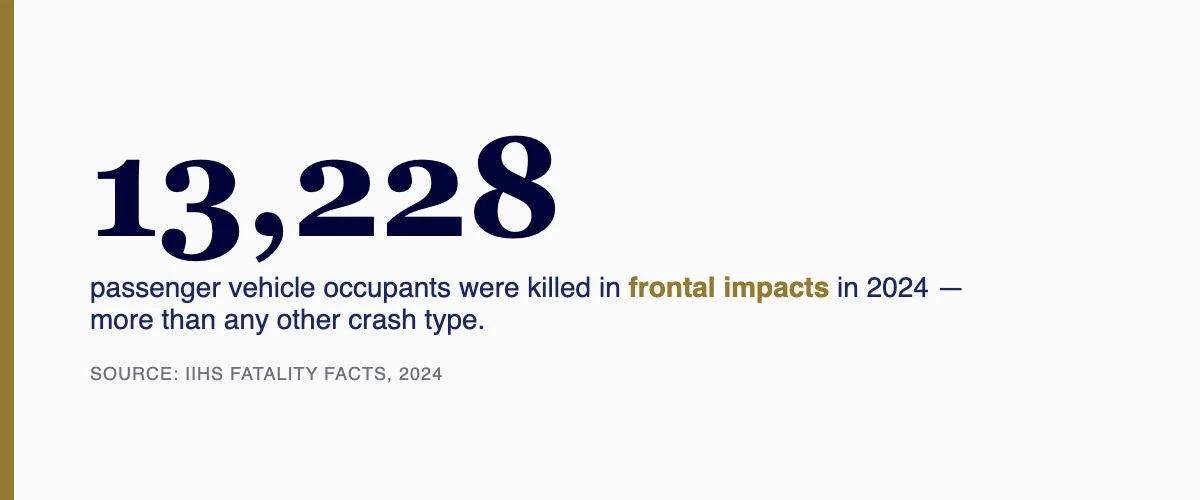
According to IIHS Fatality Facts for 2024, frontal impacts resulted in 13,228 passenger vehicle occupant deaths, more than any other impact type, and 45% of those killed were not wearing a seat belt. The combined closing speed of two vehicles traveling toward each other, rather than in the same direction, is what makes these crashes so much more dangerous than a typical rear-end or side-impact collision.
What Causes a Head-On Collision
A head-on crash happens when a vehicle crosses into oncoming traffic. Common causes include distracted driving, drowsy driving, alcohol or drug impairment, an unsafe attempt to pass another vehicle, and wrong-way driving. Illinois law, 625 ILCS 5/11-701, requires drivers to stay on the right half of the roadway except when passing, turning left, or avoiding an obstruction, crossing that line in violation of the statute is often central to how fault gets established. If wrong-way driving specifically is the cause, see our separate coverage of wrong-way crash deaths in Illinois.
Common Injuries From Head-On Collisions
Because the combined impact force is so much higher than in other crash types, head-on collisions tend to produce more severe injuries, which directly affects how a claim is valued. These commonly include traumatic brain injuries from the sudden deceleration, chest and rib injuries from seatbelt and airbag forces, lower extremity fractures from the dashboard and footwell intruding into the cabin, and spinal injuries. Severe cases often require surgery, extended rehabilitation, and ongoing care, which is why documentation of long-term and future medical needs matters as much as the initial emergency treatment. In the most catastrophic cases, injuries can result in permanent disability or disfigurement, which affects not just medical costs but future earning capacity and quality of life, both of which factor directly into how a claim is ultimately valued. Our guide on how much a car accident case is worth in Illinois covers how injury severity translates into case value.
How Fault Is Determined When Both Drivers Blame Each Other
Head-on collisions are notorious for each driver insisting the other crossed the center line. Because there are rarely independent witnesses positioned to see exactly where the crossing happened, the physical evidence usually decides the case: the vehicles’ final resting positions, skid marks and their direction, the location and pattern of the impact damage, and any video from a dashcam or nearby camera. Even small details, like which headlight or front corner sustained the primary impact on each vehicle, can help an expert determine the angle and direction each car was traveling at the moment of collision. Our guide on evidence you need after a car crash covers exactly what to collect, and why doing it quickly matters even more in a disputed head-on crash.
Head-On Collisions Involving Commercial Trucks
When a head-on collision involves a commercial truck, the severity gap widens even further due to the sheer weight difference between a loaded semi and a passenger vehicle. These cases often involve additional layers of potential liability beyond just the driver, including the trucking company, a leasing company, or a cargo loader, depending on what caused the truck to cross the center line, driver fatigue from excessive hours, inadequate maintenance, or improperly secured cargo shifting the truck’s balance can all point toward liability beyond the driver alone. They also frequently involve substantially higher insurance policy limits than a typical passenger-vehicle policy, since commercial carriers are required to carry higher minimum coverage, which can matter significantly in a case with catastrophic injuries or a fatality. Evidence preservation is also especially time-sensitive in commercial truck cases, since trucking companies routinely overwrite onboard data and dispatch records on a schedule, making prompt legal action important to secure that information before it’s gone.
Insurance Coverage and Underinsured Motorist Claims
Given how severe head-on collision injuries tend to be, insurance coverage limits become a central issue, often more so than in any other type of car accident claim. Illinois requires drivers to carry at least $25,000 per person and $50,000 per accident in liability coverage, along with $20,000 in property damage coverage. Illinois also requires uninsured motorist (UM) coverage at those same minimum limits, and underinsured motorist (UIM) coverage is generally required to be offered as well, covering the gap when the at-fault driver has insurance but not enough of it. In a serious head-on collision, it’s common for the at-fault driver’s liability limits to fall far short of the actual damages: medical bills, lost earning capacity, and pain and suffering for a catastrophic injury can easily run into hundreds of thousands of dollars or more, far beyond Illinois’ $25,000 per-person minimum. When that happens, your own UM/UIM coverage, or coverage from other potentially liable parties such as a trucking company, can become the main source of real compensation. Identifying every available layer of coverage, rather than stopping at the at-fault driver’s primary liability policy, is one of the most consequential steps an attorney takes in a catastrophic-injury head-on collision case.
Wrongful Death in Head-On Collisions
Given how often head-on collisions prove fatal, wrongful death claims are a significant part of this area of Illinois law. The Illinois Wrongful Death Act, 740 ILCS 180/1 et seq., allows a claim to be brought by the deceased’s personal representative on behalf of the surviving spouse and next of kin. Under 740 ILCS 180/2(e), this claim generally must be filed within two years of the date of death. Recoverable damages include pecuniary loss, the financial support and contributions the deceased would have provided, loss of the deceased’s companionship and guidance, and grief, sorrow, and mental suffering experienced by the surviving family. There is no statutory cap on these non-economic damages in an ordinary wrongful death case in Illinois. Because a wrongful death claim is brought on behalf of surviving family members rather than the deceased personally, it exists alongside, and is separate from, any survival action that might also be brought on behalf of the deceased’s estate for the pain and suffering they experienced between the crash and their death, which is why these cases often involve more than one type of claim running in parallel.
Why Fault Percentage Matters So Much Here
Illinois’ comparative negligence law, 735 ILCS 5/2-1116, bars recovery entirely if you’re found 51% or more at fault, no matter how catastrophic the injury. In a head-on collision, where the entire case often rests on which driver left their lane, that 51% line can be the difference between full compensation and nothing at all, which is exactly why the evidence gathered immediately after the crash carries so much weight.
What to Do Immediately After a Head-On Collision
If you’re able to safely do so, the same general evidence-gathering steps that apply to any crash matter even more here, given how often head-on collisions come down to a direct dispute over which driver crossed the line. Photograph both vehicles’ final positions before they’re moved, the roadway itself including any skid marks or debris, and the surrounding area, including lane markings, curves, or obstructions that might explain how the crash happened. If you’re seriously injured and unable to do this yourself, a passenger, witness, or family member who arrives at the scene can help, and your attorney can later request the official crash reconstruction, if one was done, along with any nearby traffic or business camera footage. Even in cases where injuries prevent any evidence-gathering at the scene at all, the police investigation itself, along with 911 call records and any first-responder observations, can still provide a usable starting point for reconstructing what happened.
Working With an Attorney on a Head-On Collision Claim
Given the severity of injuries and the frequent disputes over fault, head-on collision cases often benefit from early involvement of an accident reconstruction expert, someone who can analyze the physical evidence, the vehicles’ crush patterns, and the roadway itself to determine which vehicle crossed into the other’s lane and at what speed each was traveling. An attorney can also identify every available source of insurance coverage, which matters enormously here given how often damages exceed a single policy’s limits, and can coordinate with medical providers and life-care planners to fully document the long-term cost of catastrophic injuries, not just the immediate hospital bill, including future surgeries, long-term therapy, and modifications to a home or vehicle that a serious injury may require.
A Realistic Example of a Disputed Head-On Case
Consider two drivers on a two-lane rural highway outside Chicago who collide head-on at a curve. Driver A says Driver B drifted across the center line. Driver B says the opposite. Neither has a passenger, and it happened too fast for either to be certain. In a case like this, with no independent witness to settle the dispute, the physical evidence does the talking: the location of the debris field relative to the center line, the direction and angle of each vehicle’s skid marks, and the crush pattern on each vehicle (a driver’s-side-forward crush pattern on Driver A’s car, for instance, is consistent with Driver B’s vehicle having crossed into their lane). An accident reconstruction expert can often determine, within a reasonable degree of certainty, which vehicle left its lane, turning what looks like an unresolvable “he said, she said” into a case built on physical, defensible evidence that holds up against an insurer’s own competing theory of the crash.
Frequently Asked Questions
How severe are head-on collisions compared to other crash types?
Head-on (frontal) impacts are consistently among the most severe crash types. IIHS data for 2024 shows frontal impacts caused more passenger vehicle occupant fatalities, 13,228, than any other impact type, and 45% of those killed were not wearing a seat belt.
What usually causes head-on collisions?
Common causes include a driver crossing into oncoming traffic due to distraction, drowsy driving, impairment, improper passing, or driving the wrong way. Illinois law, 625 ILCS 5/11-701, requires drivers to stay on the right side of the roadway except when passing, turning left, or avoiding an obstruction.
How is fault determined in a head-on collision when both drivers blame each other?
Fault is established through physical evidence, final resting positions, skid marks, point of impact and vehicle damage patterns, witness accounts, and any available video. Because each driver often claims the other crossed the center line, this physical and testimonial evidence is usually decisive.
Does Illinois’ comparative negligence law apply to head-on collisions?
Yes. Under 735 ILCS 5/2-1116, if you’re found 51% or more at fault for a head-on collision, you cannot recover damages, which makes establishing exactly how the crash happened especially important in these cases.
What happens if a loved one dies in a head-on collision in Illinois?
The Illinois Wrongful Death Act (740 ILCS 180/1) allows the deceased’s personal representative to bring a claim on behalf of the surviving spouse and next of kin, generally within two years of the date of death, for losses including lost financial support, loss of companionship, and grief.
What if the at-fault driver’s insurance isn’t enough to cover a serious head-on collision injury?
Illinois requires drivers to carry uninsured motorist coverage at the same minimum limits as liability coverage, and underinsured motorist coverage is also generally required to be offered, which can provide additional compensation when the at-fault driver’s policy limits aren’t enough to cover serious injuries.
Also Read:
Wrong-Way Crash Deaths in Illinois