
There’s no Illinois law that names rubbernecking specifically, but a driver distracted by looking at something off the road, an accident scene, a police stop, construction, can still be held civilly liable for a crash they cause. The key legal hurdle isn’t proving the driver was distracted, it’s proving that distraction actually caused the collision.
What Rubbernecking Actually Is
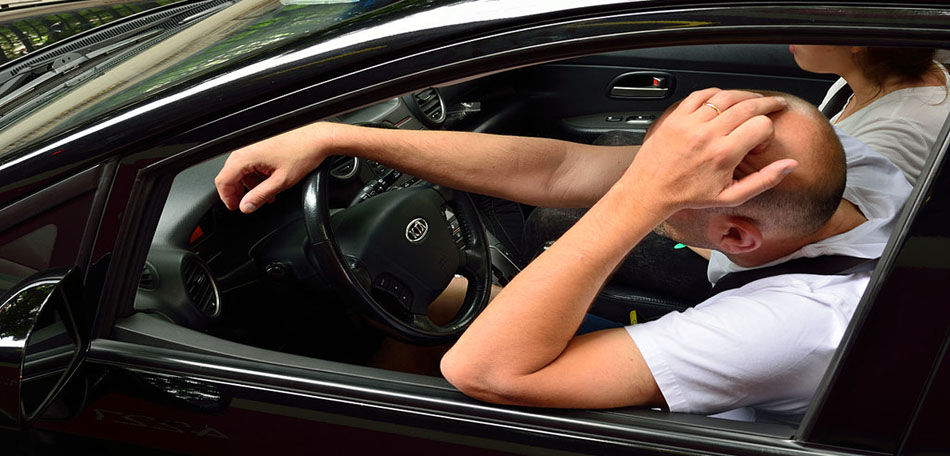
Rubbernecking is the common term for slowing down or turning your attention toward something happening off to the side of the road, most often another accident, a police stop, roadside construction, a disabled vehicle, or anything else unusual, while you’re still operating the vehicle at speed. It’s a form of visual distraction, the same broad category discussed in our guide on the types of distracted driving, and it causes a very specific, well-documented crash pattern: a chain of vehicles slows unexpectedly as each driver’s attention shifts toward the same distraction, and a following driver who doesn’t notice the slowdown in time rear-ends the vehicle ahead of them.
Why Chicago Expressways See This Pattern Constantly
Anyone who drives the Dan Ryan, the Kennedy, the Eisenhower, or I-290 regularly has experienced it: traffic slows to a crawl on one side of the highway because of an accident, a stalled car, or even just a fire truck on the shoulder, on the other side, where there’s no actual obstruction at all. Drivers slow down and look, sometimes braking hard enough to catch the driver behind them off guard. This is rubbernecking in its most common form, and it causes real secondary crashes, sometimes more serious than the original incident that drew everyone’s attention, since the secondary crash happens at higher speeds and often with less warning for the drivers involved.
Illinois’ Legal Standard: Two Kinds of Causation
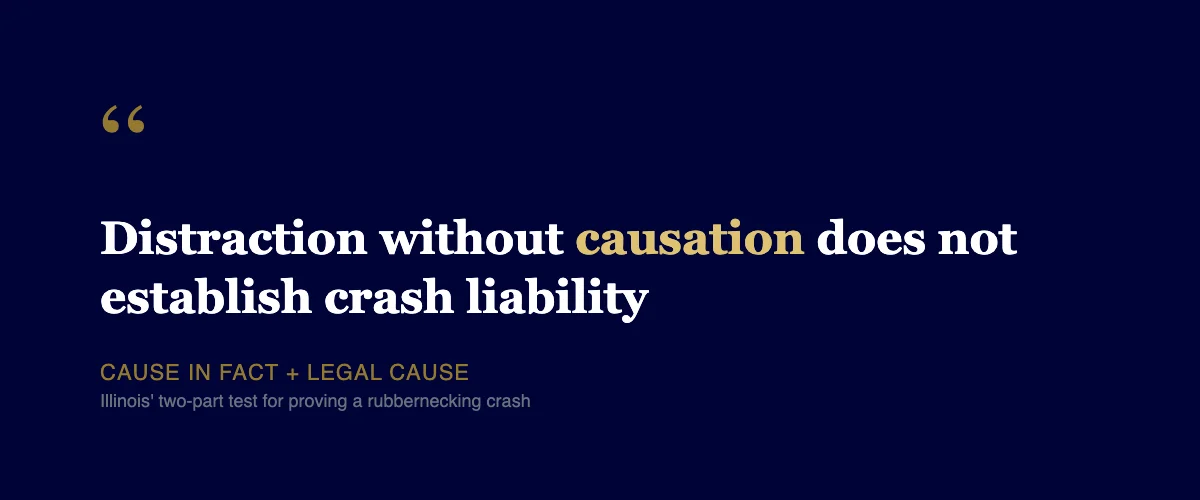
Proving a rubbernecking crash isn’t just about showing a driver was distracted, Illinois law requires two distinct kinds of causation to be established. Cause in fact means the driver’s distraction actually contributed to the collision, not just that they happened to be distracted at some point. Legal cause means the collision was a reasonably foreseeable result of that distraction, that a driver looking away from the road while traveling at speed could reasonably be expected to cause exactly this kind of crash. Distraction without causation doesn’t establish liability; a driver who was looking at an accident scene but still maintained a safe following distance and reacted appropriately isn’t automatically liable just because they were briefly distracted, since no actual harm resulted from that momentary lapse.
How Rubbernecking Crashes Typically Get Proven
A few sources of evidence tend to matter most. Witness statements, from passengers, other drivers, or bystanders, describing what the at-fault driver was looking at and for how long. The police report, which often notes the presence of a nearby incident, construction zone, or other roadside distraction as contributing context, even without using the word “rubbernecking.” Dashcam footage, either from your own vehicle or a nearby one, can be some of the most direct evidence available, showing exactly where the other driver’s attention was and how late they reacted. And the physical pattern of the crash itself, a rear-end collision with no apparent reason for sudden braking, where the explanation turns out to be an unrelated incident on the opposite side of the road, or just ahead.
Multi-Vehicle Pileups and Shared Fault
Rubbernecking rarely causes just one crash. Because the behavior spreads, driver after driver slowing to look, a single distraction event often triggers a chain-reaction pileup involving three, four, or more vehicles. In these cases, fault is typically apportioned among each driver individually based on their own contribution: the original rubbernecker who braked without cause, a following driver who was also distracted or following too closely, and so on. Illinois’ modified comparative negligence rule, 735 ILCS 5/2-1116, allows a victim to recover damages as long as they’re 50% or less at fault, reduced by their own percentage of fault, which matters in multi-car pileups where more than one party often shares some responsibility.
Is Rubbernecking “Rear-End Driver Automatically at Fault”?
Not necessarily, and this is a common misconception worth clearing up. While there’s a general tendency to assume the rear driver in a rear-end collision is at fault for following too closely, Illinois courts don’t apply an automatic presumption of fault to the rear driver, the specific facts of following distance, reaction time, and what caused the lead vehicle to brake all factor into the analysis. Our guide on liability for tailgating crashes covers this following-distance analysis in more depth, since it applies directly to the rear vehicle’s conduct in a rubbernecking-triggered rear-end crash.
What to Do If You’re Involved in a Rubbernecking Crash
Handle it like any other crash investigation, with particular attention to the broader context. Call the police and get an official report, photograph the scene including anything visible that might explain why traffic slowed (an accident on the opposite side, emergency vehicles, construction), and get contact information from any witnesses who saw what the other driver was looking at. If you have a dashcam, preserve the footage immediately, since many systems only retain a limited window before overwriting it, sometimes just a day or two depending on the device. Our guide on evidence you need after a car crash covers the broader fundamentals that apply here as well, from medical documentation to insurance communications.
Scott’s Law Complicates the Picture
There’s a real legal tension worth understanding: Illinois’ Scott’s Law, 625 ILCS 5/11-907(c), actually requires drivers to slow down and move over when approaching a stationary emergency vehicle with its lights activated, and as of a 2026 update, this now applies whether the emergency vehicle is stationary or moving. Penalties for violating Scott’s Law are serious, fines from $250 to $10,000, a Class A misdemeanor if the violation causes vehicle damage, and a Class 4 felony with license suspension or revocation if it causes injury or death. So some slowing near an emergency scene isn’t just permitted, it’s legally required, and a driver can’t be faulted simply for complying with Scott’s Law itself. The distinction that matters for a rubbernecking claim is between the slowing and caution Scott’s Law actually requires and the excessive, distracted gawking that goes beyond safe compliance and causes a driver to fail to notice the vehicle ahead stopping. A driver who slows appropriately and maintains a safe following distance is complying with the law; a driver who slows far more than necessary while staring at the scene, to the point of missing the vehicle ahead braking, has crossed into the kind of distraction a rubbernecking claim targets, well beyond what Scott’s Law itself ever asked of them.
A Worked Example
Picture a three-car chain on an expressway where a tow truck is parked on the shoulder with flashing lights, unrelated to any of the three vehicles. The lead car slows appropriately to comply with Scott’s Law. The second car, however, slows far more than necessary while turning to look at the tow truck and the vehicle it’s attending to, and doesn’t notice the lead car has stopped until it’s too late, rear-ending it. A third car, following too closely behind the second, then rear-ends that vehicle as well. Here, the second driver likely bears primary fault for the first collision, excessive, distracted slowing well beyond what Scott’s Law required, while the third driver’s own following distance becomes the central question in the second collision, potentially apportioning some fault to them as well under Illinois’ comparative negligence framework. Each collision in the chain is, in effect, its own smaller case nested inside the larger pileup.
Insurance Company Tactics in Rubbernecking Claims
Insurers handling a rubbernecking-caused claim often focus heavily on the causation gap: arguing that even if the at-fault driver was looking at something, the victim can’t prove that specific distraction, rather than ordinary traffic conditions or the victim’s own following distance, actually caused the crash. This is why contemporaneous evidence, dashcam footage, witness statements taken soon after the crash, and the police report’s documentation of conditions at the scene, carries so much weight in these particular cases, more so than in a typical two-car rear-end collision with no outside distraction involved. A claim built only on “the other driver must have been distracted by the accident everyone could see” without more specific evidence is vulnerable to exactly this kind of causation challenge, and insurers are well aware that juries can be skeptical of inferred distraction without something concrete tying it to the crash itself.
Frequently Asked Questions
Is rubbernecking illegal in Illinois?
There’s no Illinois statute that names rubbernecking specifically. But because it’s a form of visual distraction, a driver who causes a crash while rubbernecking can still be held civilly liable under Illinois’ general negligence and distracted driving framework.
Can I sue a driver who caused a crash by rubbernecking?
Yes, if you can show the driver’s distraction actually caused the crash. Illinois requires two things: cause in fact, meaning the distraction actually contributed to the collision, and legal cause, meaning the collision was a reasonably foreseeable result of looking away from the road. Distraction alone, without proof it caused the crash, isn’t enough.
Who is liable in a multi-car pileup caused by rubbernecking?
Fault is typically apportioned among each driver based on their own contribution to the chain-reaction crash under Illinois’ comparative negligence rule. More than one driver, the original rubbernecker and any following drivers who also failed to maintain a safe distance of their own, can share liability for the same pileup.
How do you prove a driver was rubbernecking?
Through witness statements describing the driver looking away from the road, the police report, dashcam or traffic camera footage if available, and the physical evidence of the crash itself, such as a rear-end collision with no apparent reason for the lead driver to have braked suddenly except for an unrelated incident nearby.
What should I do if I’m involved in a rubbernecking-caused crash?
Treat it like any other crash: call the police, document the scene with photos, get witness contact information, and seek medical attention. If the crash happened near an existing accident scene or highway incident, note that context, since it’s often central to establishing what caused the driver’s distraction.
Why Rubbernecking Is a Documented Traffic Engineering Problem
Traffic engineers have long recognized rubbernecking as a measurable cause of what’s called “non-recurring congestion,” slowdowns that aren’t caused by the roadway’s normal capacity but by drivers reacting to something off to the side of it. Studies of highway incidents consistently find that the opposite-direction lanes, where there’s no physical obstruction at all, often experience nearly as much delay as the side where the actual incident occurred, purely from drivers slowing to look at wreckage, flashing lights, or emergency responders working the scene. This pattern is well-documented enough that it factors into how transportation agencies plan incident response, clearing a crash quickly isn’t just about the lanes directly affected, it’s also about restoring normal traffic flow on the unaffected side before rubbernecking-induced slowdowns cause a second, entirely separate set of crashes with their own injured drivers and their own fault questions.
Rubbernecking Isn’t Limited to Crash Scenes
While traffic accidents are the most common trigger, the same distraction pattern applies to anything unusual along the roadway: a traffic stop, roadside construction, an unusual billboard or building, even wildlife near the shoulder. The legal analysis doesn’t change based on what the driver was looking at, the same two-part causation test, cause in fact and legal cause, applies regardless of whether the distraction was another accident, a police activity, roadwork, or something else entirely. What matters is whether that specific distraction caused the driver to fail in their ordinary duty to maintain a safe following distance and react appropriately to traffic ahead, a duty that exists regardless of what, exactly, pulled the driver’s attention away from the road in front of them.