
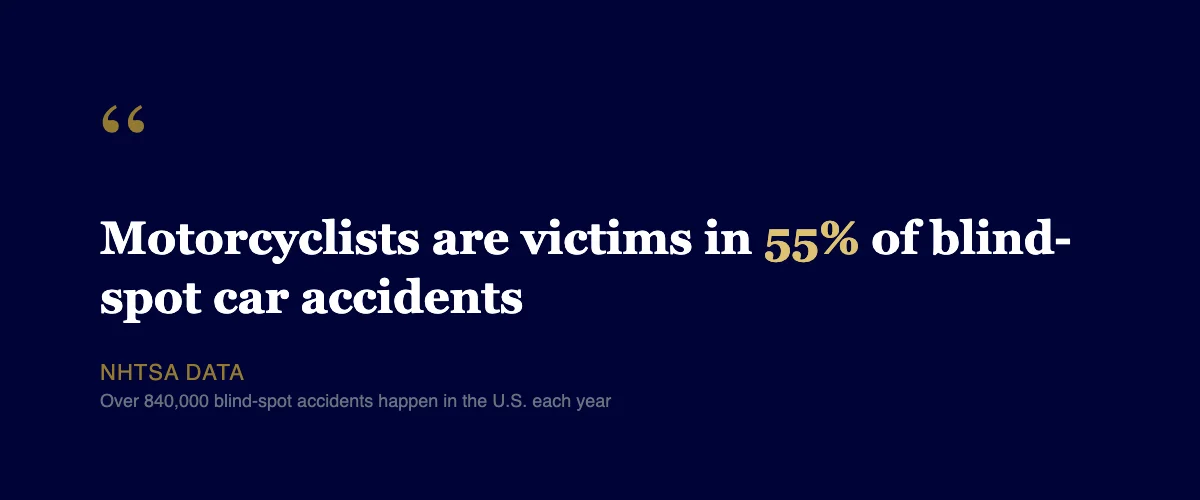
Motorcyclists are the victims in 55% of blind spot car accidents nationally, according to NHTSA data, even though motorcycles make up a small fraction of vehicles on the road. In Illinois, 3,361 motorcycle crashes in 2024 left 144 riders dead and 2,556 injured, and a driver’s failure to check a blind spot before changing lanes is one of the most common, and often one of the most legally straightforward, causes of these collisions.
Why Motorcycles Disappear Into Blind Spots
Every vehicle has blind spots, the areas just behind and to the side that aren’t visible in the mirrors or direct line of sight. For a car, SUV, or truck, another vehicle in that blind spot is usually still large enough to be noticed with a quick glance. A motorcycle’s much narrower profile makes it far easier to miss entirely, especially at highway speeds where a driver’s attention is split between multiple mirrors, the traffic ahead, and the specific maneuver they’re about to make. NHTSA estimates that over 840,000 blind spot accidents happen each year in the United States, and motorcyclists bear a disproportionate share of the resulting harm specifically because they’re so much easier to overlook.
Illinois’ Legal Standard: Reasonable Care Includes Looking
Illinois law requires every driver to exercise reasonable care in operating their vehicle, and that standard specifically includes an obligation to see what there is to be seen before taking an action like a lane change. A driver who changes lanes without adequately checking their mirrors and blind spot, and strikes a motorcycle that was there to be seen, has generally failed that duty. The size of the motorcycle, or the inherent difficulty of blind spots, doesn’t excuse the driver’s responsibility to look properly before merging; if anything, it raises the bar for how carefully a driver should check before changing lanes on any road where motorcycles regularly travel.
Illinois Motorcycle Crash Statistics
According to IDOT, Illinois recorded 3,361 motorcycle crashes in 2024, including 142 fatal crashes. A total of 144 motorcyclists were killed and 2,556 were injured in motorcycle crashes statewide that year. These numbers reflect the much higher severity motorcyclists face in any collision, lacking the structural protection a car’s frame and airbags provide, even a relatively minor car-versus-car incident can become a serious or fatal injury once a motorcycle is involved instead.
How Insurers Try to Shift Blame
Because motorcycle injuries tend to be severe, and because riders face some persistent cultural bias around perceived risk-taking, insurers handling these claims frequently look for ways to shift some fault onto the rider rather than focus solely on the driver’s failure to check their blind spot. Two tactics come up repeatedly, and both deserve a direct response.
The Helmet Argument Doesn’t Work in Illinois
Illinois has no universal helmet law for adult riders, and an insurer sometimes still tries to argue that a rider who wasn’t wearing a helmet contributed to their own injuries. Illinois courts have rejected this argument directly: evidence that a motorcyclist wasn’t wearing a helmet is generally inadmissible to establish comparative negligence, whether on the question of liability or the amount of damages. A driver who caused a crash by failing to check their blind spot can’t reduce their own liability by pointing to a rider’s legal choice not to wear a helmet.
Lane Splitting Is a Real, Separate Issue
Unlike the helmet question, lane splitting, riding between lanes of stopped or slow-moving traffic, is a genuine legal vulnerability if it applies to your case. It’s illegal in Illinois under 625 ILCS 5/11-703, and if you were lane splitting when a blind spot crash occurred, that traffic violation is real evidence of negligence an insurer can use to argue for a reduced recovery under Illinois’ modified comparative negligence rule, 735 ILCS 5/2-1116. It’s important to understand this doesn’t bar your claim outright, you can still recover if you’re found 50% or less at fault, and a driver’s own failure to check a blind spot remains independently negligent regardless of what the rider was doing, but it is a factor that genuinely affects the case, unlike the helmet issue, which Illinois courts treat as entirely off the table.
Evidence That Matters in a Blind Spot Case
The position of the damage on both vehicles is often the most telling physical evidence, a motorcycle struck on its side while traveling straight, by a vehicle’s front corner or side, strongly suggests the car merged into a lane the motorcycle was already occupying. Witness statements describing exactly how the lane change happened and whether a turn signal was used matter significantly, since Illinois law also requires signaling before a lane change. Dashcam footage, from either vehicle or a nearby one, can directly show whether the driver checked their mirror or blind spot before moving over. Our guide on evidence you need after a car crash covers the broader fundamentals that apply to any crash investigation, including this one, from medical documentation to preserving the damaged vehicles themselves before repair.
Left-Turn Blind Spots Are a Separate, Common Pattern
Not every blind spot crash happens during a lane change. A driver turning left across oncoming traffic, at an intersection or into a driveway, often checks for cars but misses an oncoming motorcycle, both because of its narrower profile and because drivers frequently underestimate just how quickly a motorcycle’s closing speed can bring it into their path. This creates a different fact pattern than a side blind spot during a lane change, but the same underlying legal duty applies: a left-turning driver must yield the right of way to oncoming traffic they can see, or reasonably should be able to see, with ordinary attention to the road, and “I didn’t see the motorcycle” is rarely, on its own, a legal excuse that absolves a left-turning driver of responsibility.
Large Vehicles Create Much Bigger Blind Spots
Trucks and buses have substantially larger blind spots, commonly called “no-zones” in trucking safety training, than ordinary passenger cars, extending well behind, directly in front of, and along both sides of the vehicle for a considerable distance. A motorcycle riding alongside or behind a commercial truck can disappear entirely from the driver’s available sightlines for an extended stretch of highway, not just a brief, momentary glance-away. Commercial drivers are specifically trained on these no-zones during their licensing and carrier-level safety training, and are expected to account for them, which can make a truck-versus-motorcycle blind spot crash an especially strong case when the truck driver failed to use mirrors, cameras, or a spotter appropriately before merging, turning, or changing lanes on a multi-lane highway.
A Worked Example
Consider a motorcyclist traveling in the right lane of a three-lane expressway when a driver in the center lane signals and begins merging right, directly into the rider’s path, without having seen the motorcycle at all. The motorcyclist lays the bike down trying to avoid a direct collision, suffering a fractured collarbone and road rash. Here, the physical evidence (side-impact or sideswipe damage consistent with a merge, not a rear-end collision), any witness who saw the lane change happen, and the simple fact that the motorcycle was traveling straight within a lane it had every legal right to occupy at the time all support a straightforward negligence claim against the merging driver, regardless of how understandable it might intuitively seem that a motorcycle is harder to spot than a full-sized car.
Why Chicago Riders Face Elevated Risk
Dense urban traffic, frequent lane changes near expressway merges and exits, and a high volume of commercial delivery and rideshare vehicles all combine to make Chicago’s expressways and arterial streets particularly challenging for motorcyclists navigating around drivers who are themselves distracted, rushed, or unfamiliar with checking carefully for smaller vehicles before merging. The Kennedy, Dan Ryan, and Eisenhower interchanges, in particular, see frequent multi-lane merging in short stretches, exactly the kind of maneuver that produces blind spot collisions when a driver is focused on finding their own exit in time rather than methodically checking for a motorcycle riding alongside them.
Common Injuries in Blind Spot Motorcycle Crashes
Because riders have no structural protection, blind spot collisions often produce serious injuries even at moderate speeds: road rash and deep lacerations from being thrown onto the pavement, fractures, particularly to the collarbone, wrists, and legs, and head or spinal injuries in the more severe cases. These injuries frequently require extended recovery time, multiple surgeries in serious fracture cases, and can permanently affect a rider’s mobility or ability to return to physically demanding work, which makes documenting the full scope of medical treatment, not just the initial emergency room visit, especially important in accurately valuing a claim.
Insurance Coverage Questions Specific to Motorcycles
Motorcycle insurance in Illinois works somewhat differently than auto coverage, and it’s worth understanding before a crash, not after. Illinois requires motorcycle owners to carry liability coverage, but uninsured/underinsured motorist coverage on a motorcycle policy isn’t always automatically included the way it generally is on a standard auto policy, so a rider’s own UM/UIM protection depends heavily on the specific terms of their individual policy. If the at-fault driver’s insurance isn’t sufficient to cover a serious injury, which is common given how much more severe motorcycle injuries tend to be relative to standard liability limits, identifying every available source of coverage, the driver’s policy, the rider’s own UM/UIM if it exists, and any applicable umbrella coverage, becomes a central part of maximizing what’s actually recoverable in the claim.
Frequently Asked Questions
Why are motorcycles especially vulnerable to blind spot accidents?
A motorcycle’s narrow profile makes it far easier to miss in a side or rearview mirror than a car, SUV, or truck. According to NHTSA data, motorcyclists are victims in 55% of blind spot car accidents, even though motorcycles make up a much smaller share of vehicles on the road.
Who is liable in a blind spot motorcycle accident?
The driver who changed lanes without properly checking their blind spot is typically liable. Illinois law requires all motorists to exercise reasonable care, which includes seeing what there is to be seen before changing lanes, regardless of whether a blind spot made the motorcycle harder to see.
Can my claim be reduced if I wasn’t wearing a helmet?
No. Illinois has no universal helmet law for adult riders, and Illinois courts have rejected using helmet non-use as evidence of comparative negligence. Whether you were wearing a helmet is generally inadmissible on the question of liability or damages in a motorcycle injury claim.
Does lane splitting affect my motorcycle accident claim in Illinois?
It can. Lane splitting, riding between lanes of stopped or slow traffic, is illegal in Illinois under 625 ILCS 5/11-703. If you were lane splitting at the time of the crash, that traffic violation is evidence of negligence that can reduce your recovery under comparative fault, but it doesn’t automatically bar your claim or excuse the other driver’s own negligence.
How common are motorcycle crashes in Illinois?
Illinois recorded 3,361 motorcycle crashes in 2024, including 142 fatal crashes, according to IDOT data. A total of 144 motorcyclists were killed and 2,556 were injured in motorcycle crashes statewide that year.
Why “I Checked My Mirror” Isn’t Always a Defense
Drivers involved in these crashes often insist they checked their mirrors before changing lanes, and sometimes they genuinely believe they did. This doesn’t automatically defeat a negligence claim, because the legal standard isn’t just whether a driver glanced at a mirror, it’s whether they exercised reasonable care in doing so, including a physical head-check of the blind spot area a mirror alone can’t fully cover. Expert testimony on vehicle visibility and blind spot geometry, combined with physical evidence of exactly where the impact occurred on both vehicles, can often establish that a driver’s mirror check, even if genuinely performed, simply wasn’t adequate for the specific lane change or merge they were attempting at that moment.
What Is Comparative Negligence?