

On November 9, 2026, the FDA ordered every company that sells a GLP-1 drug to add a new warning to its label: a possible increased risk of NAION, a rare eye condition that can cause sudden and sometimes permanent vision loss. The order covers Ozempic, Wegovy, Mounjaro, Zepbound and every other GLP-1 on the market. If you or someone in your family lost vision while taking one of these drugs, you may have a product liability claim in Illinois, and the clock on that claim may already be running.
What the FDA actually said
The agency’s Drug Safety Communication requires the NAION risk to go into the Warnings and Precautions section of the label. That is the part of a drug label doctors are trained to read before they prescribe.
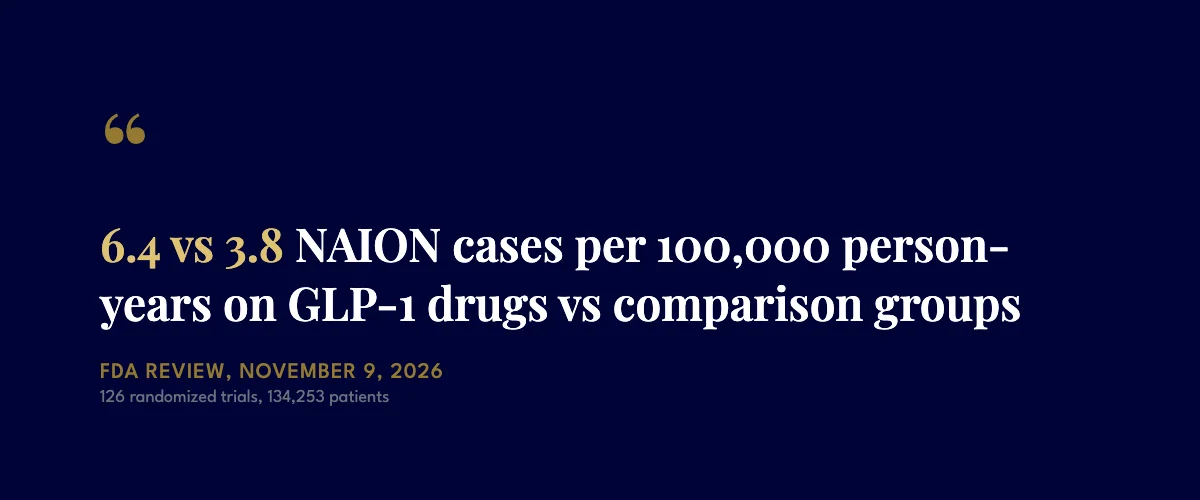
The FDA reviewed 126 randomized clinical trials with 134,253 patients. In those trials, NAION showed up at a rate of 6.4 cases per 100,000 person-years among people taking a GLP-1, compared with 3.8 per 100,000 in the comparison groups. The agency also checked its Sentinel database of real-world patients along with published observational studies, and said NAION cases have been reported for every GLP-1 product currently sold.
The FDA was careful about one point. It called this a “potential increased risk” and said the underlying cause is not completely understood. That wording matters for a lawsuit, and we come back to it below.
Which drugs the warning covers
The order applies to the whole class, not only semaglutide. These are the products on the FDA’s list, with the company that sells each brand today.
| Brand | Drug | Company |
|---|---|---|
| Ozempic, Wegovy, Rybelsus | semaglutide | Novo Nordisk |
| Victoza, Saxenda | liraglutide | Novo Nordisk |
| Xultophy | liraglutide with insulin degludec | Novo Nordisk |
| Mounjaro, Zepbound | tirzepatide | Eli Lilly |
| Trulicity | dulaglutide | Eli Lilly |
| Foundayo (approved 2026) | orforglipron | Eli Lilly |
| Soliqua | lixisenatide with insulin glargine | Sanofi |
| Byetta (brand withdrawn) | exenatide, generic only | Generic makers |
Novo Nordisk and Eli Lilly are the main defendants in the vision loss lawsuits filed so far.
What NAION is, in plain terms
NAION stands for non-arteritic anterior ischemic optic neuropathy. Doctors often describe it as a stroke of the eye. Blood flow to the front of the optic nerve drops, the nerve is damaged, and vision in that eye gets worse, often over hours or a few days.
There is no proven treatment that brings the lost vision back. Some people recover part of it. Many do not.
The FDA lists the warning signs: sudden, painless vision loss in one eye that people often notice when they wake up, blurry or missing patches of vision such as blind spots or tunnel vision, colors that look washed out or wrong, and a loss of sharpness in the center of what you see.
If that happens to you, the FDA’s advice is to contact your doctor right away and ask for a referral to an ophthalmologist. Do not stop a diabetes medication on your own. Your doctor has to weigh the eye risk against what the drug is doing for your blood sugar or your heart.
This was not the first warning
For a failure-to-warn claim, the most important question is often what the drug company knew and when it knew it. The record on NAION goes back more than two years before the FDA acted.
In July 2024, researchers at Massachusetts Eye and Ear published a study in JAMA Ophthalmology that compared patients prescribed semaglutide with patients on other medications. Among patients with type 2 diabetes, 17 semaglutide users developed NAION against 6 in the comparison group. In patients prescribed semaglutide for weight loss, the risk was about seven times higher. The study came from a single center, and its numbers are much larger than what the FDA later found across clinical trials, but it put the issue in front of doctors and drug makers.
In June 2025, the European Medicines Agency’s safety committee concluded that NAION is a very rare side effect of Ozempic, Rybelsus and Wegovy, affecting up to 1 in 10,000 users, and had the European labels updated. American labels did not carry a comparable warning until the FDA ordered one in November 2026.
That gap is the heart of many of the lawsuits. If a European patient was being warned in 2025 and an Illinois patient was not, a jury may be asked why.
The federal MDL for GLP-1 vision loss
In December 2025, the Judicial Panel on Multidistrict Litigation created a separate proceeding for these claims: MDL No. 3163, In re: Glucagon-like Peptide-1 Receptor Agonists (GLP-1 RAs) Non-Arteritic Anterior Ischemic Optic Neuropathy Products Liability Litigation. It sits in the U.S. District Court for the Eastern District of Pennsylvania before Judge Karen S. Marston.
The JPML’s November 2, 2026 report listed 278 pending cases in MDL 3163. Judge Marston also oversees MDL No. 3094, the older GLP-1 case for stomach injuries, which had 4,082 pending cases in the same report. We wrote about that side of the litigation in our post on weight loss drugs linked to stomach paralysis.
An MDL is not a class action. Each person keeps an individual case with an individual settlement value, but pretrial work such as discovery and expert challenges is handled in one court. Our guide to how mass torts work explains the difference. An Illinois resident can file in federal court and have the case transferred into the MDL, or in some situations file in state court instead. Which route is better depends on the facts, and that is a decision to make with a lawyer.
How a GLP-1 vision loss claim works under Illinois law
These are product liability cases, not medical malpractice cases. In most of them the prescribing doctor is not the target. The claim is against the manufacturer.
The main theory is failure to warn. Illinois follows the learned intermediary doctrine for prescription drugs, from Kirk v. Michael Reese Hospital & Medical Center, 117 Ill. 2d 507 (1987). Under that rule, a drug company’s duty is to warn the prescribing doctor adequately, not every patient directly. So the question becomes whether the label and the information given to doctors fairly described the NAION risk at the time you were prescribed the drug. Our post on failure to warn claims in Illinois goes deeper into what has to be proven.
Some cases also plead design defect or negligence. Illinois product cases can proceed under strict liability, which looks at whether the product was unreasonably dangerous rather than whether the company was careless. In practice, drug cases usually turn on the warning.
Causation is the fight
Remember the FDA’s careful words: a potential increased risk, with the cause not fully understood. Drug makers will argue that NAION also happens in people who never took a GLP-1, especially people with diabetes or sleep apnea, and that the drug did not cause your loss of vision.
Your side has to show two things. First, that GLP-1 drugs can cause NAION at all, which lawyers call general causation. The MDL court will decide that question with expert testimony for every case at once. Second, that the drug caused your NAION, which is specific causation. Your medical records do most of the work here: when you started the drug, the dose, when the vision loss began and what your eye doctor found.
Preemption
Drug companies often argue that federal law blocks state failure-to-warn claims because the FDA controls drug labels. The U.S. Supreme Court rejected that argument as a general rule in Wyeth v. Levine, 555 U.S. 555 (2009), because brand-name manufacturers can strengthen a label on their own. The defense can still win if it shows clear evidence the FDA would have refused the warning. With the European warning in 2025 and the FDA ordering this warning in 2026, that is a harder argument to make here.
Compounded and generic versions
Many people took compounded semaglutide or tirzepatide from a pharmacy or telehealth company during the drug shortages. Compounded drugs are not FDA-approved, and a claim over a compounded product may run against the pharmacy rather than Novo Nordisk or Eli Lilly. Generic drug makers are protected by federal preemption in ways brand-name makers are not. If you are not sure what you were taking, your pharmacy records will show it.
Illinois filing deadlines
Illinois gives you two years to file a personal injury lawsuit under 735 ILCS 5/13-202. In product cases, Illinois courts apply a discovery rule: the two years generally start when you knew or reasonably should have known that you were injured and that the injury may have been wrongfully caused, from Nolan v. Johns-Manville Asbestos, 85 Ill. 2d 161 (1981).
Be careful with that rule. A widely reported FDA warning on November 9, 2026 is the kind of event a defense lawyer will point to as the moment you should have connected your vision loss to the drug. If you lost vision a year or two ago, do not assume you have plenty of time. Illinois also has a product liability statute of repose, 735 ILCS 5/13-213, which can bar claims filed too long after the product was first sold, regardless of when you were hurt. Our guide to the Illinois personal injury statute of limitations walks through the other exceptions.
What to do now if you lost vision on a GLP-1
Get an eye exam if you have not had one, and ask the ophthalmologist to write down the diagnosis by name. NAION is diagnosed from the appearance of the optic nerve and the pattern of vision loss, and a clear diagnosis in the records is the foundation of any claim.
Request your pharmacy records showing which GLP-1 you took and every date you filled it, with the dose. Keep the pens or boxes if you still have them.
Write down when you first noticed the change in your vision and what it was like. Memory fades fast, and this timeline matters for both causation and the filing deadline.
You can also report the side effect to the FDA through MedWatch or by calling 1-800-332-1088. A report does not start a lawsuit, but it adds to the safety record.
Talk to a Chicago defective drug lawyer
Phillips Law Offices handles defective drug cases and product liability claims for people across Illinois, along with mass tort litigation against large manufacturers. We can review your records, tell you whether your vision loss fits the claims being brought in MDL 3163, and check your filing deadline before it passes. The consultation is free, and you pay no fee unless we recover compensation for you.
Call (312) 346-4262 or book a free consultation online.
Frequently asked questions
Does Ozempic cause blindness?
The FDA says GLP-1 drugs, including Ozempic, carry a potential increased risk of NAION, a rare eye condition that can cause sudden and sometimes permanent vision loss in one eye. The FDA has not concluded that the drugs cause NAION, and the overall risk is low. In clinical trials, the rate was 6.4 cases per 100,000 person-years on GLP-1 drugs compared with 3.8 in the comparison groups.
Does the FDA warning apply to Mounjaro and Zepbound?
Yes. The November 9, 2026 order covers every GLP-1 receptor agonist on the U.S. market, including tirzepatide sold as Mounjaro and Zepbound, not only semaglutide.
Is there a lawsuit for Ozempic vision loss?
Yes. Federal vision loss cases are consolidated in MDL No. 3163 in the Eastern District of Pennsylvania before Judge Karen S. Marston. The JPML’s November 2, 2026 report listed 278 pending cases. It is separate from MDL No. 3094, which covers stomach injuries such as gastroparesis.
How long do I have to file a GLP-1 vision loss claim in Illinois?
Generally two years under 735 ILCS 5/13-202, starting when you knew or reasonably should have known about the injury and its possible cause. The FDA’s public warning in November 2026 may be treated as the point you should have known, so it is safer to act now than to wait.
Can I sue my doctor for prescribing Ozempic?
Usually not for the drug’s side effect alone. Most GLP-1 vision loss claims are brought against the manufacturer for failing to warn about the risk. A doctor could be responsible in a separate malpractice claim, for example if they ignored clear symptoms or prescribed against a known warning, but that depends on the facts.