

When a lithium-ion battery catches fire in an Illinois home, the company that made it can be held responsible for the burns and the damage, and so can others in the chain that brought it to you. Illinois product liability law does not require you to prove anyone was careless. You have to show the battery was defective and that the defect caused the fire. Since January 1, 2026, Illinois has also required e-bike and scooter batteries to pass a safety test before they can be sold here.
The recalls are not slowing down. Between late July and early November 2026, the U.S. Consumer Product Safety Commission recalled power banks, hand warmers, speaker battery packs and recliner battery packs over fire and burn hazards, more than two million units in all.
Why these batteries catch fire
A lithium-ion cell stores a lot of energy in a small space. If a cell is damaged or badly made, it can start heating itself. Engineers call this thermal runaway. One cell overheats, ignites the cells next to it, and within seconds the pack can burst into flames, throw off burning material and release toxic gas.
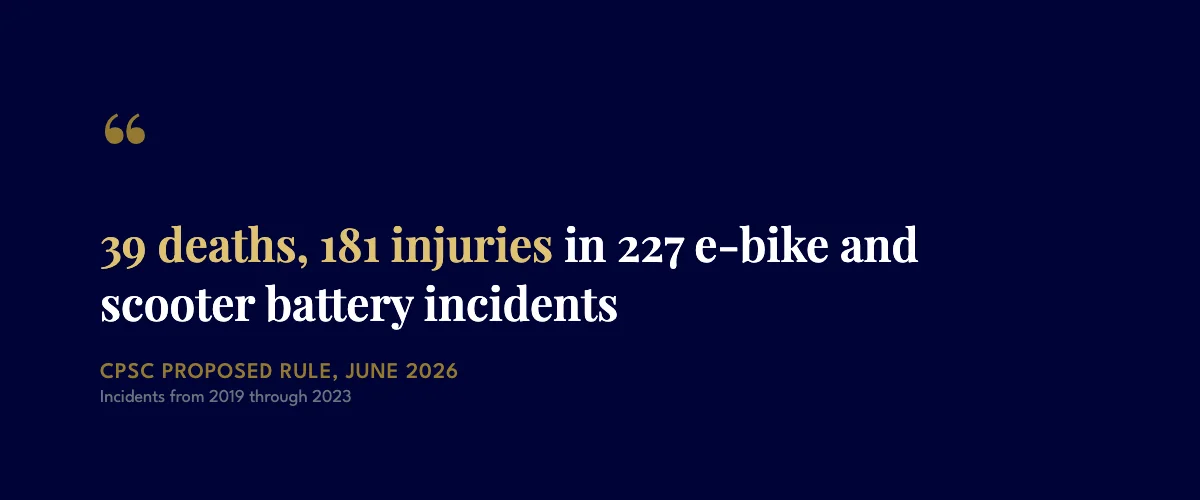
In its June 2026 proposed rule for e-bike and scooter batteries, the CPSC reviewed 227 micromobility battery incidents from 2019 through 2023, involving fires, explosions, burns and smoke inhalation. Those incidents killed 39 people and injured 181 more. The proposal adds tests that stop a battery from charging when its cells get too hot and that protect it from an incompatible charger, because charging is where so many of these failures begin.
Cheap cells and missing protection circuits are the usual suspects, often paired with a charger that does not match the battery. Those are design and manufacturing choices, which is why these cases are brought against companies and not against the person who plugged the device in.
Lithium-ion battery recalls in recent months
These are recent CPSC recalls for fire and burn hazards. Numbers come straight from each recall notice.
| Recall date | Product | Units | What the company reported |
|---|---|---|---|
| Jul 30, 2026 | OCOOPA rechargeable hand warmers | About 1.5 million | 1,480 overheating reports, 15 fires, 350 burn injuries and one death |
| Sep 24, 2026 | NEWDERY power banks (Amazon) | About 21,380 | 9 reports of exploding or igniting, including a fire with $2 million in property damage and one burn injury |
| Oct 1, 2026 | Kobayashi rechargeable hand warmers | About 77,000 | Recalled for fire and burn hazards, no injuries reported |
| Oct 29, 2026 | HAIARA power banks (Amazon) | About 11,000 | 600 reports of fire and thermal incidents, including 3 burn injuries |
| Nov 5, 2026 | Bose S1 Pro and S1 Pro+ speaker battery packs | About 634,759 | 7 reports of melting, smoke or fire, with property damage in 6 |
The OCOOPA recall is the one to read closely if you bought hand warmers for winter. An 83-year-old consumer in San Diego died in February 2026. We covered it in our post on the 1.5 million hand warmer recall. You can search any product on the CPSC recall database.
A recall helps a claim, but you do not need one. Plenty of batteries that start fires were never recalled. What matters is whether this battery was defective.
Illinois’s Micromobility Fire Safety Act
Illinois passed the Micromobility Fire Safety Act (Public Act 104-0414), which took effect on January 1, 2026. It covers e-bikes, e-scooters, hoverboards and similar devices, along with the batteries that power them.
The core rule is simple. Nobody may make, distribute, sell, lease or rent a battery for one of these devices in Illinois unless an accredited testing laboratory has tested it and found it meets UL 2271, the safety standard for light electric vehicle batteries. The act sets testing requirements for the devices themselves as well.
The enforcement clause is what makes this law useful to injured people. A violation is an unlawful practice under the Illinois Consumer Fraud and Deceptive Business Practices Act, 815 ILCS 505. That act lets a person who suffers actual damage from a violation sue for it. So if an untested battery sold in Illinois after January 1, 2026 burned your home, you may have a consumer fraud claim on top of a product liability claim.
The federal picture is still catching up. The CPSC proposed a national safety standard for e-bike and scooter batteries in June 2026, and a bill requiring one passed the House in April 2025 but has not passed the Senate. Neither is final law yet, which makes the Illinois act the stronger tool for now. Our post on the Illinois e-bike insurance law covers what riders need to know about coverage after a crash.
Who can be held liable for a battery fire in Illinois
Illinois applies strict liability to defective products. You need to show the battery was unreasonably dangerous when it left the defendant’s control, and that the danger caused your injury. A battery that bursts into flames during normal charging usually tells its own story, though the defense will still fight about why it failed.
The claim can reach several companies in the chain. The manufacturer of the battery or the cells inside it is the main target. Importers and distributors can be liable too, and so can the retailer.
Illinois gives sellers who did not make the product a way out. Under 735 ILCS 5/2-621, a retailer or distributor can ask to be dismissed once it identifies the actual manufacturer. The seller stays in the case if the manufacturer cannot be sued here or cannot pay a judgment. That exception matters with battery fires, because many of these products come from overseas companies that sell through online marketplaces and have no presence in the U.S. Whether a marketplace itself counts as a seller is contested and depends on how the sale was set up.
Our guide on design defects versus manufacturing defects explains the two theories most battery cases use.
What the defense will argue
Expect the company to blame the user. Wrong charger, a dropped device, a cheap replacement battery or a home-made modification are the standard defenses. Illinois uses modified comparative fault under 735 ILCS 5/2-1116. If you are found more than 50% responsible you recover nothing, and below that your award is reduced by your share.
That is why the physical evidence matters so much, and why it has to be saved before anyone throws it out.
Does your battery fire have a case?
Not every battery fire leads to a strong injury claim, and it helps to know where you stand before you call anyone. Three facts decide most of these cases.
How badly someone was hurt. Deep burns that need surgery or skin grafts, or smoke inhalation that put someone in the hospital, are the cases that justify the cost of fire experts and a lawsuit. A death always does. A minor burn that healed in a week is still a real claim, but its value is usually small. If nobody was hurt and only your home or belongings were damaged, the claim usually runs through your homeowner’s or renter’s insurance, and the insurer pursues the manufacturer on its own.
Whether the battery was saved. The remains of the battery, the device and the charger are what a fire expert examines to show the defect. A case can sometimes go forward without them, using photos and purchase records plus a recall notice if there is one, but it is a harder case.
Who made it and where you bought it. A battery from a well-known U.S. brand, or one bought from a major retailer, gives you a defendant that can be sued here and can pay a judgment. A no-name power bank shipped by an overseas seller can be just as defective, but collecting from that company may be difficult, which is why the U.S. sellers in the chain matter so much.
If you can answer those three questions, a lawyer can usually tell you in one conversation whether the claim is worth pursuing.
What you can recover
Battery fires cause some of the most painful injuries we see. Deep burns can need skin grafts and years of scar treatment. Smoke inhalation can damage the lungs long after the fire is out. A claim can cover medical bills now and later, lost income, pain and suffering, disfigurement and the damage to your home and belongings. Our post on compensation in a defective product claim goes through each category.
If someone died, the family can bring a wrongful death claim under the Illinois Wrongful Death Act, 740 ILCS 180.
Your homeowner’s or renter’s insurer may pay for the property damage first and then sue the manufacturer to get its money back. That is called subrogation, and it runs on its own track. Your claim for injuries belongs to you, and the insurer’s lawsuit does not cover it.
Save the evidence before it disappears
The burned battery is the single most important piece of evidence in the case. Do not throw away what is left of it, the device or the charger, even if it looks like a pile of ash. Put the remains somewhere safe and dry, away from anything that can burn.
Tell your insurance adjuster in writing that you want the remains kept. Adjusters and cleanup crews sometimes clear a fire scene before anyone has examined it, and once the battery is gone, proving what failed gets much harder.
Ask the fire department for its incident report. Take photos of the room and the device from several angles. Find your receipt, order confirmation or credit card statement, plus the product box or manual if you still have them. Your medical records from the emergency room onward complete the file.
Illinois filing deadlines
Deadlines depend on what kind of loss you are claiming. Personal injury claims must generally be filed within two years under 735 ILCS 5/13-202. Property damage claims have five years under 735 ILCS 5/13-205. A Consumer Fraud Act claim has three years under 815 ILCS 505/10a(e). Illinois also has a product liability statute of repose, 735 ILCS 5/13-213, that can bar claims over older products.
Two years goes faster than people think, especially while someone is still in burn treatment. Our guide to the Illinois personal injury statute of limitations explains how the clock works.
How to lower the risk at home
The CPSC’s advice is practical. Charge batteries on a hard surface, never on a bed or couch, and not overnight or while you are out. Use the charger that came with the device or one the manufacturer approves. Stop using any battery that swells, smells, gets unusually hot or makes popping sounds. When you buy an e-bike or scooter, look for the UL 2849 or UL 2272 certification mark, and check the recall list before you give a power bank or hand warmer as a gift.
Talk to a Chicago burn injury lawyer
Phillips Law Offices represents people hurt by defective products and has handled burn injury cases in Chicago and across Illinois. We can bring in an independent fire investigator to preserve the battery and trace every company in the chain that sold it to you. The consultation is free, and you pay no fee unless we recover compensation for you.
Call (312) 346-4262 or book a free consultation online.
Frequently asked questions
Can I sue if a lithium-ion battery caught fire in my home?
Yes, in many cases. Illinois applies strict liability to defective products, so you need to show the battery was defective and that the defect caused the fire, not that the company was careless. The manufacturer is the main defendant, and importers or retailers can be responsible too.
Do I need a recall to have a battery fire claim?
No. A recall can help show the product was dangerous, but many batteries that start fires were never recalled. The claim depends on whether your battery was defective.
What is the Illinois Micromobility Fire Safety Act?
It is an Illinois law, Public Act 104-0414, that took effect January 1, 2026. It bars selling or renting batteries for e-bikes, e-scooters and similar devices in Illinois unless an accredited laboratory has tested them to the UL 2271 standard. A violation is an unlawful practice under the Illinois Consumer Fraud Act.
Who pays if I bought the battery from an overseas seller online?
Illinois lets a retailer or distributor be dismissed once it names the manufacturer, under 735 ILCS 5/2-621, but the seller stays in the case if the manufacturer cannot be sued in the U.S. or cannot pay. Whether an online marketplace counts as a seller depends on how the sale was set up.
Do I have a case if a battery fire damaged my home but no one was hurt?
Usually the property damage claim goes through your homeowner’s or renter’s insurance, and the insurer can then pursue the manufacturer. A personal injury claim needs a physical injury, such as burns or smoke inhalation. If anyone was hurt, even mildly, talk to a lawyer before the battery or the fire scene is cleared.
How long do I have to file a battery fire claim in Illinois?
Generally two years for injuries under 735 ILCS 5/13-202 and five years for property damage under 735 ILCS 5/13-205. A Consumer Fraud Act claim has three years. Save the burned battery right away, because losing it can weaken the case long before any deadline.