

Today, a compliant Class 1, 2, or 3 e-bike under 750 watts needs no license, registration, or insurance in Illinois, the same as a regular bicycle. Starting January 1, 2027, that changes for “high-speed” e-bikes capable of exceeding 28 mph, which will require a driver’s license, title, registration, and liability insurance under Senate Bill 3484.
Illinois’ E-Bike Classes, Explained
Illinois defines a “low-speed electric bicycle” under 625 ILCS 5/1-140.10 as a bicycle with fully operable pedals and an electric motor under 750 watts. This covers the three e-bike classes most riders encounter:
- Class 1: pedal-assist only, motor cuts off at 20 mph.
- Class 2: has a throttle, motor cuts off at 20 mph.
- Class 3: pedal-assist, motor cuts off at 28 mph, typically requires the rider be at least 16.
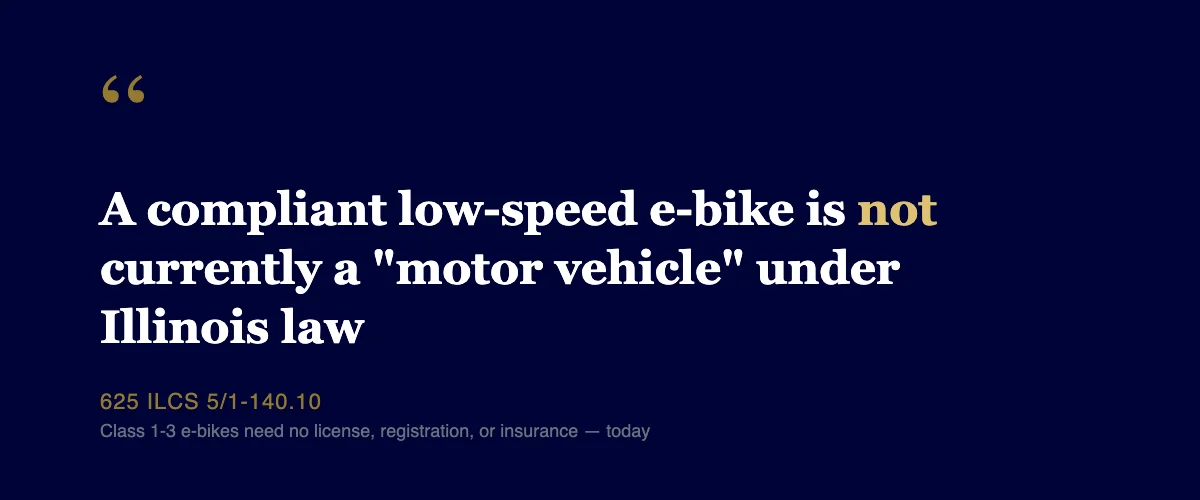
A compliant Class 1, 2, or 3 e-bike is treated like a regular bicycle under Illinois law. No driver’s license, no title, no registration, and no insurance requirement, today.
What Changes Under the New Law
Senate Bill 3484, signed by Governor Pritzker, takes effect January 1, 2027. It creates a new category, the “high-speed” e-bike, defined as one with a motor capable of propelling the bike faster than 28 mph, above the Class 3 cap. Riders of these high-speed e-bikes will need to:
- Hold a valid driver’s license.
- Title and register the e-bike with the state.
- Carry liability insurance on it.
The law also restricts where high-speed e-bikes can be ridden, on roads only, not in bike lanes, on bike paths, or on sidewalks, and sets minimum age requirements for riders of electric micromobility devices generally. Illinois joins New Jersey as one of only two states currently requiring insurance specifically for high-speed e-bikes.
Why Illinois Made This Change
The push for the new law followed a rise in serious crashes involving e-bikes modified or sold with motors well beyond the 750-watt, 28-mph threshold, bikes that can reach 40 mph or more but were, until now, regulated no differently than a standard bicycle. State Senator Robert Peters and Secretary of State Alexi Giannoulias both backed the measure, which passed the Senate unanimously, arguing that a bike capable of highway-adjacent speeds presents a genuinely different risk profile, to the rider, to pedestrians, and to drivers, than a pedal-assist commuter e-bike, and that the old one-size-fits-all bicycle classification hadn’t kept pace with what was actually being sold and ridden.
What Happens If You’re Hit by an E-Bike Today
This is the part most coverage of the new law skips, and it matters most to accident victims right now, before the 2027 changes take effect. If a compliant, low-speed e-bike rider causes a crash today, they can still be held civilly liable for your injuries. Illinois Vehicle Code provisions governing bicycles, including 625 ILCS 5/11-1501 (rules of the road for bicyclists) and 625 ILCS 5/11-601 (speed), apply to e-bike riders the same way they apply to cyclists. Negligence, running a red light, riding against traffic, failing to yield, speeding through a crosswalk, is negligence regardless of whether the bike has a motor, and an injured victim can pursue a standard personal-injury claim against the rider directly.
The complication is coverage, not liability. Because a compliant low-speed e-bike isn’t currently classified as a “motor vehicle” under Illinois law, a standard auto uninsured/underinsured motorist (UM/UIM) claim, which typically requires the at-fault party to have been operating a motor vehicle, may not apply the way it would if you were hit by a car. Many e-bike riders also carry no personal liability insurance at all, since none is currently required. That can leave an injured pedestrian or driver with a judgment against an individual rider who may not have the assets to pay it.
Homeowners and renters insurance policies sometimes provide personal liability coverage that could respond to a claim against an e-bike rider, but this varies significantly by policy and insurer, some exclude motorized vehicles outright, others don’t address e-bikes specifically at all, and a few carve out an exception specifically for low-wattage pedal-assist bikes while excluding throttle-only models. If you’re hit by an e-bike rider, it’s worth having an attorney review both the rider’s available coverage and your own policies rather than assuming either applies or doesn’t.
Delivery and Commercial E-Bikes Are a Different Risk
E-bikes used for food delivery (DoorDash, Uber Eats, Grubhub couriers) and bike-share programs like Divvy add another layer of complexity. A delivery courier’s personal e-bike, even if compliant and currently insurance-free under state law, may be covered differently depending on whether the delivery platform provides any supplemental coverage for the courier’s on-the-job activity, policies and coverage amounts vary by company and change over time, so this is worth confirming directly with the platform or an attorney rather than assuming a standard answer applies. A crash involving a Divvy e-bike raises separate questions about the bike-share operator’s own maintenance and liability obligations, distinct from the rider’s individual conduct.
What Changes for Accident Victims After January 2027
Once the high-speed e-bike insurance requirement takes effect, a victim injured by a high-speed e-bike rider will, for the first time, have a defined insurance policy to pursue, similar in structure to a car accident claim: the rider’s liability coverage becomes the first source of recovery, and depending on how your own auto policy defines “motor vehicle” going forward, a UM/UIM claim may become available in a way it currently isn’t for low-speed e-bike collisions. Standard Class 1, 2, and 3 e-bikes are unaffected, they remain outside this insurance requirement, so the coverage gap described above persists for crashes involving compliant low-speed e-bikes even after the new law takes effect.
What This Means for a Chicago Personal Injury Claim
For a Chicago attorney evaluating an e-bike injury claim today, the practical path usually starts with identifying who the rider is and whether any coverage, personal, homeowners, employer, or platform-provided, actually responds to the claim, rather than assuming a motor-vehicle-style insurance policy exists the way it would after a car accident. That makes early evidence collection and prompt identification of the rider even more important in an e-bike case than in a typical car accident, since there’s often no insurance card exchanged at the scene the way there would be between two drivers, and a rider who leaves without identifying themselves can be far harder to pursue later than a driver whose license plate was captured.
What to Do If You’re Injured by an E-Bike Rider
The evidence that matters is largely the same as any other crash: photos of the scene, the rider’s identifying information if they remain at the scene, witness contact information, and a police report if you call one in. Illinois requires police notification for crashes involving injury, and documenting the collision the same way you would a car accident gives you the strongest basis for a claim regardless of which coverage, the rider’s personal liability policy, a homeowners policy, or eventually a dedicated e-bike policy, ends up applying. Our guide on evidence you need after a car crash covers this process in more detail; most of it applies directly to an e-bike collision as well.
Insurance Options Available to Riders Right Now
Nothing stops a low-speed e-bike rider from buying liability coverage voluntarily before the 2027 requirement applies to anyone. Specialty insurers that write e-bike and bicycle policies, separate from the standard auto market, already offer standalone liability and theft coverage for e-bike owners who want protection, or want to protect others, before any law requires it. For a rider doing delivery work or commuting daily in heavy Chicago traffic, that voluntary coverage can matter more than the minimum the new law will eventually require, since it closes the exact gap described above for compliant low-speed bikes that remain outside SB 3484’s insurance mandate.
How Comparative Negligence Applies to E-Bike Crashes
E-bike collisions are evaluated under the same modified comparative negligence framework as any other Illinois accident. If you’re a pedestrian or driver injured by a negligent e-bike rider, your own conduct, whether you were crossing against a signal, or the rider was weaving through traffic illegally, gets weighed under Illinois’ comparative negligence rule, 735 ILCS 5/2-1116. If you’re found 50% or less at fault, you can still recover damages, reduced by your percentage of fault; at 51% or more, you recover nothing. This cuts both ways in e-bike cases specifically, since riders weaving between sidewalks, bike lanes, and roads can create fault disputes that are more fact-intensive than a straightforward car-versus-car crash.
Where E-Bikes Can Currently Ride in Chicago
Under current Chicago traffic rules, compliant Class 1, 2, and 3 e-bikes are generally permitted in bike lanes and on most multi-use paths, the same as regular bicycles, and Class 3 e-bikes (28 mph pedal-assist) are typically restricted from certain paths with heavy pedestrian traffic. The Chicago Park District and the city have adjusted path rules for e-bikes and e-scooters more than once as usage has grown, particularly with the expansion of Divvy’s e-bike fleet and the surge in delivery courier e-bike traffic citywide, so it’s worth checking current signage on a specific path or trail rather than assuming last year’s rule still applies. Once the high-speed category takes effect in 2027, those bikes will be barred from bike lanes, paths, and sidewalks entirely, restricted to roads, which is a meaningfully different rule than what applies to compliant e-bikes today.
Frequently Asked Questions
Do I need insurance to ride an e-bike in Illinois?
Not today, for a compliant Class 1, 2, or 3 low-speed e-bike under 750 watts. Starting January 1, 2027, under Senate Bill 3484, riders of “high-speed” e-bikes capable of exceeding 28 mph will need a driver’s license, title, registration, and liability insurance.
What is a low-speed electric bicycle under Illinois law?
Under 625 ILCS 5/1-140.10, a low-speed electric bicycle has fully operable pedals and an electric motor under 750 watts. Compliant Class 1, 2, and 3 e-bikes fall under this definition and are currently treated like regular bicycles, not motor vehicles, for registration and insurance purposes.
What happens if I’m hit by an e-bike rider who has no insurance?
Because a compliant low-speed e-bike isn’t currently classified as a motor vehicle, your own uninsured/underinsured motorist coverage may not apply the way it would in a car-versus-car crash. Your options typically include a direct claim against the rider and, if applicable, their homeowners or renters insurance. An attorney can evaluate exactly what coverage is available in your specific case.
When does Illinois require insurance for e-bikes?
Starting January 1, 2027, under Senate Bill 3484, only “high-speed” e-bikes, those with a motor capable of propelling the bike faster than 28 mph, will require a driver’s license, registration, title, and liability insurance. Standard Class 1, 2, and 3 e-bikes remain license- and insurance-free.
Can an e-bike rider be held liable for causing an accident?
Yes. E-bike riders are generally subject to the same rules of the road as bicyclists under the Illinois Vehicle Code, including 625 ILCS 5/11-1501 and 11-601, and can be held civilly liable for injuries their negligence causes, regardless of whether their e-bike currently requires insurance.
The Bigger Picture: Micromobility Is Outpacing the Law
E-bikes are just one part of a broader shift in how Chicagoans get around, alongside e-scooters, mopeds, and other electric micromobility devices that didn’t exist in meaningful numbers when most of the Illinois Vehicle Code’s bicycle provisions were written. SB 3484’s new minimum age requirements for electric micromobility devices generally, not just e-bikes, signal that the legislature expects to keep revisiting this area as adoption grows and as the kinds of devices on the road keep changing. For riders and accident victims alike, that means the rules in this guide, accurate as of this writing, are likely to keep evolving, and it’s worth confirming current requirements directly with the Secretary of State’s office or an attorney rather than relying on older guidance once the January 2027 effective date arrives and the first wave of registrations and policies begins.
Also Read: