
Starting with rate filings and renewal notices on or after July 1, 2027, Illinois insurers must give 60 days’ notice (homeowners) or 30 days’ notice (auto) before raising rates more than 10%, and the Illinois Department of Insurance can reject increases it finds excessive or unfairly discriminatory, under two laws Governor Pritzker signed on August 4, 2026.
What the Two New Laws Actually Do
On August 4, 2026, Governor JB Pritzker signed two companion bills into law. Public Act 104-0752 (formerly House Bill 4273) covers homeowners insurance, and Public Act 104-0753 (formerly Senate Bill 714) covers auto insurance. Both give the Illinois Department of Insurance new authority it didn’t previously have: the power to review a proposed rate increase and reject it if the department finds the new rate “excessive, inadequate, or unfairly discriminatory,” and to order an insurer to rebate customers for excess premiums already collected under a rejected rate.
Before this, Illinois was one of only a handful of states where insurers could raise home and auto premiums without any state review at all, a “file and use” system rather than the “prior approval” system most states use. Under file and use, an insurer files its new rate and can start charging it immediately; the regulator can only challenge it after the fact. Under prior approval, the regulator has to sign off before the new rate takes effect at all. Illinois is moving a meaningful distance toward the prior-approval model, though not all the way: insurers can still implement a rate change before the department completes its review, subject to the rebate requirement if the department later finds it improper.
Why This Law Exists
The immediate trigger was State Farm’s 2025 homeowners insurance rate increase of roughly 27%, about $523 million in additional premium collected from Illinois policyholders in a single year. That increase, layered on top of several years of rising premiums industry-wide, pushed the legislature to act. The Illinois Insurance Association, the American Property Casualty Insurance Association, and the National Association of Mutual Insurance Companies opposed the bills, arguing the new rules address symptoms rather than the underlying cost pressures, rebuilding costs, severe weather losses, and litigation costs driving premiums up industry-wide, and could lead some insurers to write less business in Illinois or tighten underwriting elsewhere to offset the new constraint on pricing.
What “Excessive, Inadequate, or Unfairly Discriminatory” Actually Means
The new review standard borrows language used in insurance regulation in other states for decades. An “excessive” rate is one that produces an unreasonably high profit relative to the risk being insured. An “inadequate” rate is the opposite problem, one too low to cover expected losses, which can threaten an insurer’s solvency and ultimately its ability to pay claims. “Unfairly discriminatory” means the rate treats similarly situated policyholders differently without an actuarial basis for the distinction. The Department of Insurance’s review is supposed to apply these three tests to a proposed rate filing, not simply ask whether a rate increase feels too large to policyholders.
What Changes, and When
The notice and review requirements are not retroactive. They apply to rate filings and renewal notices on or after July 1, 2027. Until that date, insurers can continue adjusting rates under the current, less-regulated system. Once the law is in effect:
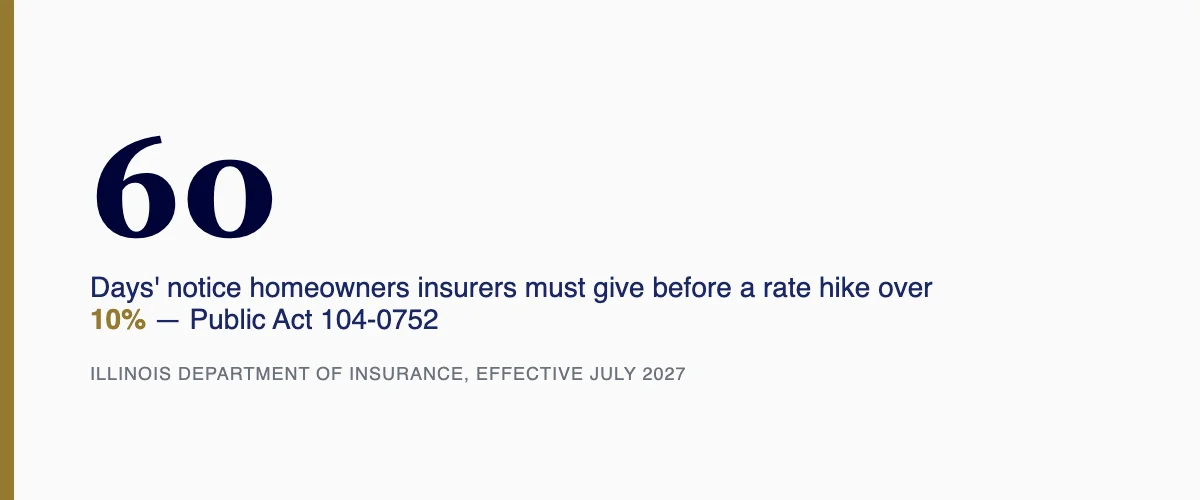
- Homeowners insurance (PA 104-0752): 60 days’ advance notice required before a rate increase exceeding 10%.
- Auto insurance (PA 104-0753): 30 days’ advance notice required before a rate increase exceeding 10%.
- In both cases, the Department of Insurance can review the filing and deny it, or order a rebate, if it determines the rate is excessive, inadequate, or unfairly discriminatory.
A Worked Example
Say your homeowners renewal notice, mailed after July 1, 2027, proposes a 15% premium increase. Because that exceeds the 10% threshold, your insurer must have given you the notice at least 60 days before the new rate takes effect, and the filing underlying that increase is subject to Department of Insurance review under the excessive/inadequate/unfairly-discriminatory standard. If the department later finds the filed rate improper, it can order the insurer to rebate the difference to affected policyholders, including you, for any excess premium already collected. If your increase is 8%, below the 10% threshold, none of these new notice or review protections apply; insurers remain free to make smaller adjustments without the added process.
This Law Regulates Pricing, Not Claims Handling
It’s worth being precise about what these laws do and don’t touch. PA 104-0752 and PA 104-0753 govern how and when an insurer can raise what you pay for a policy. They say nothing about how an insurer handles an actual claim after a crash, that’s governed by separate provisions of the Illinois Insurance Code. Most relevant to accident victims is 215 ILCS 5/155, which allows a policyholder to recover additional damages, including attorney’s fees, if an insurer’s refusal to pay a claim, or its delay in paying one, is found to be “vexatious and unreasonable.” A rate increase being properly noticed and approved under the new law doesn’t excuse an insurer from its separate, ongoing duty to adjust and pay valid claims in good faith.
How Rising Premiums Connect to Your Coverage After a Crash
Rate regulation matters to accident victims for a less obvious reason: premium pressure is one of the biggest reasons drivers reduce their coverage, often right when they can least afford to. Illinois only requires minimum liability limits of $25,000 per person / $50,000 per accident for bodily injury and $20,000 for property damage, numbers that haven’t kept pace with the real cost of a serious crash. When rates climb, some drivers respond by dropping optional coverage like uninsured/underinsured motorist (UM/UIM) coverage to keep their premium down, which is exactly the coverage that protects you if the other driver’s insurance isn’t enough to cover your injuries. Illinois does require UM coverage matching your liability limits by default, but drivers can reject higher UM limits in writing, so it’s worth checking your own policy rather than assuming you’re adequately covered. This is especially relevant in disputed-fault cases like tailgating crashes and head-on collisions, where the at-fault driver’s own coverage often becomes the ceiling on what a victim can recover.
What to Do If Your Rate Jumps After You File a Claim
Insurers are allowed to raise your individual premium after an at-fault claim, that’s a separate underwriting decision from the industry-wide rate filings this new law regulates. If your rate increases significantly after a crash that wasn’t your fault, a few things are worth doing: confirm the increase is tied to your own claims history and not a broader filed rate change, request a written explanation from your insurer, and shop other carriers before renewal, since underwriting guidelines, and how heavily they weigh a single not-at-fault claim, vary significantly between companies. If you believe the increase, or the handling of your underlying claim, crossed into bad-faith territory, that’s a 215 ILCS 5/155 question worth raising with an attorney, separate from anything in the new rate-review law.
What This Means If You’re Shopping for Insurance Right Now
Because the new notice and review rules don’t take effect until July 1, 2027, insurers can still raise rates under the current system through at least mid-2027. If you’re shopping for a policy, or reviewing your coverage after a recent crash, that’s still a good reason to compare multiple carriers now rather than wait for the new protections to apply. The law, once in effect, adds a notice window and a regulatory check on the size of future increases, it doesn’t cap what your premium can ultimately become, and it does nothing to change your coverage limits unless you change them yourself.
What Happens If the Department Rejects a Filed Rate
If the Department of Insurance determines a filed rate is excessive, inadequate, or unfairly discriminatory, it can deny the filing and require the insurer to refile at an acceptable rate. For rates already collected under a rejected filing, the department can order the insurer to rebate policyholders the excess amount. The practical effect for an individual policyholder is that a successful department challenge doesn’t require you to do anything yourself, the rebate, if ordered, should apply automatically to affected policies, though it’s reasonable to confirm with your insurer in writing if you believe your renewal was affected by a filing the department later found improper.
How Illinois Compares to Other States
Illinois’ move brings it closer to states like California and New York, which have long operated prior-approval systems for auto and homeowners rates. It still falls short of a true prior-approval model, since insurers can implement a rate before the department finishes reviewing it, with the rebate serving as the after-the-fact correction rather than a true pre-approval gate. States that already regulate rates this way have, at various points, seen insurers respond by tightening underwriting or reducing the business they write in a state rather than accept a rate they consider inadequate, a dynamic Illinois regulators and consumer advocates will likely watch closely as the new rules take effect in mid-2027.
Frequently Asked Questions
What are Public Acts 104-0752 and 104-0753?
They are two Illinois laws signed by Governor Pritzker on August 4, 2026. Public Act 104-0752 (formerly House Bill 4273) covers homeowners insurance, and Public Act 104-0753 (formerly Senate Bill 714) covers auto insurance. Both give the Illinois Department of Insurance authority to review rate increases and reject ones found excessive, inadequate, or unfairly discriminatory.
When do the new insurance rate review rules take effect?
The new rate standards, notice requirements, and Department of Insurance review powers apply to rate filings and renewal notices on or after July 1, 2027. They are not retroactive to policies already in force.
How much notice must my insurer give before raising my rate?
For homeowners policies, insurers must give 60 days’ notice before a rate increase of more than 10%. For auto policies, insurers must give 30 days’ notice before a rate increase of more than 10%. In both cases, the Illinois Department of Insurance can review the increase and order a rebate if it finds the rate excessive or unfairly discriminatory.
Does this new law change how my insurer handles my accident claim?
No. Public Acts 104-0752 and 104-0753 regulate premium pricing, not claims handling. An insurer’s duty to investigate and pay a valid claim in good faith is governed separately, including under 215 ILCS 5/155, which allows for additional damages and attorney’s fees if an insurer unreasonably and vexatiously delays or denies a claim.
Why was this law passed?
It followed State Farm’s 2025 homeowners rate increase of roughly 27%, about $523 million statewide, which drew legislative attention to the fact that Illinois was one of the few states without prior-approval rate regulation for home and auto insurance.
Can my insurer still raise my individual rate after I file a claim?
Yes. An insurer’s decision to raise your individual premium after a claim is a separate underwriting decision from the industry-wide rate filings this law regulates. The new notice and review rules apply to filed rate changes affecting a class of policyholders, not to how an individual insurer prices your renewal based on your own claims history.
If a Crash Leaves You Underinsured
None of this changes what to do if you’re already dealing with a crash where the at-fault driver’s coverage, or your own, isn’t enough to cover your injuries. Illinois’ minimum limits are often exhausted quickly in a serious collision, and identifying every available source of coverage, the at-fault driver’s policy, your own UM/UIM coverage, and any applicable umbrella, employer, or commercial policy covering the vehicle involved, is usually where an experienced attorney adds the most practical value to a claim. Our guide on evidence you need after a car crash covers what to gather early, since the same documentation that proves fault is often what establishes the full extent of damages once coverage questions come into play.
Also Read: