
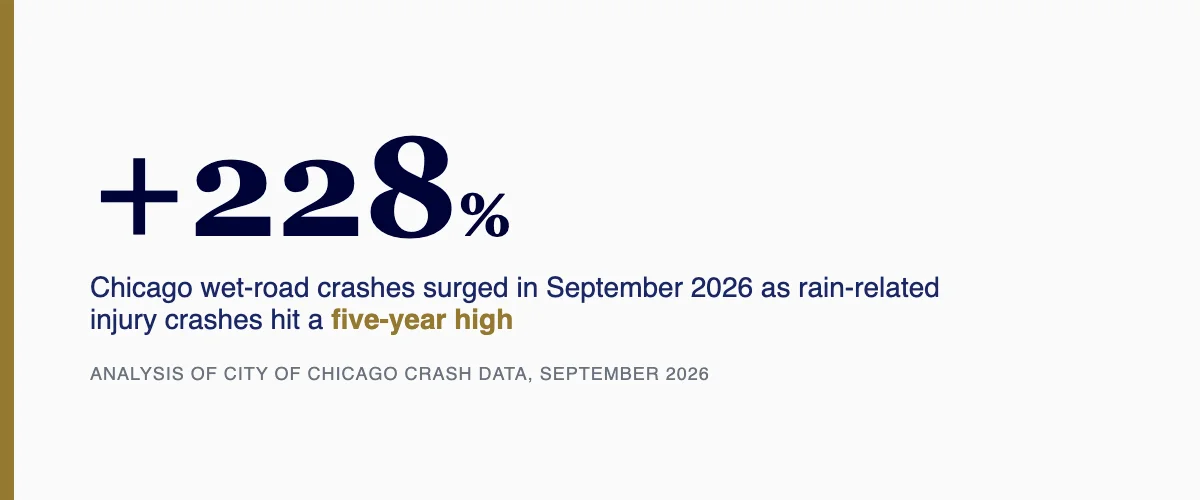
Rain, not snow, has been the bigger driver of Chicago’s recent crash spike: wet-road crashes jumped 227.8% in September 2026, and injury crashes hit a five-year high for the month, according to an analysis of City of Chicago crash data. Under Illinois’ basic speed law, a driver can be at fault for a weather-related crash even while driving at or under the posted speed limit.
The September 2026 Spike, by the Numbers
An analysis of the City of Chicago’s public crash dataset found that total crashes in Chicago rose 5.7% year-over-year in September 2026, to 9,176. Injury crashes hit 1,662, a five-year high for the month, edging past the prior September record of 1,661 set in 2024. The sharpest increase wasn’t overall volume, it was weather-related: wet-road crashes surged 227.8% to 954, an increase of 663 crashes, while dry-road crashes actually fell 4.7% over the same period. In other words, nearly all of the month’s increase in crashes happened on wet pavement.
Why Rain Is More Dangerous Than Most Drivers Treat It
Rain gets less attention than snow and ice, but it creates real, measurable risk for a few specific reasons. Stopping distance on wet pavement can be roughly double what it is on dry pavement, so the same following distance that’s safe in clear weather often isn’t in rain. The first rain after a dry stretch is often the worst: oil, rubber residue, and dust that have built up on the road surface mix with the initial rainfall to create an especially slick film before it washes away, a well-documented effect that makes the first 10 to 20 minutes of a rainstorm disproportionately dangerous. Reduced visibility compounds the problem, both from the rain itself and from spray kicked up by other vehicles, particularly on expressways.
Illinois’ “Too Fast for Conditions” Law
Illinois’ basic speed law, 625 ILCS 5/11-601(a), requires that no vehicle be driven at a speed greater than is reasonable and proper for the traffic, road, and weather conditions actually present, regardless of the posted limit. The statute specifically identifies weather and visibility, rain, fog, snow, ice, as conditions that can require a driver to slow down well below what would otherwise be legal. This means a driver traveling at, or even under, the posted speed limit can still be found to have been driving too fast for conditions, and can be held liable in a civil claim on that basis, if their speed was unreasonable given the rain, fog, or wind at the time.
Fog: Chicago’s Other Recurring Hazard
Fog produces its own distinct crash pattern, multi-vehicle chain-reaction collisions, because visibility can drop from clear to near-zero over a short stretch of road, catching a line of vehicles traveling at normal highway speed before any individual driver has time to react. Illinois expressways, including stretches of I-57 near Peotone, have seen multi-vehicle fog-related pileups for exactly this reason: a bank of fog settles over a low-lying or rural stretch of highway, the lead vehicles slow or stop, and following vehicles traveling too close for the suddenly reduced visibility rear-end them in sequence.
Wind and High-Profile Vehicles
Sustained high winds create a different risk, primarily for trucks, vans, SUVs, and other high-profile vehicles with more surface area for crosswinds to act on. Chicago’s elevated and lakefront-adjacent expressway stretches, including portions of the Skyway and the Dan Ryan, see periodic high-wind advisories that specifically warn high-profile vehicle operators to reduce speed or delay travel. A commercial truck that fails to adjust for a posted wind advisory and loses control or crosses lanes as a result can face a negligence claim similar to any other at-fault crash, the wind doesn’t erase the driver’s and often the carrier’s duty to account for known, forecast conditions.
The Extreme Case: Mass Pileups in Low Visibility
The most severe version of this risk is a mass pileup. In May 2023, a sudden dust storm reduced visibility to near zero on Interstate 55 near Farmersville in downstate Illinois, triggering a roughly 72-vehicle pileup that killed 7 people and injured dozens more, with multiple tractor-trailers involved and two catching fire. While a dust storm is a different weather event from Chicago’s more common rain and fog, the underlying legal pattern in any mass pileup is the same: fault is rarely attributable to one driver. Instead, each vehicle’s involvement, how closely it was following, whether it slowed appropriately as visibility dropped, is evaluated individually, which is why reconstructing a multi-vehicle pileup typically requires far more evidence gathering than a standard two-car crash.
How Fault Is Determined in a Weather-Related Crash
Weather-related fault determinations run through the same modified comparative negligence framework as any other Illinois crash. Under 735 ILCS 5/2-1116, a driver found 50% or less at fault can still recover damages, reduced by their own percentage of fault; at 51% or more, they recover nothing. In a weather-related case, the basic speed law often becomes the key fact at issue: was the defendant driving at a speed that was reasonable for the rain, fog, or wind actually present, regardless of the posted limit? A rear-end collision in heavy rain, for example, still generally points to the following driver’s failure to maintain a safe distance for the conditions, the same underlying duty discussed in our guide on liability for tailgating crashes, just evaluated against wet-weather stopping distances rather than dry ones.
What Evidence Matters in a Weather-Related Crash
Weather-related claims depend heavily on documenting conditions at the exact time and place of the crash, since weather can change block to block and hour to hour. Archived radar and weather station data for the specific time and location, available through the National Weather Service and third-party weather archive services, can establish exactly how much rain was falling, or whether fog or high winds were present, at the moment of the collision. Beyond that, the same evidence that matters in any crash still applies: the police report, photos of road conditions and vehicle damage, witness statements, and dashcam footage where available. Vehicle maintenance records, particularly tire tread depth, can also become relevant if hydroplaning or loss of traction is central to the dispute, worn tires substantially increase hydroplaning risk and can undercut a driver’s claim that a wet-weather crash was unavoidable. Our guide on evidence you need after a car crash covers the fundamentals that apply regardless of what caused the crash in the first place.
Is Hydroplaning a Legal Excuse?
Not on its own. Hydroplaning happens when a tire loses contact with the road surface on a film of water, and it’s generally the predictable result of excessive speed for the conditions, worn tires, or both. Courts typically treat it as a foreseeable risk that a reasonable driver should have anticipated and adjusted for, rather than a true accident, unless there’s evidence of a sudden, specific hazard, standing water from a drainage failure, for instance, that a driver couldn’t reasonably have detected or avoided.
What to Do If You’re Injured in a Weather-Related Crash
Treat it like any other crash investigation, with extra attention to documenting the conditions themselves. Note the time, take photos that show visible rain, standing water, or fog if it’s safe to do so, and request the police report, which typically notes road and weather conditions as part of the standard crash report format. If the crash involved multiple vehicles, identifying every driver present and their position in the sequence of impacts matters more than in a simple two-car crash, since apportioning fault among several vehicles is usually the central question an insurer or court will have to resolve.
Commercial Drivers Face a Higher Weather Standard
Truck and bus drivers operate under a stricter federal standard than passenger vehicle drivers when conditions turn hazardous. Federal Motor Carrier Safety Administration regulations, specifically 49 CFR 392.14, require commercial drivers to exercise “extreme caution” in hazardous conditions, including rain, fog, snow, ice, and other conditions that adversely affect visibility or traction, and to reduce speed accordingly. If conditions become sufficiently dangerous, the regulation requires the driver to discontinue driving until it’s safe to resume. A commercial truck involved in a weather-related crash is held to this heightened standard on top of Illinois’ basic speed law, and a carrier’s dispatch records, along with the truck’s electronic logging device data, can sometimes show whether a driver was pressured to continue despite worsening conditions, evidence that can matter significantly in a case against a trucking company rather than just the individual driver.
Insurance and Weather-Related Crashes
Weather-related crashes raise a coverage question worth understanding before you need it: your own collision coverage, not liability coverage, is what typically pays for your vehicle’s damage in a single-car weather event, like sliding off the road in heavy rain with no other vehicle involved. If another driver’s negligence caused the crash, their liability coverage remains the primary source of recovery for your injuries, the same as in any other at-fault collision. With Illinois’ new insurance rate-review law taking effect for auto policies in mid-2027, and premiums already a frequent topic among Chicago-area drivers, discussed further in our guide on Illinois’ new insurance rate review law, it’s worth periodically confirming your own policy still carries adequate collision and UM/UIM coverage, since premium pressure is one of the more common reasons drivers quietly let that protection lapse.
Frequently Asked Questions
Can I be at fault for a crash caused by rain or fog if I wasn’t speeding?
Yes. Under Illinois’ basic speed law, 625 ILCS 5/11-601(a), a driver must reduce speed below the posted limit when weather or visibility makes that limit unsafe. You can be found at fault, or ticketed for driving too fast for conditions, even while traveling at or under the posted speed limit.
How much did wet-road crashes increase in Chicago recently?
According to an analysis of City of Chicago crash data, wet-road crashes in Chicago rose 227.8% in September 2026, to 954, while overall crashes rose 5.7% to 9,176 and injury crashes hit a five-year high for the month at 1,662.
Is hydroplaning a valid legal excuse for causing an accident?
Not by itself. Hydroplaning typically happens because a driver was traveling too fast for wet conditions or on worn tires. Courts generally treat it as a foreseeable risk a driver is expected to account for, rather than an unavoidable accident, unless there’s evidence of a sudden, undetectable road hazard.
Who is liable in a multi-vehicle pileup caused by fog or low visibility?
Liability in a chain-reaction pileup is typically apportioned among multiple drivers based on each one’s own negligence, for example, following too closely or failing to slow for the conditions, under Illinois’ comparative negligence rule. It is rarely a single driver’s fault, and reconstructing exactly how the collisions occurred usually requires early evidence collection.
What evidence matters most in a weather-related car accident claim?
Archived weather and radar data for the time and location of the crash, the police report, photos of road conditions and vehicle damage, witness statements, and dashcam footage if available. Vehicle maintenance records, particularly tire tread, can also matter if hydroplaning or loss of traction is at issue.
Weather Isn’t a Shield From Liability
The single most important takeaway from the September 2026 data is that severe weather doesn’t excuse unsafe driving, it exposes it. Illinois law has anticipated this for decades: the basic speed law exists precisely because posted speed limits are set for average, not worst-case, conditions, and a driver who doesn’t adjust for rain, fog, or wind is choosing to accept a risk the law expects them to manage. For accident victims, that means a weather-related crash is rarely a dead end on liability, it’s usually a question of proving what a reasonable driver would have done differently, and building that case starts with documenting the conditions as thoroughly as the collision itself.
Also Read:
Chicago Winter Car Crashes: Injuries & Who’s Liable