

A public school can be held liable for a student-on-student injury, but only if its supervision failure was “willful and wanton,” a higher bar than ordinary negligence, and you have just one year to file under Illinois’ Tort Immunity Act. Private schools, the student who caused the injury, and in some cases the student’s parents can also be pursued separately, each under a different legal standard entirely.
Public vs. Private Schools: Two Different Legal Standards
The single most important fact in a student-injury case is whether the school is public or private, because Illinois applies two entirely different liability standards.
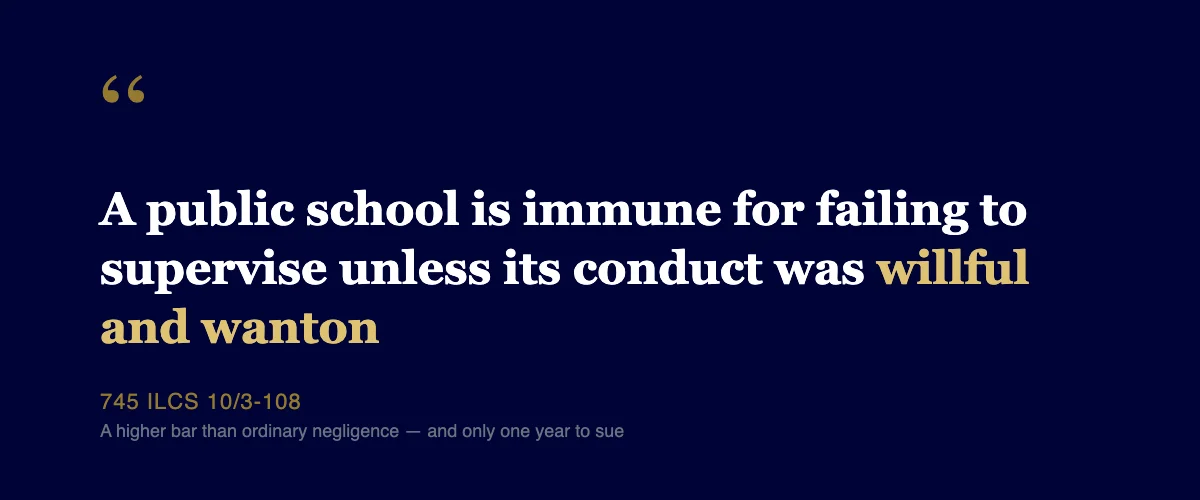
A public school, as a local governmental entity, is protected by the Illinois Local Governmental and Governmental Employees Tort Immunity Act. Under 745 ILCS 10/3-108, the school and its employees are immune from liability for a failure to supervise an activity on school property unless that failure amounts to “willful and wanton” conduct, legally defined as an actual or deliberate intention to cause harm, or an utter indifference to or conscious disregard for the safety of others. Ordinary carelessness, a teacher briefly distracted, a hallway momentarily unsupervised, generally isn’t enough on its own.
A private school isn’t a government entity and isn’t covered by the Tort Immunity Act. It’s held to the ordinary negligence standard that applies to any private party: did the school fail to exercise reasonable care, and did that failure cause the injury. This is a meaningfully lower bar to clear than the willful-and-wanton standard public schools enjoy.
What “Willful and Wanton” Conduct Actually Looks Like
Because the standard against public schools is high, the facts that tend to support a claim usually involve the school having specific, prior knowledge of a risk and doing nothing about it. Courts have found potential willful and wanton conduct where a school knew about a specific bully’s history of violence and left the victim unsupervised with that student anyway, where staff ignored repeated, documented complaints about a dangerous student or situation, or where a known hazardous pattern (fights at a specific time and location) went unaddressed despite being reported. A single, unforeseeable incident with no prior warning signs is much harder to pursue against a public school precisely because the standard requires more than hindsight, it requires showing the school disregarded a known, specific risk rather than simply failing to prevent something no one could have reasonably anticipated.
The Strict One-Year Deadline Against Public Schools
This is the detail families most often miss, and it can end a valid claim before it’s ever filed. Illinois’ standard personal injury statute of limitations is two years, and a minor’s clock doesn’t start until they turn 18, giving most injured children until their 20th birthday to sue. Claims against a public school work differently. Under 745 ILCS 10/8-101 of the Tort Immunity Act, the deadline to sue a local governmental entity, including a public school district, is just one year from the date of the injury. For a minor, that one-year clock runs from their 18th birthday, not two years, meaning a public-school claim can expire years before an otherwise-similar claim against a private party would. Because this deadline is so much shorter than families generally expect, evaluating a potential school-injury claim promptly matters more here than in most other personal injury contexts.
Suing the Student Who Caused the Injury
Separately from any claim against the school, the student responsible for the injury can be held civilly liable directly, typically through a battery claim (if the act was intentional) or an ordinary negligence claim (if it was careless rather than intentional). This claim isn’t subject to the Tort Immunity Act’s short deadline or heightened standard, since the student isn’t a government entity, though minors as defendants raise their own practical issues, chiefly whether they, or their parents, have any assets or insurance to actually satisfy a judgment.
Can You Sue the Other Student’s Parents?
Sometimes, though only in a limited way. Illinois’ Parental Responsibility Law, 740 ILCS 115, allows a parent or legal guardian to be held liable for the willful or malicious acts of their minor child, but the recovery is capped: up to $20,000 in actual damages for a first occurrence, and up to $30,000 if a pattern or practice of such acts exists, plus court costs and attorney’s fees in addition to those caps. This law is narrower than general negligence, it applies specifically to willful or malicious conduct by the child, not ordinary carelessness or horseplay, and the caps mean it’s rarely a complete solution on its own for a seriously injured child, though it can be a meaningful additional source of recovery alongside a claim against the school or a homeowners/renters policy that may provide broader personal liability coverage for the family.
Bullying Patterns and Prior Complaints
Because the willful-and-wanton standard against public schools turns heavily on what the school knew, documenting a pattern matters as much as documenting the injury itself. If your child, or other students, reported bullying or threats before the incident, through a teacher, counselor, principal, or the school’s own reporting system, that documentation becomes central evidence. Illinois schools are required to maintain bullying policies and incident-reporting procedures under the School Code; requesting your child’s disciplinary file and any incident reports involving the other student, through a formal records request if necessary, is often one of the first and most important steps in evaluating whether a prior-knowledge argument against the school is viable at all.
What Evidence to Gather
Beyond the school’s own records, the same fundamentals that matter in any personal injury claim apply here: a written account of what happened from your child and any witnesses while memories are fresh, medical records documenting the injury and treatment, photos of any visible injuries, and a copy of any incident report the school generated. If the incident happened in a space with cameras, a hallway, cafeteria, or bus, requesting that footage promptly matters, since schools don’t always retain video indefinitely. Our guide on evidence you need after a car crash covers the same underlying principle, documented early and thoroughly, applied to a different setting; the evidence-preservation logic carries over directly.
What to Do If Your Child Was Injured by Another Student
Report the incident to the school in writing, not just verbally, and request a copy of any incident report. If the school is public, don’t delay evaluating your options given the one-year deadline. Seek medical attention and keep all records, request your child’s and, if accessible, the other student’s relevant disciplinary history through the appropriate channels, and consider having an attorney assess early on whether the facts support a willful-and-wanton argument against the school, a direct claim against the other student, a parental-liability claim, or some combination, since each runs on a different legal track with different deadlines and different proof requirements.
A Worked Example
Suppose a student has a documented history, multiple prior incidents, written up by teachers, reported to the principal, discussed at parent conferences, of physically confronting classmates during unsupervised periods before school starts. A school that continues leaving that same unsupervised window in place, despite the documented pattern, and a child is seriously injured during it, presents a much stronger willful-and-wanton argument than a first-time, unforeseeable altercation between two students with no prior history. The difference isn’t the severity of the injury, it’s whether the school had specific notice of the risk and chose not to act on it. Families evaluating a potential claim should focus early fact-gathering on exactly this question: what did the school already know, when did it know it, and what, if anything, did it actually change in response.
School Buses, Field Trips, and Off-Campus Activities
The same public-entity analysis extends beyond the classroom. A public school district’s buses, athletic events, and school-sponsored field trips are also covered by the Tort Immunity Act, meaning the willful-and-wanton standard and the one-year filing deadline apply to an injury a student causes to another student on a school bus or during a school-sponsored off-campus activity, not just inside the building. A private school’s buses and trips, by contrast, remain subject to the ordinary negligence standard that applies to the rest of its operations, so identifying whether a school is public or private early in the process shapes nearly every decision that follows.
Insurance and Practical Collectability
A judgment against a minor student or their parents is only as useful as the resources available to pay it. Homeowners or renters insurance policies sometimes provide personal liability coverage for a minor child’s conduct, similar to how these policies can respond in other contexts, though many policies specifically exclude intentional or willful acts from liability coverage, which can create a real gap precisely in the cases where the Parental Responsibility Law’s willful-or-malicious standard is most likely to apply. Reviewing the family’s available coverage early, alongside the merits of a claim against the school itself and any viable claim against the student directly, is usually part of a complete evaluation rather than an afterthought, since the most promising legal theory on paper isn’t always the one most likely to actually result in compensation.
Frequently Asked Questions
Can I sue a public school if my child was injured by another student?
Yes, but the standard is higher than ordinary negligence. Under 745 ILCS 10/3-108 of the Illinois Tort Immunity Act, a public school is immune from liability for a supervision failure unless its conduct was “willful and wanton,” meaning an actual or deliberate intent to cause harm, or an utter indifference to or conscious disregard for student safety.
How long do I have to sue a public school in Illinois?
Only one year from the date of the injury, under 745 ILCS 10/8-101. For a minor, that deadline is one year after the child turns 18, not the two years that normally applies to injury claims against private parties. This is significantly shorter than Illinois’ standard personal injury deadlines.
Is a private school held to the same standard as a public school?
No. The Illinois Tort Immunity Act applies only to public entities. A private school is generally held to an ordinary negligence standard, not the heightened willful-and-wanton standard, and claims against it follow the standard personal injury statute of limitations rather than the one-year government deadline.
Can I sue the other student or their parents directly?
Yes. The student who caused the injury can be held civilly liable, typically through a battery or negligence claim. Separately, under Illinois’ Parental Responsibility Law, 740 ILCS 115, a parent can be liable for their minor child’s willful or malicious acts, capped at $20,000 for a first occurrence and $30,000 if a pattern of such acts exists, plus court costs and attorney’s fees.
What evidence matters most in a student-injury claim?
Documentation showing the school knew or should have known about a risk, prior complaints, reported threats, a history of bullying, incident reports, along with witness statements, medical records, and any available video or disciplinary records. For a willful-and-wanton claim against a public school, evidence of prior notice to staff is often the central issue.
Why These Cases Require Moving Quickly
Student-injury cases combine two features that make early action unusually important: a one-year deadline against public schools that most families don’t know exists, and a legal standard, willful and wanton conduct, that depends almost entirely on evidence of what the school knew before the injury happened. Incident reports can be purged on a schedule, staff turn over, and video footage is often overwritten within weeks. A family that waits months to investigate, even well within what feels like a reasonable timeframe under an ordinary two-year statute, can lose access to the exact records that would have proven the school had prior notice of the risk in the first place. Acting promptly isn’t just about the filing deadline itself, it’s about preserving the evidence the deadline exists to protect.
Also Read: