
If you have dashcam footage from a Chicago car accident, the video is generally admissible in an Illinois court as long as it’s authentic and unaltered, but the audio is a different story. Illinois’ two-party consent eavesdropping law means a dashcam’s recorded conversations often can’t be used, even though the video of the crash itself usually can.
Video vs. Audio: Illinois Treats Them Very Differently
Illinois courts generally allow dashcam video showing the roadway, traffic, and the moments around a crash, provided it’s relevant and hasn’t been edited or tampered with. Audio is governed by a separate, stricter rule: the Illinois eavesdropping law, 720 ILCS 5/14-2, makes Illinois a two-party (technically “all-party”) consent state, a rule covered in more detail in our guide on evidence you need after a car crash. Recording a conversation without the knowledge of everyone in it is generally illegal, which means the audio track on a dashcam, your own conversation, a passenger’s, or the other driver’s at the scene, may not be legally obtained or usable as evidence, separate from whatever the video shows.
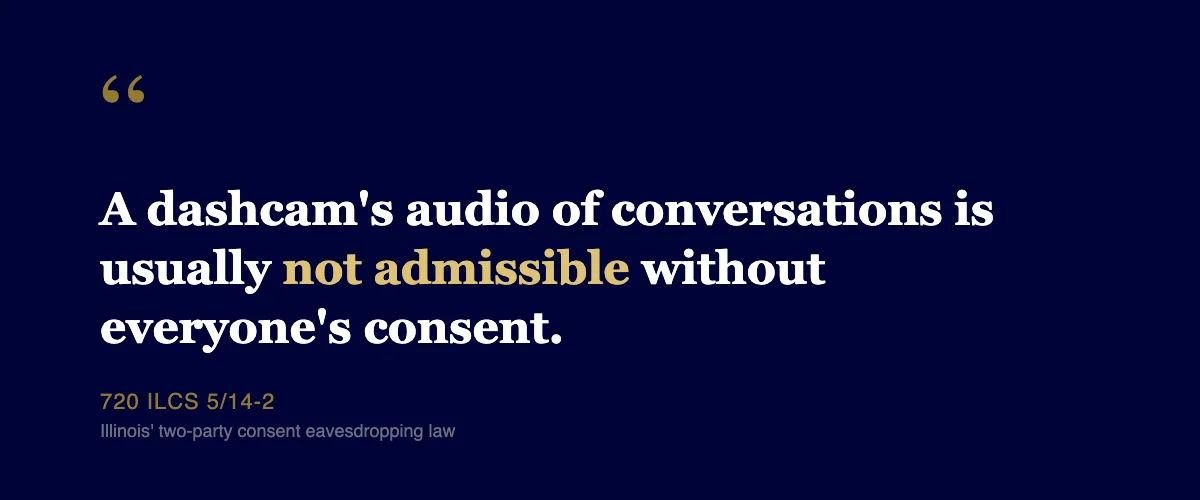
Practically, this means a dashcam that only records video, or one where the audio can be disabled, is the safer setup for anyone concerned about staying fully within Illinois law while still documenting the road.
Types of Dashcams and What They Actually Capture
Not all dashcams capture the same thing, and the type you have affects how useful the footage ends up being in a claim.
- Front-only cameras record the road ahead. They’re the most common and the cheapest, but they won’t show what happened behind you or inside the cabin.
- Dual-channel (front and rear) cameras add a second lens, usually mounted on the rear windshield, which is especially useful in rear-end and tailgating crashes where what happened behind you matters as much as what happened in front.
- 360-degree or multi-camera systems cover the sides of the vehicle as well, which can help in intersection crashes, lane-change collisions, and parking lot incidents where the point of impact isn’t directly ahead or behind.
- Cloud-connected or app-linked dashcams upload footage automatically or let you pull clips remotely, which matters if the physical device is damaged or the car is totaled in the crash and you can no longer access the SD card directly.
For evidentiary purposes, higher resolution and a wider field of view generally produce more useful footage, a blurry, narrow shot of a crash is far less persuasive than a clear one showing both vehicles’ full movement.
Where You Can Legally Mount a Dashcam
Illinois law (625 ILCS 5/12-503) prohibits placing any object, including electronics, on the windshield in a way that materially obstructs the driver’s view. There’s no law written specifically for dashcams, but this general windshield-obstruction rule applies to them. The safest placement, consistent with how most dashcam manufacturers design their mounts, is high on the windshield directly behind the rearview mirror, out of the driver’s direct line of sight.
How Insurers and Courts Evaluate Dashcam Footage
Having the footage is only the first step, how it holds up depends on a few practical factors insurers and courts look at:
- Chain of custody. Can you show the file hasn’t been altered since the moment it was recorded? Keeping the original, unedited file (not a re-saved or cropped copy) matters.
- Metadata. Most dashcams embed a timestamp, and some embed GPS coordinates and speed. This metadata helps establish exactly when and where the footage was captured, which strengthens its credibility.
- Continuity. Footage that captures the moments leading up to the crash, not just the impact itself, is far more persuasive for establishing what each driver was doing beforehand.
- Video quality and angle. A clear, well-positioned recording that shows the other vehicle’s position, signals, and movement carries more weight than grainy or partially obstructed footage.
An attorney or, in a disputed case, a forensic video expert can authenticate footage and address any challenge to its reliability before it’s used in negotiations or at trial.
Dashcam Footage and Illinois’ Comparative Negligence Rule
Dashcam footage matters so much in Illinois specifically because of how the state’s modified comparative negligence rule works. Under 735 ILCS 5/2-1116, if you’re found 51% or more at fault for a crash, you recover nothing, regardless of your injuries. Footage that clearly shows the other driver running a red light, following too closely, or drifting out of their lane can be the difference between a fault split that still lets you recover and one that bars your claim entirely. Because insurance adjusters often start fault negotiations by trying to shift blame onto the other driver, clear video evidence takes a lot of that argument off the table before it starts.
For example: if a dashcam clearly shows the other driver running a red light while you were traveling at a normal speed through a green one, an adjuster has very little room to argue you share 10% or 20% of the fault. Without that footage, the same crash often turns into a “he said, she said” dispute where the adjuster offers a fault split that reduces your payout, simply because there’s nothing concrete to push back against.
Dashcam Footage in Hit-and-Run Cases
Dashcam footage is especially valuable when the at-fault driver flees the scene. A clip that captures a license plate number, the vehicle’s make, model, and color, or distinguishing damage or markings can give police the lead they need to identify the driver. Even partial information, a few digits of a plate, a distinctive bumper sticker, a cracked taillight, combined with witness accounts and nearby camera footage, can be enough to track down a driver who otherwise would never be identified. If you’re the victim of a hit-and-run, provide any dashcam footage to the responding officer immediately and keep a backup copy for your own records.
Common Dashcam Myths in Illinois
A few misconceptions come up often enough that they’re worth addressing directly:
- “Dashcam footage always gets thrown out.” Not true, video footage is regularly used in Illinois car accident claims and lawsuits. What can get challenged is authenticity or chain of custody, not the mere fact that it’s a dashcam recording.
- “I need the audio too, or the footage isn’t useful.” Also not true. The video alone, showing the crash itself, is typically the valuable part. Audio adds legal risk without adding much evidentiary value in most crash scenarios.
- “Any footage automatically proves who was at fault.” Footage is persuasive evidence, not an automatic verdict. It’s weighed alongside the police report, witness statements, and physical evidence, see our guide on evidence you need after a car crash for the full picture of what a claim actually relies on.
What to Look for When Choosing a Dashcam
If you’re deciding whether to install one or which model to buy, a few features make the biggest difference for how useful the footage will actually be if you’re ever in a crash:
- Resolution. At least 1080p is worth insisting on; license plates and road signs become unreadable at lower resolutions, especially at night or in bad weather.
- Loop recording with a large enough card. This lets the camera keep recording continuously by overwriting the oldest footage, but a larger SD card means more footage is retained before anything gets overwritten.
- A G-sensor (impact sensor). This automatically locks and protects the clip around a sudden impact so it doesn’t get overwritten by the loop recording before you can save it manually.
- Parking mode. Some dashcams keep recording, or start recording on motion detection, while the car is parked, useful for hit-and-run damage that happens while you’re not in the vehicle.
- Night vision / low-light performance. A large share of crashes happen in low light; a camera that produces a washed-out, unreadable image at night loses much of its value.
None of this is required by Illinois law, these are practical choices that affect how persuasive the footage ends up being if you ever need to rely on it.
What to Do With Dashcam Footage After a Crash
- Save the footage immediately. Many dashcams overwrite old footage on a loop; back up the relevant clip to your phone or a separate drive before the card cycles.
- Don’t edit or trim the clip. Courts and insurers scrutinize footage for signs of editing. Keep the original file, timestamps included.
- Note the exact time and location. This helps match your footage against the police report and any other camera footage from the scene.
- Check if anyone else’s dashcam caught it. If another driver stopped to help or a witness mentions having a dashcam, ask if they’d be willing to share the clip.
What If You Don’t Have a Dashcam?
Video evidence doesn’t have to come from your own vehicle. Nearby businesses, red-light or traffic cameras, and even other drivers often have footage that captured the crash. This is time-sensitive: many commercial security systems overwrite footage within days to a couple of weeks, so requesting it early matters far more than requesting it thoroughly. Our full guide on evidence you need after a car crash covers the complete checklist, including how to track down this kind of third-party footage before it’s gone.
Working With an Attorney on Dashcam Evidence
If your footage is central to a disputed claim, an attorney can help in ways that go beyond simply handing the clip to an adjuster. That includes preserving a forensic copy of the file before anything happens to the device, requesting matching footage from the other driver or nearby businesses through formal channels if they’re uncooperative, and, where needed, retaining a video analysis expert to authenticate the footage or extract additional detail like enhanced plate numbers or frame-by-frame timing. These steps matter most in cases where fault is genuinely contested and a lot turns on exactly how the footage holds up under scrutiny.
Frequently Asked Questions
Is dashcam video admissible in an Illinois car accident case?
Generally yes, as long as the video is authentic, unaltered, and relevant to the crash. Illinois has no statute banning dashcams or their video footage from being used as evidence in a civil case.
Can I record audio with my dashcam in Illinois?
Only with caution. Illinois’ eavesdropping law (720 ILCS 5/14-2) is a two-party consent statute, meaning recording someone’s voice without their knowledge is generally illegal. Dashcam audio of conversations inside or outside the vehicle can create legal exposure separate from the crash claim itself, and may not be admissible.
Where can I legally mount a dashcam in Illinois?
Illinois law (625 ILCS 5/12-503) prohibits placing any object on the windshield that materially obstructs the driver’s view. A dashcam mounted high on the windshield, directly behind the rearview mirror, is the safest placement to avoid an obstruction violation.
What if I don’t have a dashcam? Can I still get video evidence?
Often, yes. Nearby businesses, traffic cameras, and other drivers’ dashcams may have captured the crash. Footage from business security systems is frequently overwritten within days to weeks, so it should be requested as soon as possible after the crash.
Does dashcam footage automatically win my case?
No. Footage is one piece of evidence among several. It still has to be authenticated, and Illinois’ comparative negligence rule means fault is weighed using all the evidence together, not any single clip alone.
What should I do if the other driver’s dashcam caught the crash?
Ask if they’re willing to share it, and note that they have it so your attorney can request it formally if needed. If the case becomes a lawsuit, that footage can be obtained through discovery even if the other driver doesn’t volunteer it.
Can dashcam footage help prove a hit-and-run driver’s identity?
Yes. A clear shot of a license plate, vehicle make and model, or distinguishing damage can be critical for identifying a driver who fled the scene, and can be provided to police to support the investigation.
Also Read: