
The most damaging mistakes after a Chicago car accident aren’t about what you fail to do, they’re about what you say and share. Apologizing at the scene, giving a recorded statement too early, posting on social media, and delaying medical care are among the most common mistakes that weaken an otherwise strong claim.
Most of these mistakes aren’t made out of dishonesty, they come from shock, politeness, financial pressure, or simply not knowing how an insurance claim actually works. Understanding them in advance is the single easiest way to avoid them when it matters.
1. Apologizing or Admitting Fault at the Scene
“I’m sorry, I didn’t see you” feels like basic courtesy in the shock of a crash, but it can be used against you later, regardless of what the evidence eventually shows. Fault in Illinois is determined by the facts, the police report, witness statements, and physical evidence, not by what either driver says in the first confusing minutes. Adrenaline and shock make people say things they don’t mean or that aren’t even accurate; a driver who apologizes reflexively often hasn’t actually processed what happened yet. Stick to exchanging information and avoid characterizing how the crash happened until you’ve had time to think it through. See our full guide on evidence you need after a car crash for what to actually focus on at the scene instead.
2. Giving a Recorded Statement Too Soon
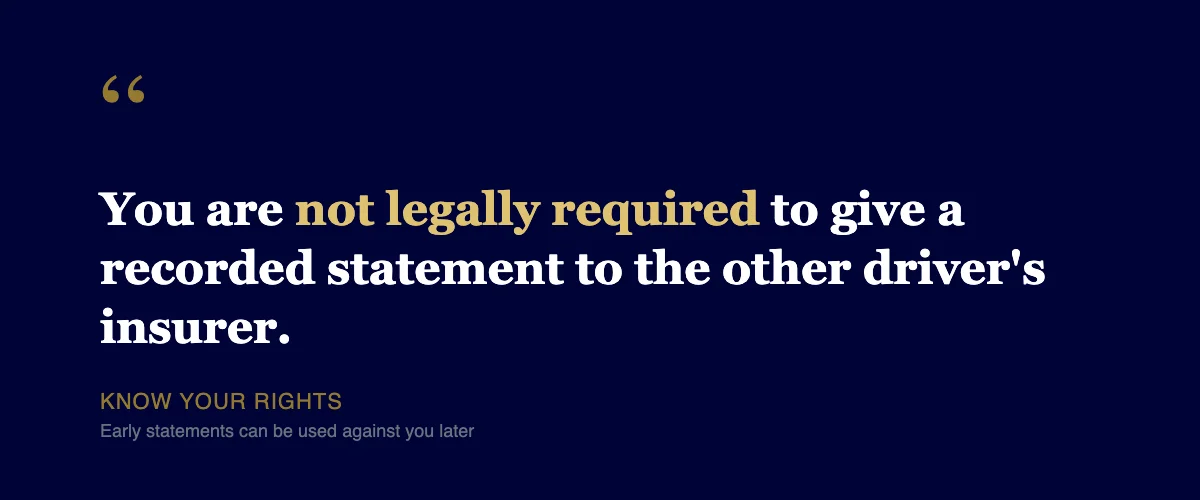
You are not legally required to give the other driver’s insurance company a recorded statement, and doing so before you understand the full extent of your injuries can be a costly mistake. Whiplash, concussions, and soft-tissue injuries often don’t show their full effect for days. A statement given the day after the crash, before symptoms fully emerge, can be used to argue your injuries developed later or aren’t related to the crash at all. Adjusters are trained to ask open-ended questions designed to get you talking, and casual phrasing, like describing yourself as “fine” out of politeness, can later be used to argue you weren’t hurt.
3. Posting About the Accident (or Anything Else) on Social Media
Insurance companies and defense attorneys routinely review claimants’ social media during a claim. It doesn’t have to be a post about the crash itself to cause a problem, a photo from a family event, a workout, or even a smiling vacation picture can be used to argue your injuries aren’t as serious as you’ve described, even when the photo has nothing to do with your actual condition. Privacy settings offer limited protection, since screenshots from mutual friends or public posts are often enough. The safest approach is to avoid posting about your activities at all until your claim is resolved.
4. Delaying Medical Treatment
Gaps in treatment are one of the first things an insurance adjuster points to when disputing a claim. Waiting days or weeks to see a doctor, or skipping follow-up appointments once the initial pain fades, creates a record that can be read as “not seriously hurt,” whether or not that’s true. This also applies to switching providers or missing physical therapy sessions, each gap becomes a data point an adjuster can cite. For more on how this plays out with adjusters specifically, see our breakdown of common insurance mistakes after a car accident in Illinois.
5. Accepting the First Settlement Offer
Early settlement offers are often calculated before the full cost of an injury is known, before all medical bills are in, before lost wages are totaled, and before anyone knows whether an injury will require ongoing care. Once you accept and sign a release, the claim is closed permanently, even if your condition worsens afterward. Insurers often make their fastest, lowest offers in the first few weeks, specifically because that’s when claimants are most likely to accept out of financial pressure before understanding the claim’s real value.
6. Not Understanding How Fault Percentage Affects Your Recovery
Illinois follows a modified comparative negligence rule: if you’re found 51% or more at fault, you recover nothing, no matter how serious your injuries are. Many people don’t realize how directly their own evidence, and their own statements, affect that percentage. Our guide on Illinois’ comparative negligence law explains exactly how this works.
7. Waiting Too Long to Act
Illinois’ statute of limitations for a personal injury claim is generally two years from the date of the crash (735 ILCS 5/13-202), but waiting anywhere near that deadline is its own mistake. Surveillance footage gets overwritten, witnesses move or forget details, and vehicles get repaired or scrapped. Our podcast episode on mistakes people make after a motor vehicle accident covers more of these pitfalls in detail.
8. Repairing or Discarding Your Vehicle Too Soon
The vehicle itself is evidence. The location and pattern of damage, the direction of impact, and even paint transfer from the other car can all support your account of how the crash happened. Getting repairs done, or trading in or scrapping a totaled vehicle, before it’s been thoroughly photographed and documented can permanently eliminate evidence that might have been important, especially in a disputed-fault case. If possible, get a full set of photos from multiple angles and keep the repair estimate before any work begins.
9. Waiting Too Long to Involve an Attorney
This is one of the most common and most costly mistakes on this list, because it compounds all the others. Many people wait to call a lawyer until the insurance company’s offer feels obviously too low, or until a dispute over fault starts to stall the claim. By that point, some of the damage from the mistakes above may already be done. An attorney involved early can intervene before a recorded statement is given, before a low settlement is accepted, and while evidence like dashcam footage or surveillance video is still available to request.
10. Downplaying Your Injuries to Family, Friends, or Coworkers
It’s natural to tell people you’re “doing okay” or “getting better” even when you’re still in real pain, especially to avoid worrying loved ones or explaining the details repeatedly. The problem is that these casual, optimistic comments can surface later, through witness interviews, social media, or even a deposition of someone close to you, and get contrasted against the more serious picture presented in your claim. Being accurate about how you’re actually doing, even in casual conversation, avoids creating a conflicting record.
11. Not Keeping Your Own Records
Insurance companies and medical providers keep records; most people don’t keep their own. A simple daily or weekly note on pain levels, missed activities, appointments, and how an injury is affecting work and daily life creates a contemporaneous record that’s far more credible than trying to reconstruct months later how bad a particular week was. This kind of personal record can meaningfully strengthen a pain-and-suffering claim, which otherwise relies heavily on medical notes that don’t always capture the day-to-day reality.
A Realistic Example of How a Small Mistake Compounds
Consider a common, realistic scenario: someone is rear-ended, feels shaken but not obviously hurt, and tells the other driver “I think I’m okay” at the scene. A friend posts a photo of them at a birthday party two days later, smiling, with no visible injury. A week after that, worsening neck pain sends them to urgent care, and they finally start treatment. None of these individual moments is a lie or even unreasonable, but together, an adjuster can stitch them into a narrative that the injury wasn’t serious, developed later for unrelated reasons, or is being exaggerated. Avoiding this outcome isn’t about hiding anything; it’s about being deliberate rather than reflexive about what gets said and shared in the days after a crash.
How Insurance Adjusters Exploit These Mistakes
Adjusters aren’t acting maliciously when they use these mistakes against a claim, they’re doing their job, which is to resolve the claim for as little as the company can justify. A gap in treatment becomes “the injury wasn’t serious.” An early apology becomes “even the claimant admitted fault.” A social media photo becomes “inconsistent with the claimed injuries.” None of these mistakes are necessarily fatal to a claim on their own, but they give an adjuster leverage in negotiations, and leverage translates directly into a lower offer.
Already Made One of These Mistakes? Here’s What Still Helps
None of these mistakes automatically end a claim. An early apology can be explained as shock, not an admission. An ill-timed recorded statement can often be clarified or supplemented once your medical picture is clearer. A social media post can be put in context. What matters most from this point forward is stopping the damage: get a full medical evaluation if you haven’t already, start keeping your own written record of what happened and how you’re recovering, and avoid any further contact with the other driver’s insurer without first talking to an attorney. The earlier a lawyer gets involved after a mistake, the more room there usually is to manage its impact on the claim.
A Quick Checklist for the First 48 Hours
If you’ve just been in a crash, the mistakes above come down to a short list of things to avoid and do: don’t apologize or speculate about fault at the scene, don’t give a recorded statement to the other driver’s insurer yet, don’t post about the crash or your activities on social media, don’t delay seeing a doctor even if you feel “mostly fine,” don’t let the vehicle get repaired before it’s documented, and don’t sign or accept anything from an insurance company without understanding what you’re giving up. Do get medical care, do keep your own notes, and do talk to an attorney before the conversation with the insurance company goes any further than exchanging basic information.
Frequently Asked Questions
Should I say sorry or admit fault at a car accident scene?
No. Fault is determined by evidence, the police report, and the insurers’ investigation, not by what either driver says at the scene. An apologetic statement like “I didn’t see you” can be used against you later even if you weren’t actually at fault.
Do I have to give a recorded statement to the other driver’s insurance company?
No, you are generally not legally required to give a recorded statement to the other driver’s insurer. Early statements, given before you know the full extent of your injuries, can lock you into wording that doesn’t match how your condition develops.
Can social media posts hurt my car accident claim?
Yes. Insurance companies and defense attorneys routinely review claimants’ social media. Even unrelated photos, such as attending a family event, can be used to argue your injuries aren’t as serious as you’ve claimed.
How long do I have to file a car accident claim in Illinois?
Generally two years from the date of the crash under 735 ILCS 5/13-202. Waiting too long to act, even before that deadline, can mean lost evidence and faded witness memories, which is its own common mistake.
Should I get my car repaired right away after a crash?
Not before it’s been documented. Get repair estimates and photograph the damage thoroughly before any repairs begin, since the vehicle itself is evidence of how the crash happened and how severe the impact was.
Is it too late to fix a mistake I already made after my accident?
Usually no. Most mistakes, like an early statement or a social media post, can be explained or managed with the right strategy once an attorney is involved. The bigger risk is doing nothing and letting the mistake stand unaddressed.
When should I hire a car accident attorney?
As early as possible, ideally before you give any statement to an insurance company. An attorney can intervene before mistakes happen rather than trying to minimize the damage afterward.
Also Read:
Evidence You Need After a Car Crash in Chicago