

How Fault Is Determined in a Chicago Burn Injury Case
Burns are among the most painful and expensive injuries in personal-injury law. Fault is rarely obvious. This page walks through how Illinois courts and Chicago juries actually decide who caused the fire or explosion, and what evidence Phillips Law Offices uses to prove it. Free consultation. No fee unless we win.
A serious burn injury reshapes a life. Beyond the immediate pain, victims often face years of grafting and reconstructive surgery, permanent scarring, and psychological trauma. The cost of treatment at a regional burn center routinely runs into six and seven figures. The legal question that sits at the center of every claim is the same: who was at fault, and how is that proven? The lawyers at Phillips Law Offices have handled burn-injury cases across Chicago and Illinois for decades, and this page is meant as a working guide for how fault is actually determined in these cases.
Recognized for results in Illinois personal-injury law
Eight decades of trial work has put the firm and its lawyers on the lists that matter. A sample of the recognitions on file:
Super Lawyers
Personal Injury – Plaintiff
Million Dollar Advocates Forum
Member
Multi-Million Dollar Advocates Forum
Member
Best Lawyers in America
Personal Injury Litigation – Plaintiffs
AV Preeminent
Martindale-Hubbell peer rating
Illinois Trial Lawyers Association
Member in good standing
American Association for Justice
Member
Chicago Bar Association
Member
No aspect of these advertisements has been approved by the Supreme Court of Illinois. Past results do not guarantee future outcomes.
Common burn-injury scenarios in Chicago
Before you can determine fault, you have to understand how the burn happened. Burn-injury cases that come through Phillips Law Offices generally fall into a handful of recurring patterns:
- Kitchen and restaurant scalds – employees burned by spilled fryer oil, ruptured pressure cookers, or steam tables; customers burned by overheated coffee, soup, or by sterno fires.
- Building fires from defective electrical or heating equipment – failed space heaters, recalled lithium batteries, faulty wiring, and overloaded outlets in older Chicago two-flats and three-flats.
- Chemical burns at industrial workplaces – exposure to acids, alkalis, and solvents at Chicago-area plants and warehouses.
- Gas-line explosions – failed utility shutoffs, mismarked underground lines, and contractor strikes during excavation.
- Gasoline-fire crashes – tank ruptures and post-collision fires in motor-vehicle and truck wrecks.
- Electrical burns from contact with downed power lines after storms and construction-equipment contact with overhead lines.
- Scalding-water burns to children in landlord-controlled units – thermostats set above code and missing anti-scald valves.
Establishing fault: the four elements of negligence
Illinois follows the traditional four-element negligence framework, and a burn-injury case is built one element at a time:
- Duty. The defendant owed a duty of care to the burn victim. Landlords owe duties to tenants under the Premises Liability Act. Employers owe duties to workers. Product manufacturers owe duties to foreseeable users. Gas and utility companies owe duties to the public.
- Breach. The defendant failed to meet the standard of care. In burn cases this usually means a code violation, a missed inspection, an ignored work order, a recalled product still on the shelf, a missed locate-call on a gas line, or an unsafe procedure on the production floor.
- Causation. The breach actually caused the fire or explosion that burned the victim. This is where the origin-and-cause investigator earns their fee.
- Damages. The victim suffered measurable harm – medical bills, lost income, pain and suffering, disfigurement, and loss of normal life.
The Illinois burn-degree framework
The severity of the burn matters for fault analysis because it points to the energy source and the duration of contact. Treating physicians grade burns by depth and by total body surface area (TBSA):
- First-degree burns affect only the epidermis. Redness without blistering. Painful but heal without scarring.
- Second-degree burns affect the dermis. Blistering, severe pain, and a real risk of infection and scarring.
- Third-degree (full-thickness) burns destroy the entire skin layer and damage subcutaneous tissue. The skin appears leathery or charred. These always require grafting.
- Fourth-degree burns extend into muscle, tendon, and bone. Often require amputation.
- Smoke and inhalation injury. Often the deadliest part of a fire case. Treated by burn-center pulmonology and can drive long-term disability independent of skin burns.
Who can be held liable
- Property owners and landlords under the Premises Liability Act, 740 ILCS 130/2 – for code-violating wiring, missing smoke detectors, blocked egress, and unsafe water-heater settings.
- Product manufacturers for defective lithium batteries, space heaters, fryers, pressure cookers, and recalled appliances under Illinois product-liability law (subject to the statute of repose, 735 ILCS 5/13-213).
- Employers through the Workers’ Compensation Act, 820 ILCS 305 – the exclusive remedy against the employer, but separate third-party claims are still available.
- Contractors and subcontractors on construction sites – struck gas lines, unsafe hot-work, and missing fire watches.
- Gas and utility companies for failed locates, defective fittings, and failed shutoffs.
- Government entities in narrow circumstances – subject to the strict notice and limitations rules of the Tort Immunity Act, 745 ILCS 10/8-101.
The Illinois law that drives a burn case
- Statute of limitations – personal injury: two years under 735 ILCS 5/13-202.
- Wrongful death: two years under 740 ILCS 180/2.
- Modified comparative fault (50% bar): 735 ILCS 5/2-1116.
- Premises Liability Act: 740 ILCS 130/2.
- Product-liability statute of repose: 735 ILCS 5/13-213.
- Workers’ Compensation Act: 820 ILCS 305.
- Tort Immunity Act: 745 ILCS 10/8-101 – one-year statute and notice requirement against public entities.
Defenses you should expect
- Open-and-obvious doctrine. Defendants argue the danger was visible and the victim should have avoided it. Illinois recognizes a “distraction” exception that often defeats this defense.
- Comparative fault. Under 735 ILCS 5/2-1116, the defense will try to assign you a percentage of fault. Cross 50% and recovery is barred. Stay at or below 50% and damages are reduced by your share.
- Assumption of risk. Limited in Illinois but raised in industrial and recreational burn cases.
- “The product was modified after sale.” A common product-liability defense, often defeated by the original design’s foreseeable misuse.
- “It was a pre-existing condition.” Used to limit damages where the victim had prior skin conditions or surgical scars.
What to do in the first 72 hours after a Chicago burn injury
- Get to a regional burn center. The Chicago area has dedicated burn centers at Loyola University Medical Center, Stroger Hospital, the University of Chicago Medicine, and OSF Saint Anthony in Rockford. Burn-center care dramatically improves outcomes for serious burns.
- Preserve the scene. An origin-and-cause investigator needs the scene as untouched as possible. Photograph it immediately and ask the building owner or employer not to disturb it.
- Identify witnesses and first responders. Chicago Fire Department investigators, ATF agents (in some commercial fires), and Illinois State Fire Marshal investigators may all be involved.
- Save all damaged property. Burned clothing, appliances, batteries, and packaging are often the best evidence in a product-liability case. Do not throw them out.
- Do not give a recorded statement to any insurer. Adjusters will call within 24 to 48 hours. You are not required to talk to them.
- Call a burn-injury lawyer right away. Surveillance footage, building maintenance logs, and corporate inspection records can lawfully be overwritten on rolling cycles. A spoliation letter has to go out fast.
How Phillips Law Offices investigates a Chicago burn injury case
- Day 1 – Spoliation and evidence-preservation letters. We put the property owner, employer, manufacturer, contractor, and utility on written notice to preserve the scene, the product, the maintenance file, and any surveillance.
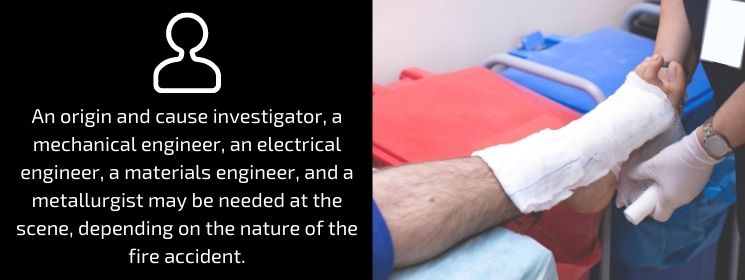
- Origin-and-cause investigation. We retain a certified fire investigator, and where the facts call for it, an electrical engineer, a mechanical engineer, a materials engineer, or a metallurgist to determine the fire’s point of origin and ignition source.
- Medical workup. We coordinate with treating burn surgeons, pulmonologists (for inhalation injury), reconstructive surgeons, and mental-health providers. We retain a life-care planner to project lifetime grafting, scar revisions, and rehabilitation.
- Insurance and corporate discovery. We identify every layer of coverage – commercial general liability, product liability, umbrella, excess, and Workers’ Comp – so the full coverage is on the table.
- Resolution. Most cases resolve through pre-suit negotiation or mediation. When the carrier will not pay fair value, we file suit and try the case.
Meet the attorneys who will work on your case

Stephen D. Phillips
Managing Partner. Decades of trial experience in serious-injury and wrongful-death litigation.

Stephen J. Phillips
Partner. Focuses on complex personal-injury and burn-injury cases throughout Illinois.

Michael J. Phillips
Partner. Wide trial experience in product-liability, premises, and burn-injury matters.

Terrence M. Quinn
Partner. Litigation focus on catastrophic injury, wrongful death, and trial practice.

Alec D. Mesrobian
Associate. Works on case investigation, discovery, and trial preparation in serious-injury matters.
What our Illinois clients have said
“Stephen Phillips and his team were absolutely incredible to work with. They were professional, responsive, and genuinely cared about my case.”
Reagan Tokoly
“Phillips Law Offices handled my case with professionalism and care. They kept me informed throughout the entire process.”
Brandon DeWitt
“The team at Phillips Law Offices was outstanding. They fought hard for my case and got me the compensation I deserved.”
Dani Berny
Client testimonials reflect individual experiences and are not a guarantee of any particular result. Every case is unique and is evaluated on its own facts.
Frequently asked questions
How is a burn injury legally classified?
Burns are clinically graded by depth (first through fourth degree) and by total body surface area (TBSA). First-degree burns affect only the epidermis. Second-degree burns affect the dermis and produce blisters. Third-degree (full-thickness) burns destroy the entire skin layer and the structures beneath it. Fourth-degree burns extend into muscle, tendon, and bone. Smoke inhalation is treated as a separate injury and often drives the most serious long-term consequences.
Can I sue if the fire happened in my apartment?
Often, yes. Apartment-fire cases are usually premises-liability claims against the landlord, the building owner, or the property-management company under 740 ILCS 130/2. Common claims include missing or non-working smoke detectors, blocked egress, code-violating wiring, defective heating equipment, scalding-water temperatures, and unsafe stove or oven installations. Tenants can also bring product-liability claims if the fire traces to a defective appliance.
What if I was burned at work?
Burn injuries on the job in Illinois are covered by the Workers’ Compensation Act, 820 ILCS 305 – medical care, temporary total disability, and a permanency award are available regardless of who was at fault. A separate third-party personal-injury claim can also be filed against a non-employer defendant who caused the fire or explosion – a subcontractor, equipment manufacturer, gas-line operator, or property owner.
How is permanent scarring valued in Illinois?
Disfigurement and scarring are recoverable as their own category of damages in Illinois. A treating burn surgeon documents TBSA, color and texture differences, contracture, and the projected need for scar revision surgery. Juries are allowed to consider visibility, body location, and the victim’s age. Pediatric facial burns and burns to the hands, neck, and chest tend to carry the highest disfigurement awards.
How long do I have to file a burn injury lawsuit in Illinois?
Adult personal-injury plaintiffs have two years from the date of the burn under 735 ILCS 5/13-202. Wrongful death follows a two-year window under 740 ILCS 180/2. Product-liability claims are subject to the statute of repose under 735 ILCS 5/13-213. If a public entity is involved, the Tort Immunity Act (745 ILCS 10/8-101) cuts the window to one year and adds a formal notice requirement.
Hablamos español
Si usted o un ser querido sufrió una lesión por quemadura en Chicago o en cualquier parte de Illinois, llámenos al (312) 346-4262. La consulta es gratis y no cobramos honorarios a menos que ganemos su caso.
Contact our Chicago burn injury attorney
If you or a family member has been injured in a fire, explosion, or other burn incident in Chicago, Cook County, DuPage County, Lake County, or Will County, call Phillips Law Offices for a free, no-obligation case review. The sooner we get the spoliation letter out and the origin-and-cause investigation started, the stronger your case will be. Reach us any time at (312) 346-4262.
Free, confidential case review
Phillips Law Offices, 161 N Clark St #4925, Chicago, IL 60601. Monday-Friday, 9am-5pm. Calls answered 24/7.
Related Phillips Law Offices pages
- Chicago Burn Injury Lawyer (main practice page)
- Premises Liability Attorneys
- Product Liability Lawyers
- Burns in Nursing Homes
- Professional Negligence Claims
- Contact Phillips Law Offices
Page reviewed by the attorneys at Phillips Law Offices. The information on this page is for general education only and is not legal advice. Reading this page does not create an attorney-client relationship. Past results do not guarantee a similar outcome. No aspect of these advertisements has been approved by the Supreme Court of Illinois.