

If you caught Legionnaires’ disease after using a hotel hot tub or pool in Illinois, the hotel’s owner and operator can be held responsible. Illinois requires hotels and other property owners to keep their premises reasonably safe for guests, and that includes the water in a spa. The hardest part of these cases is not the law. It is proving where the bacteria came from, which is why the first days after a diagnosis matter so much.
The issue is close to home. In September 2026, the City of Evanston announced two confirmed cases of Legionnaires’ disease linked to the Hilton Garden Inn North Shore/Evanston. Both people had been in the hotel’s pool and hot tub area in August, and testing by the Illinois Department of Public Health found Legionella bacteria in the water system serving the hot tub.
What Legionnaires’ disease is
Legionnaires’ disease is a serious type of pneumonia caused by Legionella bacteria. According to the CDC, people get it by breathing in mist or small droplets of water that contain the bacteria. It does not normally spread from person to person.
Legionella grows in warm water that is not properly treated. Hot tubs are one of the classic sources, because they combine warm water with jets that throw mist into the air right where people are breathing. Cooling towers and building plumbing are others.
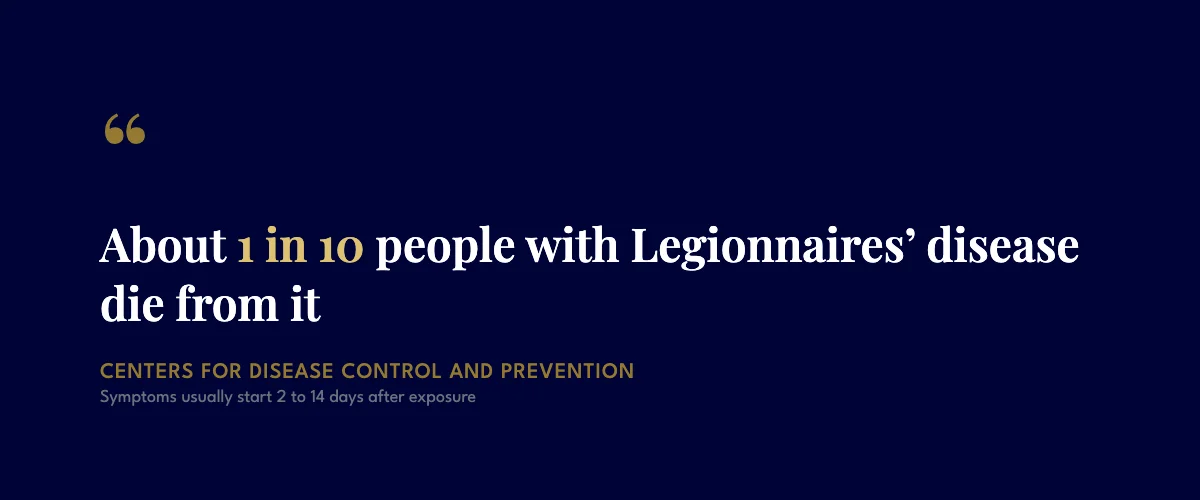
Symptoms usually start 2 to 14 days after exposure: cough, fever, shortness of breath, headache and muscle aches. Most healthy people who are exposed never get sick. The illness hits hardest in people over 50 and in current or former smokers. People with chronic lung disease or a weakened immune system are also at higher risk. The CDC estimates that about 1 in 10 people who get Legionnaires’ disease die from it.
Illinois sees hundreds of cases a year. The Illinois Department of Public Health reported 287 cases statewide in its preliminary data through early October 2025, in a release about a separate cluster linked to a skilled nursing facility in Bloomingdale.
Who can be held liable
The hotel owner and operator
Under the Illinois premises liability law, 740 ILCS 130, a property owner owes guests a duty of reasonable care. For a hotel with a pool or hot tub, that means keeping the water properly disinfected and the equipment maintained, and acting on problems instead of waiting for someone to get sick.
Illinois regulates pools and spas under the Swimming Facility Act and the Department of Public Health’s swimming facility rules. Those rules set water quality and operating standards for spas at hotels and similar facilities. In Illinois, breaking a safety regulation meant to protect the public can be used as evidence that the owner was negligent, so inspection reports and the hotel’s own water testing logs are often central to the case.
Franchisors and management companies
Many hotels carry a national brand but are owned by one company and run by another. Responsibility usually falls on whoever owned and operated the property. A brand or franchisor is liable only if it controlled the day-to-day operations that failed, such as setting and enforcing the water maintenance program. Sorting out who actually ran the pool is an early step in these cases.
Contractors
Some hotels hire outside companies to service their pools and spas or to manage water treatment. If that contractor skipped required work or ignored warning signs, it can share responsibility.
Proving where you caught it
Because symptoms can take up to two weeks to appear, the hotel will argue that you could have been exposed anywhere. Most of these cases turn on the medical proof and the public health findings, backed by the hotel’s own records.
Start with the diagnosis. The CDC recommends that doctors test for Legionnaires’ disease with both a urine antigen test and a culture from a lower respiratory sample. A culture matters because it lets the lab compare the bacteria from your lungs with bacteria found in the hotel’s water.
Then there is the public health investigation. When health officials link several cases to one place and then find Legionella in the water people were exposed to, as happened in Evanston, that finding carries real weight.
Finally, the hotel’s own records matter: water chemistry logs, maintenance records, past inspection results and complaints from other guests. Those records can disappear or be overwritten, so a lawyer will usually ask the hotel to preserve them right away.
What you can recover
Legionnaires’ disease often means a hospital stay, sometimes in intensive care on a ventilator, and recovery can take months. A claim can cover medical bills and lost income, along with the pain of a serious illness and any lasting lung damage the medical records support. If someone died, the family can bring a wrongful death claim under the Illinois Wrongful Death Act, 740 ILCS 180.
Guests from other states who got sick at an Illinois hotel can usually bring their claim in Illinois, where the hotel is located.
What to do if you got sick after a hotel stay
Tell your doctor you used a hot tub or pool in the two weeks before you got sick, and ask whether you should be tested for Legionella. Many pneumonia cases are treated without anyone checking for it, and an untested case is much harder to connect to the hotel.
Report the illness to your local health department. One report can start an investigation, and it helps the next guest. Keep your hotel confirmation and receipts, and write down the dates you used the pool or spa.
Do not sign anything from the hotel or its insurer, or accept a refund offered as a settlement, before you understand your claim. Our guide on what to do right after a premises liability injury covers the basics.
Illinois filing deadlines
Illinois generally allows two years to file a personal injury lawsuit (735 ILCS 5/13-202) and two years from the date of death for a wrongful death claim (740 ILCS 180/2). Because the source of an infection is not always clear at first, the date that starts the clock can be disputed. Our guide to the Illinois personal injury statute of limitations explains how that works.
Legionnaires’ disease is also a concern in nursing homes and hospitals, where the death rate is much higher. If your family member got sick in a care facility, see our page on nursing home infections.
Talk to an Illinois premises liability lawyer
Phillips Law Offices handles premises liability cases across Illinois. Our swimming pool accident attorneys can move quickly to preserve the hotel’s records and bring in the medical experts needed to connect your illness to the source. We covered another outbreak case in our post on the 2026 Illinois Cyclospora outbreak. The consultation is free, and you pay no fee unless we recover compensation for you.
Call (312) 346-4262 or book a free consultation online.
Frequently asked questions
Can you get Legionnaires’ disease from a hotel hot tub?
Yes. Hot tubs are one of the most common sources, because warm water and jets spray mist that can carry Legionella bacteria into the lungs. In 2026, Illinois health officials linked two cases to the hot tub area of an Evanston hotel after finding Legionella in its water system.
Can I sue a hotel for Legionnaires’ disease in Illinois?
Often, yes. Illinois premises liability law requires hotels to keep their property reasonably safe for guests, including pool and spa water. The key is proving the illness came from the hotel, which is why a Legionella test and the hotel’s water records matter so much.
How long after exposure do Legionnaires’ symptoms start?
Usually 2 to 14 days after exposure, according to the CDC. Symptoms include cough, fever, shortness of breath, headache and muscle aches. Tell your doctor about any hot tub or pool use in the two weeks before you got sick.
Is Legionnaires’ disease contagious?
No, not in typical circumstances. People get it by breathing in water droplets that contain the bacteria, not from another person.
How long do I have to file a Legionnaires’ claim in Illinois?
Generally two years for an injury claim and two years from the date of death for a wrongful death claim. The start date can be disputed when the source was not identified right away, so it is safer to get advice early.