

After a car crash in Chicago, the evidence that matters most is: photos of the scene and vehicle damage, the official police report, the other driver’s contact and insurance information, witness statements, your medical records, and dashcam or surveillance footage where it exists. Under Illinois’ comparative negligence law, this evidence doesn’t just support your claim, it directly decides how much of it you can recover, or whether you can recover anything at all.
Why Evidence Matters More in Illinois Than in Most States
Illinois follows a modified comparative negligence rule (735 ILCS 5/2-1116): if you’re found 50% or less at fault for a crash, you can still recover damages, reduced by your percentage of fault. But if you’re found 51% or more at fault, you recover nothing, regardless of how badly you were hurt. Lawyers call this the “51% bar,” and it means the evidence you gather in the minutes and days after a crash can be the entire difference between a real settlement and a denied claim.

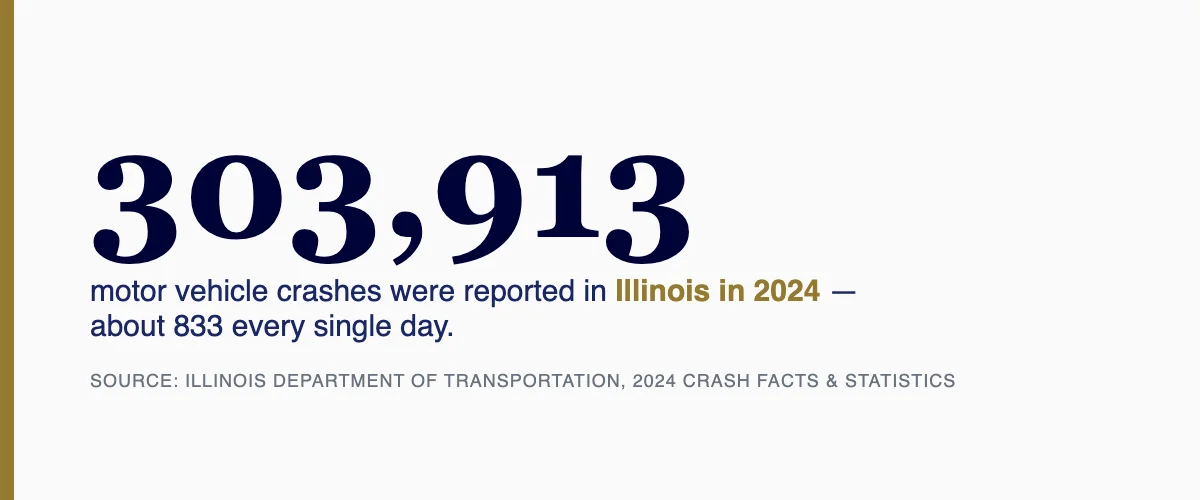
This isn’t a theoretical risk. Illinois recorded 303,913 motor vehicle crashes in 2024, the most recent year with final state data, roughly 833 crashes every day. Of those, 63,109 (20.8%) caused an injury and 1,085 were fatal, resulting in 1,196 deaths, including 217 pedestrians. Speed was a factor in 31.1% of all crashes and 45.3% of fatal ones.
In nearly every one of these cases, fault isn’t obvious from the wreckage alone, it’s reconstructed from evidence, usually by an insurance adjuster whose job is to minimize what their company pays. Read our full breakdown of Illinois crash statistics for more context on how common and how serious these numbers really are.
If you’re unsure how fault percentages affect a payout, see our guide on Illinois’ comparative negligence law.
The 7 Types of Evidence to Collect at the Scene
If you’re safe to do so, collect as much of the following as you can before you leave the scene. Insurance companies and courts both weigh evidence gathered in the moment far more heavily than a recollection written days later.
- Photos and video of everything, vehicle damage from multiple angles, the full accident scene, skid marks, debris, road and weather conditions, traffic signals or signs, and your visible injuries. Time-stamped photos are especially persuasive.
- The police report. Illinois law requires a crash to be reported to police when it involves injury, death, or more than $1,500 in property damage ($500 if a government vehicle or property is involved). The report is often the single most-cited document in a claim. See our guide on how to obtain a police report after a car accident if you weren’t given a copy at the scene.
- The other driver’s information, name, phone number, driver’s license number, license plate, and insurance company and policy number. Photograph their license and insurance card directly if they’ll allow it; it’s faster and more accurate than writing it down.
- Witness names and contact information. Witnesses often leave before police arrive. If you can safely approach anyone who saw what happened, get their name and phone number, their statement can carry real weight if the other driver disputes fault later.
- Dashcam or surveillance footage. Video of the roadway from a dashcam is generally admissible in an Illinois case, but Illinois’ eavesdropping law (720 ILCS 5/14-2) is a two-party consent statute: a dashcam’s audio of people’s voices is usually not admissible without everyone’s consent, even though the video is fine. If a nearby business has an exterior camera that may have caught the crash, ask before the footage is overwritten, many systems only retain video for a week or two.
- Medical documentation, even for minor injuries. See a doctor promptly and report every symptom, including ones that seem minor at first (whiplash and concussions often don’t show their full effect for days). Gaps in treatment are one of the first things adjusters point to when disputing a claim. Our guide on what evidence is needed to support a personal injury claim covers this in more depth.
- Your own written account, while your memory is freshest. Write down what happened, direction of travel, speed, weather, what each driver said, the same day if possible. Memory fades fast, and insurers will ask for a recorded statement before you’ve had time to reconstruct events on your own.
Evidence That Matters After You Leave the Scene
The strongest claims keep building evidence well past the day of the crash:
- All medical bills and records, not just the first ER visit, follow-up appointments, physical therapy, imaging, and prescriptions all document the real cost and severity of your injury.
- Repair estimates and vehicle damage appraisals, which help establish the force of the collision.
- Pay stubs or employer letters documenting lost wages if your injuries kept you out of work.
- All written and recorded communication with insurance companies, save emails, letters, and claim numbers; note the date, time, and content of every phone call.
- An accident reconstruction or medical expert report, for serious-injury cases where fault or causation is disputed.
Together, this is what turns a claim into a case with a real, provable dollar value. Our guide on how much a car accident case is worth in Illinois walks through how these pieces combine into a settlement figure.
What Insurance Adjusters Look For, and Exploit
An adjuster’s job is to close your claim for as little as the company can justify. Thin or inconsistent evidence gives them room to do that: a gap in treatment becomes “the injury wasn’t serious,” a missing police report becomes “liability is unclear,” and a recorded statement given before you’ve reviewed the facts becomes something used against you later. Our breakdown of common insurance mistakes after a car accident in Illinois and this podcast episode on mistakes people make after a motor vehicle accident cover the specific traps to avoid. The short version: the better documented your claim is from day one, the less room an adjuster has to dispute it.
How Long You Have to Preserve Evidence in Illinois
Illinois’ statute of limitations for a personal injury claim is generally two years from the date of the crash (735 ILCS 5/13-202). If the at-fault party is a government entity, a CTA bus, a Pace bus, a city vehicle, that window can shrink to as little as one year, with additional notice requirements that apply much sooner.
The legal deadline to file isn’t the same as the practical deadline to preserve evidence, though. Surveillance footage from nearby businesses is often overwritten within days to weeks. Vehicles get repaired or scrapped, erasing physical evidence of the impact. Witnesses move, change numbers, or simply forget. The earlier your evidence is locked down, ideally within the first 1–2 weeks, the stronger your claim stays, no matter how much time remains on the legal clock.
Frequently Asked Questions
Is dashcam footage admissible in an Illinois car accident case?
Yes, dashcam video is generally admissible in Illinois if it is authentic, unaltered, and relevant. Audio is different: Illinois’ eavesdropping law (720 ILCS 5/14-2) requires consent from everyone being recorded, so dashcam audio of voices is often not admissible unless all parties agreed to it.
Do I have to call the police after a minor car accident in Illinois?
Illinois law requires police notification when a crash causes injury, death, or more than $1,500 in property damage ($500 if government property is involved). Even below that threshold, calling the police creates an official report that can be critical evidence if the other driver later disputes what happened.
What if I didn’t take photos at the accident scene?
You can still build a strong claim. Request the police report, ask nearby businesses about surveillance footage before it’s overwritten, get repair estimates showing vehicle damage, and write down everything you remember as soon as possible. An attorney can also help track down additional evidence like traffic camera footage.
How does evidence affect my settlement under Illinois’ comparative negligence law?
Under 735 ILCS 5/2-1116, your compensation is reduced by your percentage of fault, and you recover nothing if you’re found 51% or more at fault. Evidence is what determines that fault percentage, so stronger documentation directly translates into a larger, or sometimes the only, recovery.
How long do I have to file a car accident claim in Illinois?
Illinois’ statute of limitations for personal injury claims is generally two years from the date of the crash (735 ILCS 5/13-202). Claims against a government entity, such as a CTA or Pace bus, often have a shorter one-year deadline with earlier notice requirements, so it’s important to confirm the deadline that applies to your specific case.
Also Read:
What Is Comparative Negligence?