
Updated November 18, 2026.
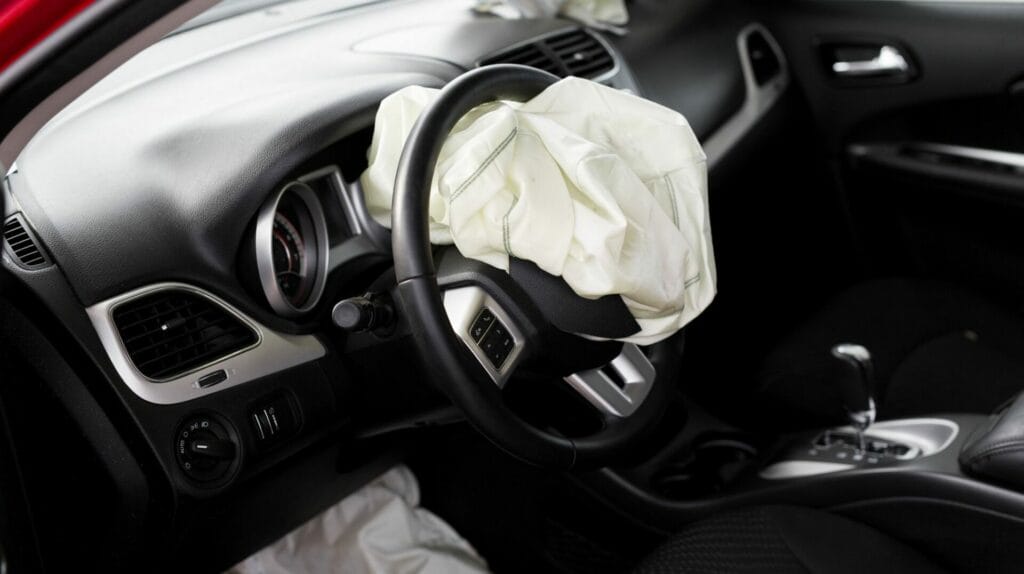
A faulty airbag can fail to deploy in a crash, deploy when it should not, deploy with too much force, or, in the most dangerous cases, rupture and spray metal fragments into the vehicle. The Takata recall, the largest auto safety recall in U.S. history, involved inflators that could explode and was linked to more than two dozen deaths in the United States. When a defective airbag causes or worsens an injury, the vehicle or airbag manufacturer can be held liable under Illinois product liability law, even if another driver caused the crash itself.
Types of airbag defects
Rupturing inflators. Takata inflators used a propellant that could degrade over time, especially in heat and humidity, causing the inflator to explode and send metal pieces into the cabin. Federal regulators have also investigated inflators made by ARC Automotive.
Failure to deploy. Faulty sensors, wiring or control modules can keep an airbag from going off in a serious crash. Our post on what to do if your airbags did not deploy covers these cases.
Unexpected deployment. An airbag that deploys without a crash can injure the driver or cause a collision.
Excessive force or poor design. Airbags can injure occupants, particularly children or short adults, if they deploy too forcefully or are poorly positioned.
Check your vehicle for open recalls
Enter your vehicle identification number (VIN) on the National Highway Traffic Safety Administration’s recall lookup at nhtsa.gov/recalls. Airbag recall repairs are free at dealers. NHTSA has urged owners of some older vehicles with Takata inflators not to drive them until they are repaired.
Who is liable for a faulty airbag injury
Illinois product liability law allows claims against the manufacturer of a defective airbag, the vehicle manufacturer, and sometimes other companies in the chain of distribution. A claim can be based on a design defect, a manufacturing defect, or a failure to warn. Under strict liability, you generally do not have to prove the manufacturer was careless, only that the product was unreasonably dangerous when it left the manufacturer’s control and that the defect caused your injury.
Airbag defect cases often involve “enhanced injury” or crashworthiness claims: the other driver caused the crash, but the defective airbag made the injuries worse. You may have claims against both the at-fault driver and the manufacturer. Our page on suing a car manufacturer explains more.
Preserve the vehicle
The single most important step is to keep the vehicle and the airbag components. Insurers often move totaled cars to salvage yards quickly, where they can be destroyed. Tell your insurer in writing not to dispose of the car, and have a lawyer arrange for an expert inspection and download of the airbag control module data.
Product liability claims in Illinois generally must be filed within two years of the injury, and a statute of repose in 735 ILCS 5/13-213 can bar claims involving older products, so act quickly.
Talk to a Chicago product liability lawyer
Phillips Law Offices represents people injured by defective vehicle parts, including airbags, across Chicago and Illinois. Learn more on our product liability page. The consultation is free, and you pay no fee unless we recover compensation for you.
Call (312) 346-4262 or book a free consultation online.
Frequently asked questions
Can I sue if my airbag did not deploy?
Possibly. If a defect kept the airbag from deploying in a crash where it should have, the vehicle or airbag manufacturer may be liable for the injuries it would have prevented or reduced.
What was the Takata airbag recall?
The largest auto safety recall in U.S. history, involving inflators that could rupture and spray metal fragments. It was linked to more than two dozen deaths in the United States.
How do I know if my airbag is recalled?
Enter your VIN at nhtsa.gov/recalls. Recall repairs are free at authorized dealers.
What should I do with my car after an airbag injury?
Keep it. Tell your insurer in writing not to dispose of it, because the vehicle and airbag components are key evidence.