
When a train hits a car at an Illinois railroad crossing, the driver is often blamed first. That is not always where responsibility ends. A railroad can be liable when crossing gates fail to come down or the crew does not sound the horn as federal rules require. Brush and parked rail cars that block a driver’s view of the tracks can put the blame on the railroad too. In some cases a town or county that designed the road or timed a nearby traffic light can share the blame. Working gates do not settle the question either.
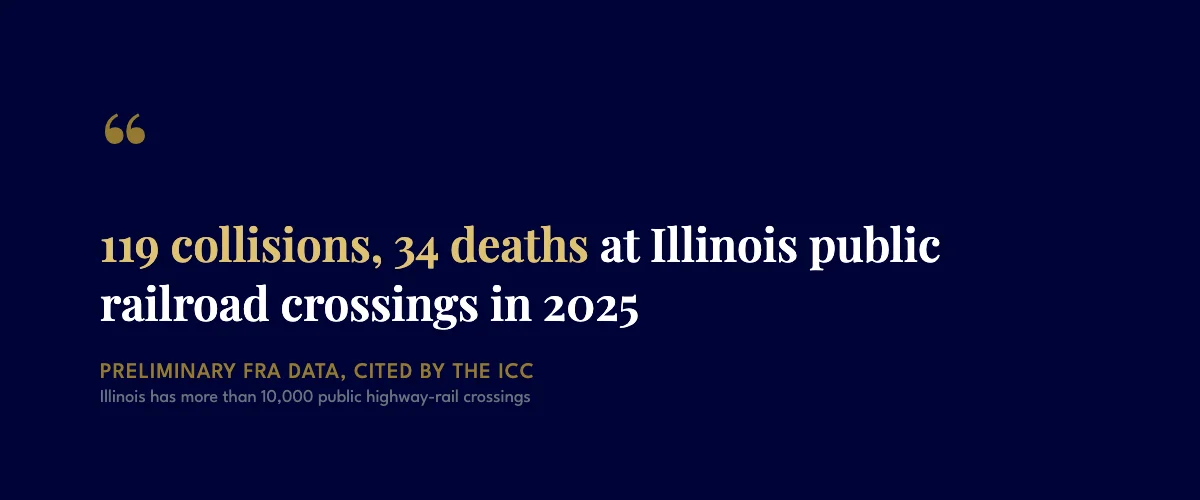
Illinois has more than 10,000 public highway-rail crossings, and the toll is rising. Preliminary Federal Railroad Administration data cited by the Illinois Commerce Commission shows 119 collisions at public crossings in Illinois in 2025, with 34 people killed. On November 11, 2026, an Amtrak train struck a vehicle at the Wolf Road crossing in Western Springs. That crash is still under investigation, and our thoughts are with the families and the school community affected.
Why crossing crashes are so deadly
A loaded freight train can weigh several thousand tons and may need a mile or more to stop. By the time an engineer sees a vehicle on the tracks, a collision is usually unavoidable. That is why crossing law focuses on what happens before the train arrives: whether the warnings worked and whether drivers had a fair chance to see and hear the train coming.
Who can be held responsible
The railroad
Railroads have duties that do not disappear just because a crossing has lights and gates. Federal regulations require railroads to test crossing signal systems on a schedule and to respond to reports of malfunctions (49 CFR Part 234). Gates that fail to activate or come down too late can point to a maintenance failure. So can gates that drop so often for no reason that drivers learn to ignore them.
Under the federal train horn rule (49 CFR Part 222), locomotive engineers generally must sound the horn as they approach a public crossing, unless the crossing sits in an approved quiet zone. A missing horn is a common issue in these cases, and the locomotive’s event recorder usually shows whether it sounded.
Railroads also control what grows and sits along their right of way. Overgrown brush or a string of rail cars parked near a crossing can hide an approaching train. The Illinois Commerce Commission has authority over crossing safety under the Illinois Commercial Transportation Law, 625 ILCS 5/18c-7401, and communities have used it to make railroads clear vegetation that blocks drivers’ view.
The government that built or controls the road
A crossing can be dangerous because of the road around it. A traffic signal that lets cars back up across the tracks can play a part, and so can a sharp curve just before the rails. Claims against a city or county are governed by the Local Governmental and Governmental Employees Tort Immunity Act, 745 ILCS 10, which gives local governments several immunities and sets a much shorter deadline. In most cases the suit must be filed within one year (745 ILCS 10/8-101).
Other drivers
Some crossing crashes start with another vehicle, such as a driver who rear-ends a car and pushes it onto the tracks, or a truck that blocks the crossing and forces traffic to stop on the rails. That driver’s insurance can be part of the recovery.
The federal preemption problem
Railroads often argue that federal law blocks the claim. Two U.S. Supreme Court cases set the limits.
In CSX Transportation v. Easterwood, 507 U.S. 658 (1993), the Court held that a claim that a train was going too fast is preempted if the train was within the federal speed limit for that class of track. In Norfolk Southern Railway v. Shanklin, 529 U.S. 344 (2000), it held that once federal funds paid for warning devices at a crossing, a state-law claim that those devices were not adequate is preempted. In practice, that means you usually cannot argue that a federally funded crossing with flashing lights should have had gates.
Many claims survive those rulings. Congress amended the Federal Railroad Safety Act in 2007 so that state-law claims can proceed when a railroad failed to follow a federal safety standard or its own plans and rules (49 U.S.C. 20106(b)). Claims that gates malfunctioned or that the horn was not sounded are often argued under that path, along with claims that a railroad ignored a known hazard such as blocked sight lines. Sorting out which claims survive is one of the first things a railroad crossing lawyer does.
What about the driver’s own fault?
Illinois law requires drivers to stop between 15 and 50 feet from the nearest rail when a crossing signal is flashing or the gates are down (625 ILCS 5/11-1201). The same duty applies when a train is close enough to be a hazard. A railroad will look hard at whether the driver followed that rule.
Illinois uses modified comparative fault under 735 ILCS 5/2-1116. A person found more than 50% at fault recovers nothing, and anyone below that line has their award reduced by their share. Passengers in the vehicle are in a different position. A passenger who did nothing wrong is not reduced by anyone else’s share of fault and can usually recover from each party whose negligence caused the crash.
Evidence disappears quickly
Railroads investigate their own crashes immediately. The evidence that decides these cases mostly sits in the railroad’s hands: the locomotive event recorder showing speed and horn use; forward-facing video from the train; signal system logs showing when the gates activated; inspection and maintenance records for the crossing; and records of earlier complaints about the crossing.
A lawyer can send a preservation demand to the railroad right away so that data is not overwritten or lost. Families should also keep photos of the crossing taken as soon as possible after the crash, before brush is cut or signals are repaired, and the police report.
The National Transportation Safety Board investigates some crossing crashes and the Federal Railroad Administration investigates others. Their reports can take a year or more, and federal law limits how NTSB conclusions can be used in court, so a civil case cannot wait for them.
Filing deadlines in Illinois
Most personal injury claims must be filed within two years under 735 ILCS 5/13-202. A wrongful death action under the Illinois Wrongful Death Act must generally be filed within two years of the death (740 ILCS 180/2). Claims against a local government usually have a one-year deadline under the Tort Immunity Act, and that shorter clock catches many families off guard. Our guide to the Illinois personal injury statute of limitations covers the exceptions.
Railroad workers hurt on the job follow a different system. Their claims fall under the Federal Employers’ Liability Act, which we cover in our post on filing a FELA lawsuit in Chicago.
If you are ever stuck on the tracks
Get everyone out of the vehicle immediately and move away from the tracks. Operation Lifesaver advises walking toward the oncoming train at an angle, so that debris from the impact is thrown away from you. Once you are safe, look for the blue and white Emergency Notification System sign posted at every crossing. It lists a phone number and a crossing ID number, and calling it lets the railroad warn or stop approaching trains. If the gates at a crossing ever seem to malfunction, that same number is the place to report it.
Talk to a Chicago railroad crossing accident lawyer
Phillips Law Offices handles train accident cases and railroad accident claims across Illinois, along with wrongful death cases for families who have lost someone. We move quickly to preserve the railroad’s data, and we bring in the engineers and signal experts these cases need. The consultation is free, and you pay no fee unless we recover compensation for you.
Call (312) 346-4262 or book a free consultation online. You can also read our overview of what kind of lawyer handles train accident injuries.
Frequently asked questions
Can a railroad be liable if the crossing gates were working?
Yes, in some cases. Working gates do not end the inquiry if the train crew failed to sound the horn or the gates came down too late, and blocked sight lines can matter too. Those points can be checked against the locomotive’s event recorder and the signal system logs.
Who investigates railroad crossing accidents in Illinois?
Local police respond first. The Federal Railroad Administration and sometimes the National Transportation Safety Board investigate, and the Illinois Commerce Commission oversees crossing safety in the state. The railroad also runs its own investigation, which is why preserving its data quickly matters.
How many railroad crossing crashes happen in Illinois?
Preliminary Federal Railroad Administration data cited by the Illinois Commerce Commission shows 119 collisions at public highway-rail crossings in Illinois in 2025, with 34 deaths. Illinois has more than 10,000 public crossings.
Does federal law prevent me from suing the railroad?
Not entirely. Federal law can block some claims, such as arguing that a federally funded crossing needed better warning devices or that a train under the federal speed limit was going too fast. Claims that a railroad broke a federal safety rule, such as failing to maintain its signals or sound its horn, can still go forward under 49 U.S.C. 20106(b).
How long do I have to file a railroad crossing accident claim in Illinois?
Generally two years for injuries and two years from the date of death for a wrongful death claim. If a local government shares responsibility, the deadline against it is usually one year under the Tort Immunity Act.